Fragments of past transmissions echo below.

Category: Piano technique

  • How to Play with Two Hands at the Same Time

    First, it’s normal to have trouble with this. Patting your head and rubbing your stomach at the same time screws up nearly everyone.

    Piano’s the same. Playing each hand on its own works fine. But, when you try to put them together, all hell breaks loose. Your left hand wants to do what your right hand is doing, or vice versa.

    It’s like none of the work you did with each hand on its own counts for anything.

    That’s because there’s a huge gap in difficulty between two of the steps:

    1. Play left hand by itself. (easy enough)
    2. Play right hand by itself. (easy enough)
    3. Play both hands together. (omg wtf!!!)

    When you do it this way, there’s no smooth progression.

    It’s as if you go from kindergarten to 1st grade and then skip directly to university. It would be a shock to your system and you’d fail.

    Not that you’re genetically incapable of succeeding at university. You’re just incapable right now, because you haven’t gone through the steps leading up to it.

    You skipped steps, so there was a difficulty gap that overwhelmed you.

    That’s why you can’t learn a piano song in three steps like that.

    You’re skipping way too much.

    The way to fix this is to add steps in between 2 and 3 that will make it into a smooth climb. But, those in-between steps are far from obvious.

    For example, take the song “Golden Hour” by JVKE:

    Your left hand plays these notes.
    Your right hand plays these notes.

    But, how do you play them at the same time?

    You can’t just throw them together and pray for the best. You’re skipping steps if you do it that way.

    There’d be a huge difficulty gap.

    You’ve got to break it down into more than three steps.

    You need to be patient. It’s not possible to jump immediately to playing both hands together the way you want to. You’ve gotta go through 2nd-12th grades before you can enter university.

    Are you on board with that?

    Your next step won’t feel like university.

    It won’t be impressive. But, it’ll be easy enough that you can do it. Then, we’ll go to the step after that, and the next, and so on, until we get to the final destination.

    So, without further ado, here’s the next step:

    Play both hands together, but play one note at a time.

    Words can only explain so much.

    It’s easier to see it in a video:

  • Don’t complain until you’ve tried it

    Joe: Hey Michael, I’m having trouble playing the piano.

    Michael: Oh yeah? What’s wrong?

    J: All sorts of things. I can’t play fast. I can’t stay in tempo. My fingers keep getting tangled up. I just don’t feel good about it.

    M: Yeah, that’s normal.

    J: What should I do?

    M: Well, you know JS Bach said something about how “all one has to do is hit the right keys at the right time and the instrument plays itself.”

    J: That’s pretty vague.

    M: No, it’s extremely specific.

    J: Huh?

    M: I’m serious. He’s telling you exactly what you need to do.

    J: I don’t get it. First of all, my problem is that I can’t play the right keys at the right time. Second of all, that can’t be ALL you need to do. What about expression and dynamics and all that?

    M: One thing at a time. What are you having trouble with?

    J: I can’t play the right keys at the right time. I mean, I basically can. But I can’t do it fast.

    M: Right, that’s because your nervous system isn’t conditioned in the exact right way to make that happen.

    J: Yeah, that’s an understatement. So, what do I do? Practice slowly?

    M: No, that’s just a folk remedy you heard from a piano teacher. You have to train your nervous system to comprehend the exact causes and conditions of everything involved here.

    J: I don’t understand.

    M: What don’t you understand?

    J: What should I practice?

    M: I just told you.

    J: Your advice is incredibly vague and non-specific. You’re not telling me, step-by-step, what to do.

    M: Oh, I didn’t realize you wanted step-by-step instructions. You came to me with a vague problem, after all. I was giving you a general solution.

    J: Fine. But, I don’t know how to be precise with the formulation of my problem.

    M: Neither do I.

    J: So, what do I do?

    M: It sounds to me like you’re having trouble playing a specific piece of music. If that’s the case, you would need to dig into that particular piece of music and figure out what’s going on.

    J: Hm, OK. I’ve been practicing it forever, and I can’t get it right.

    M: Have you tried the waterfall technique?

    J: No, what’s that?

    M: It’s a practice technique I invented that will help you train yourself to play absolutely anything.

    J: Oh yeah, I think I remember you posted that on a piano teacher Facebook group a couple years ago. Wow, they really tore you apart. I’m not sure I want to be associated with someone like you…

    M: Don’t be silly. You know as well as I do that none of them even considered trying it.

    J: True. So, how do I do it?

    M: I’ll tell you, but first you must promise that you will try it, and that you will only raise objections and concerns which are based on your experiences trying it, and not on your theoretical or conceptual prejudices or ego-driven, a priori, assumptions about what constitutes proper piano practice.

    J: I don’t know if I can promise that. When I joined the world of classical music, I did swear an oath to keep the open-minded part of my mind firmly closed.

    M: Yes, but you can break that oath.

    J: That’s morally wrong, though.

    M: Yes, it is.

    J: So, I can’t learn from you.

    M: Fair enough.

    J: Then, what do I do?

    M: Sounds like you’re stuck.

    J: You’re not helping.

    M: What would you like help with?

    J: I want you to teach me the waterfall technique.

    M: Do you promise that you will try it? And not complain until you’ve tried it? And only complain about stuff that came up while trying it?

    J: That sounds extremely unreasonable.

    M: Take it or leave it.

    J: Fine, I promise.

    M: Great. Here’s how it works: (1) Choose a piece, and decide how many beats there are per measure. (2) Set your metronome to the maximum tempo. (3) Play the piece by dropping your arms on the keyboard, once per beat. (4) Ask yourself, “is this how I want this piece to sound at this tempo?” If the answer is yes, go back to step 2. If the answer is no, decrease the metronome by 1 click and go back to step 3.

    J: That can’t possibly do anything.

    M: You promised you wouldn’t complain yet.

    J: But, it’s obviously ridiculous.

    M: Ridiculously powerful, you mean.

    J: No, I mean ridiculously ridiculous. What is this supposed to do for me?

    M: I don’t know. You’ll have to try it and see.

    J: I won’t try it until I know what it’s supposed to do.

    M: OK.

    J: What do you mean, “OK”? You said this would help me.

    M: I said you must try it before complaining about it. And, you promised to do that. So, what will it be?

    J: Fine, I’ll try it.

    M: Wow, you’re a special person. NOBODY tries it.

    (later that week)

    J: Michael, you’re right. This has totally changed my life.

  • Piano Technique: Learning with mindfulness

    Piano Technique: Learning with mindfulness

    Piano Technique Basics

    What is the definition of piano technique?

    “Piano technique” is a tricky concept to define. It could refer to:

    1. The actual, physical way you play the piano. For example: move your thumb under, play staccato with a finger motion rather than an arm motion, or move the wrists in circles, play legato by delaying releasing the key.
    2. The mental way of understanding how you play. For example: pull the sound out of the piano, use the weight of the arm, or play in a “singing” manner.

    To make matters more complicated, there can be overlap. Very often, what we think is an accurate physical description is more of a mental image. There is no “best piano technique.” Every pianist has his or her own technique.

    To me, technique is the study of:

    • How to play the piano.
    • How to make our bodies do what we intend at the piano.
    • How to form a bridge between the intellectual analysis of the music and the real, actual sound.

    This should be completely practical. There is nothing stuffy about it.

    Why play with good technique?

    If you don’t play with good technique, you may find that your playing is:

    • Unpredictable (not in a good way)
    • Painful or tiring
    • Difficult to listen to

    If you have these problems, it is worth improving your piano technique.

    Can anyone play the piano well?

    Anyone can learn to improve their piano technique, and this is a worthwhile goal. Depending on the quality and quantity of practice, amazing results are possible. However, it can be a life-long process. Additionally, there are obstacles to technical development. For example, distractions or anxiety can derail an otherwise skilled performer.

    And yes, anyone of average-sized hands (or even smaller) can play difficult music. It does not matter how long your fingers are, or if your right or left hand is the dominant one.

    How to improve your piano technique

    The best way to learn piano technique is to play as many different pieces as you can. You will learn something from each of them. As you do this, pay attention to what things feel like. Also, notice when things work, and when they don’t work. Your brain will automatically learn how to improve your piano technique.

    How to master piano technique

    To learn technique from the ground up, I recommend you check out my online course: Mindful Piano Basics.

    Piano Posture

    What is the proper posture at the piano?

    Sit at the bench. Feel how the bench supports your weight.

    You may need to play around with:

    • The height of the piano bench.
    • How far from the edge of the bench you are sitting.
    • The distance of the bench from the keyboard.
    • The height of the keyboard (not always easy to adjust!)
    • Leaning forward or backward.
    • Looking down at your hands, or straight ahead.
    • “Sitting up straight” more or less.
    • “Slouching” more or less.

    There is no correct posture. That is, you need to find what works for you. Specifically, the correct posture should make things easier, not harder. Pay attention to what feels easy and what feels hard. This is more important than what is right or what is wrong. So, don’t be afraid to experiment.

    Fingering

    How do I learn correct fingering?

    Piano fingering is a big topic. In general, certain fingerings make passages easier, and other fingerings make them harder. In contrast, the proper fingering is the one that makes playing easier, not harder.

    You don’t always need to plan out your fingering. Specifically, i’s better to learn to trust your instincts and to train those instincts to be trustworthy. Furthermore, planning out fingering tends to encourage an intellectual approach, rather than a spontaneous, in-the-moment approach. Let your brain learn by itself which fingers to use when playing the piano.

    How do I strengthen my fingers?

    Many students wonder how to strengthen their fingers for piano. This is understandable because when your fingers feel weak, it is hard to play. However, you don’t need to strengthen your fingers. Proper piano technique is about coordination, not strength. That is, the reason your fingers feel weak is that you are not properly balanced. Instead of trying to build strength in your fingers, you should pay closer attention to when they feel weak. Those are the moments when you need to develop awareness.

    Hand Position

    How do I position my hands on the piano?

    The proper hand position is the one that makes playing easier, not harder. This also applies to any other “position” (e.g., wrist position).

    Many teachers will suggest trying to create a certain arch in the hand, and may recommend holding a ball in the palms, or letting the hands fall to the sides and observing the shape, or deliberately curving the fingers. Sometimes these tricks work, but I try to avoid them.

    The position of your hands and wrists should be natural and intuitive. That doesn’t mean we are born knowing how to play the piano. It means that we should use our natural coordination as a starting point, and work from there. If it ain’t broke, don’t fix it. If the key goes down at the right time, makes the sound you are looking for, and doesn’t cause you pain, then you certainly have the correct hand position.

    Despite what you may have learned in a method book, the “five-finger position”, where each finger is rested simultaneously over its own key, is probably not a very natural position. Try this out for yourself.

    How to stop making mistakes on the piano

    How do we learn to make mistakes?

    Habits are learned. We learn to do things by receiving a reward when we do them, and by noticing the connection between what we did and the reward we received. Learning does not happen only through repetition. It is possible to learn something very well after only a single repetition. For example, you may have learned to keep your hand away from fire after only burning yourself once. You can also learn with no repetitions. For example, you may have learned to avoid pointing a loaded gun at your face, even if you have only ever seen a loaded gun on television. The image serves as a cue that immediately triggers the fear.

    What does this have to do with piano playing? Mistakes in piano playing are learned, as well. That is, you need to set up your practice such that the correct technique is rewarded, and incorrect technique is ignored. Fortunately, there are many obvious rewards available to you. Good technique…

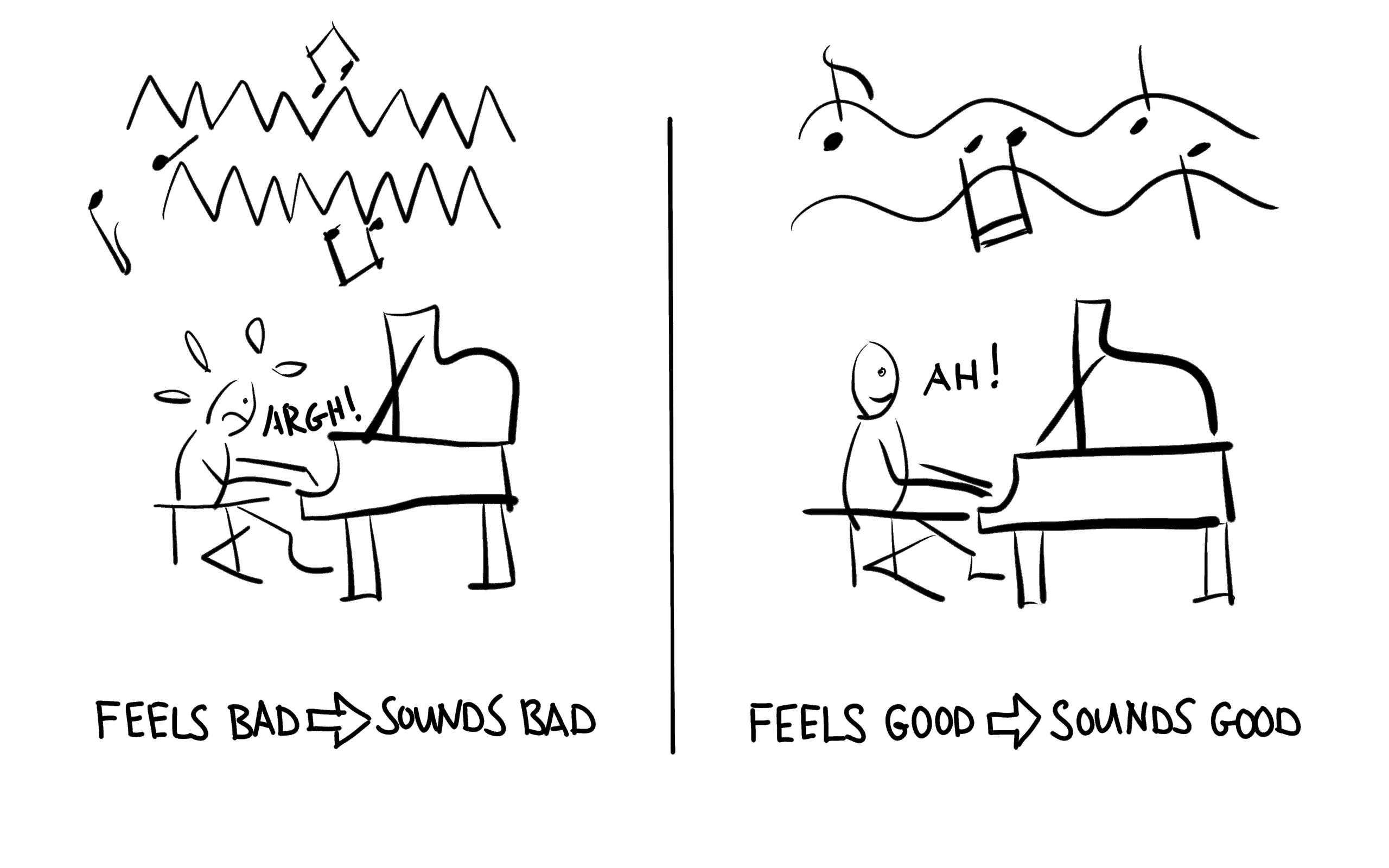
    • …feels good, bad technique doesn’t.
    • …sounds good, bad technique doesn’t.
    • …is less stressful, more musical, and less distracting.

    Many teachers will try to reward you for good technique by praising you, by explaining to you why it’s good, or by criticizing you when it’s wrong. In my opinion, these strategies generally don’t work. The intrinsic rewards of good technique are more certain.

    What is the point of repetitive practice?

    Repetition is worth doing, however. Repetition can give you opportunities to test what you have learned. That is, it can show you what you still need to learn. It can show you how to learn, and how to play more accurately.

    Slow and Fast Practicing

    Should I practice slowly?

    Slow practice can be a great idea. When you are practicing slowly, you have more time to take in more details. Now, by slowly, I do mean really slowly. For example, if the piece of music you are learning has a performance tempo of 120, you might try practicing at 60. The piece will feel completely different at such a slow tempo. But, you will learn a lot about the piece, and about yourself, when you force yourself to look at things from different angles.

    Should I think before playing?

    The danger in slow practice is that you may encourage yourself to overthink. Piano playing should be easy. You should be confident while playing, and your movements should be simple and secure. However, practicing slowly, where you have the opportunity to anticipate mistakes before they happen, can lead to uncertainty. To be clear, this does not mean that you should not practice slowly. It means that when you practice slowly, you should do so in a way that is confident and secure.

    What is the problem with impatience?

    Slow practice can also lead to impatience. And, this impatience must be conquered. The reason for the impatience is that your mind is not interested in what you are currently doing, but instead in what is coming up next. When this happens, try to be interested in what is happening right now. For example,

    •  The feeling of your fingers on the keys
    • The sensations of moving your arms
    • The sound coming out of the piano
    • The sensations of impatience itself
    • The feeling of freedom in playing (if you don’t feel free when you play, work on that!)

    You must make this very moment extremely interesting, or you are simply not giving it the attention it deserves. As a result, your playing will be rushed, uncertain, and distracted.

    Or, perhaps you are bored when you practice. Again, you must find a way to play without getting bored. Find something interesting about this moment. You can do it.

    Should I practice fast?

    You should also practice fast. Do not be afraid to speed it up. Fast playing makes it harder to worry about mistakes, and makes it easier to focus on what is happening right now. You can speed it up a couple of clicks, or even more (twice as fast!).

    Unless, of course, fast playing stresses you out. If this happens, you should work on that. Play fast, and notice what the stress feels like. Notice how you can get rid of it if you are willing to make more mistakes. Fast playing has a lot to teach you about stress. If you are afraid of playing fast, you will always hit speed walls.

    Movements

    Should movements be deliberate or arbitrary?

    Your movements at the piano should be based on the music. Unless you are going really slowly, you probably cannot make “deliberate” movements. So, they may feel arbitrary. However, the movements need to serve the music, not be random. This is what practice is for. Practicing will help you find the movements that work, and it will help you see the movements that don’t work. Until this is obvious to you, don’t worry about it. A lot of great pianists make movements that seem extraneous, even though they get good results. It’s difficult to say that these movements are too much if they are working. Focus on what is and isn’t working, rather than what looks right or doesn’t look right. Movements do not necessarily need to be choreographed.

    Pianists sometimes love to argue about things like “thumb under vs. thumb over.” If the movement you do is working, there is no argument. If it’s not working, then it might be worth trying something else.

    Should I focus more on muscle memory or music?

    When you play, just play. The music is the result of the movements of your muscles. There is no difference between “muscle memory” and “music.” Music is movement, not intellectual thought.

    Practicing involves two different things:

    1. Analyzing the music to understand its structure.
    2. Training your mind and body to move in a way that works for your analysis.

    After practicing, playing correctly should feel like second nature. If it doesn’t, you either have an unworkable analysis, or you haven’t trained in proper piano technique, or you just need more time.

    Memorizing music is a complex process. However, it starts with trusting yourself.

    Bad Technique

    What are some examples of bad piano techniques?

    “Bad technique” is:

    • Whatever doesn’t work
    • Whatever causes injury

    It’s not easy to define, because different pianists might describe their technique in the same way, and yet get different results. There are many arguments over things like:

    • Should I curve my fingers?
    • Should I use arm weight?
    • Should I play more with the fingers or more with the arms?
    • Should I be relaxed?

    In reality, these are all simply words. There is no “right” or “wrong” without knowing exactly what is meant by them. Furthermore, even if a teacher instructs their students to “use arm weight” (for example), this does not mean that the teacher is effective in getting the students to do this.

    There is only one correct piano technique: the one that works. However, there are many ways to get there.

    How do I avoid developing bad practice habits?

    I want to make two points about this:

    1. The way to avoid establishing bad habits is by practicing good habits, and by learning to see how you get better results.
    2. You shouldn’t worry about developing bad habits.

    You don’t avoid bad habits by being warned against them. If you tend to perform a bad habit, you should realize that you are doing this for a reason. You will probably not change simply after hearing a warning. Instead, you need to notice how the bad habit is leading to bad results. Then, you will have an incentive to try something else. If you still find yourself doing the bad habit, you are probably still receiving a reward from it.

    I say you shouldn’t worry about developing bad habits. This is because, if you are a beginner, you will certainly be developing bad habits. You can’t avoid it, and you shouldn’t waste your energy trying. You don’t have enough awareness to know why they are bad. Instead, you should act like a curious child, exploring as much as possible. It doesn’t matter if it’s right or wrong. You will figure it out over time. Many teachers will say “but if you repeat a bad habit, you will never be free of it!” This is only true if you practice in a way that is not curious or exploratory.

    Common Practice Techniques

    Should I repeat a section over and over?

    You should repeat sections until you have exhausted all possibilities inherent in them. This is because every time you play a section, there is something new to learn. If your practice technique is structured so that you are exploring, rather than simply blindly drilling, it is good to repeat. However, always keep in mind that the point of repetition is to find variety. The point of repetition is not to “cement” something in your mind. These are not mindless repetitions.

    Should I practice in rhythms?

    Many teachers advocate practicing a technically difficult passage “in rhythms.” This involves changing the rhythms to lend variety.

    Practicing in rhythms is probably a more effective strategy than simply repeating something over and over without any plan whatsoever. However, I think there are more effective strategies for achieving the same thing in a difficult section.

    Should I practice with different articulations?

    Articulation in music is like inflection in speech. You don’t need to practice it. Rather, you need to understand what you are saying, and then trust your instincts to convey the message.

    You can certainly experiment with different articulations if you are looking to be inspired musically.

    From a technical perspective, I don’t see the point in changing articulation arbitrarily. I think that often this technique is intended to avoid unwanted accents. Music is composed of beats, and if you understand this, and practice this way, you will not have the problems that this technique is supposed to solve.

    Is Hanon worth it?

    I would suggest ignoring the instructions written by Hanon. I think his understanding of technique was misguided (at least in terms of how he verbalized it). Modern piano playing has moved on since the publication of this book. This doesn’t mean the exercises are bad. It depends on how you do them. If you find them interesting and useful, you should practice them. Otherwise, you can skip them. In my opinion, there are more interesting collections of piano finger technique exercises out there. You can also take any passage of music and make a graded sequence of exercises based on it.

    Injury

    What problems does bad technique cause?

    Piano playing can be dangerous! It is possible to develop tendinitis, carpal tunnel syndrome, and other disorders. However, it is possible to play without injury.

    For more information on piano injuries, see: http://pianomap.com/injuries/

    How do I avoid injury?

    You avoid injury by paying attention to how you feel while you play. However, this can be easier said than done. Many pianists are so distracted while they are playing, that they have no attention left over for their physical well-being. Nonetheless, you need to find a way of playing that can be done comfortably.

    This can be an extremely subtle problem, with far-reaching consequences. What’s more, pianists who are prone to playing-related injuries usually have a stressed physical and psychological approach to their daily lives, and it can be difficult to change this. However, I know some pianists who swear that after a short course of lessons with one particular teacher, they were cured. So, if you are injured, I hope you find that kind of assistance!

    Meditation, yoga, Alexander Technique, the Taubman approach, etc., can all be very useful in uncovering and correcting the causes of injury.
    Recommended Piano Technique Resources

    Here is a list of recommended resources for learning more about piano technique. Ultimately, I don’t believe it’s possible to learn piano playing from anything other than practicing the piano. All books and methods are incomplete. However, it is worth exposing yourself to different ideas. The ones I am listing here have been especially helpful or thought-provoking. I do not consider myself a practitioner, or even a disciple, of any of these methods.

    Piano Technique Books


    Piano Technique Demystified, by Neil Stannard. This is an honest, unconventional book that has a lot of ideas that seem to be influenced by the Taubman approach.

    What Every Pianist Needs to Know About the Body, by Thomas Mark. A good resource for understanding the anatomy involved in piano playing. This book is based on “body mapping,” and is based on ideas from the Alexander Technique.

    20 Lessons in Keyboard Choreography, by Seymour Bernstein. A step-by-step approach to learning piano playing in 20 exercises. This was written by one of my teachers, and it is the book that made me realize it’s possible to understand piano technique on a deep level.

    Piano Technique Videos


    Freeing the Caged Bird – Developing Well-Coordinated, Injury-Preventive Piano Technique by Barbara Lister-Sink. An approach that seems to be influenced by the Alexander Technique. Based on this short video, I like the way she thinks about piano playing.

    Piano Technique Websites


    The Taubman Approach is an interesting analytical approach to piano playing. Dorothy Taubman had a clear way of understanding things.

  • Why piano technique is a waste of time

    At the end of the day, the music you are playing either sounds good, or doesn’t sound good.

    Music sounds good because you are in the zone when you play. Your technique works naturally, and there is a flow to the whole thing.

    If none of that is present, the music will not sound good. It doesn’t matter how “correctly” you are playing.

    Throughout my life, I’ve learned so many things from books. When I saw that people wrote books about
    piano technique, I thought this was the solution to all my problems.

    I figured all I needed to do was read those books, practice what they described, and then I’d be all set.

    It didn’t quite work out that way.

    I soon realized that “knowing” a lot about piano technique was only a tiny piece of the picture. If this knowledge isn’t integrated, it is next to useless.

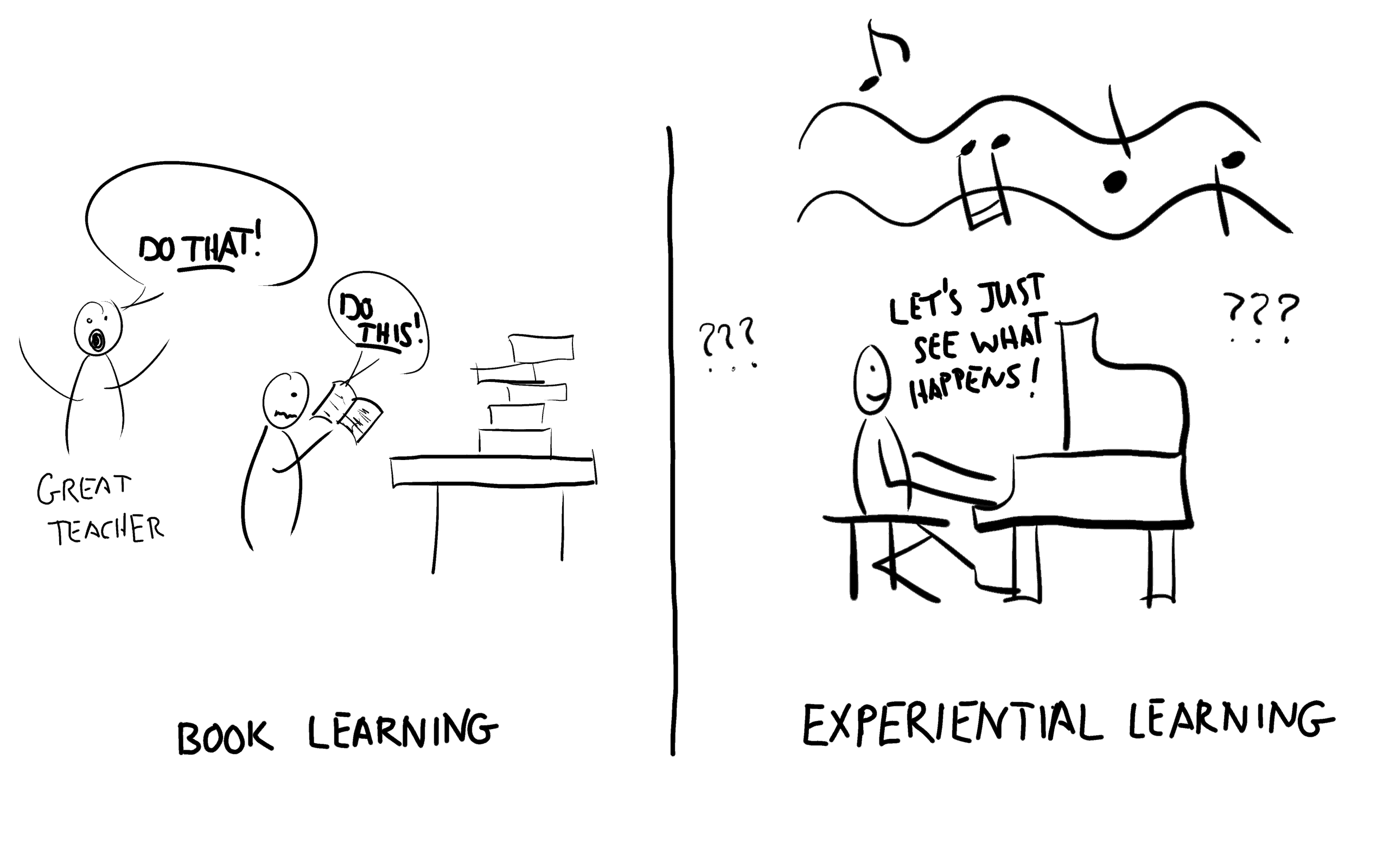
    And here’s the thing: Book learning cannot help you integrate your piano technique. You need experiential learning.

    For example, suppose you’re practicing a technical exercise. You can’t always be reevaluating whether it’s the right exercise, or if you’re doing it right. You have to just do it, and experience what that feels like. 

    This was a huge problem for me. I knew that I spent so much of my time overthinking and overanalyzing. At least, that’s what I was told. By many, many people…

    And yet, I couldn’t stop. My mind just did what it wanted to do, no matter how hard I tried to keep it in line.

    I wanted music to be easy. But, it wasn’t.

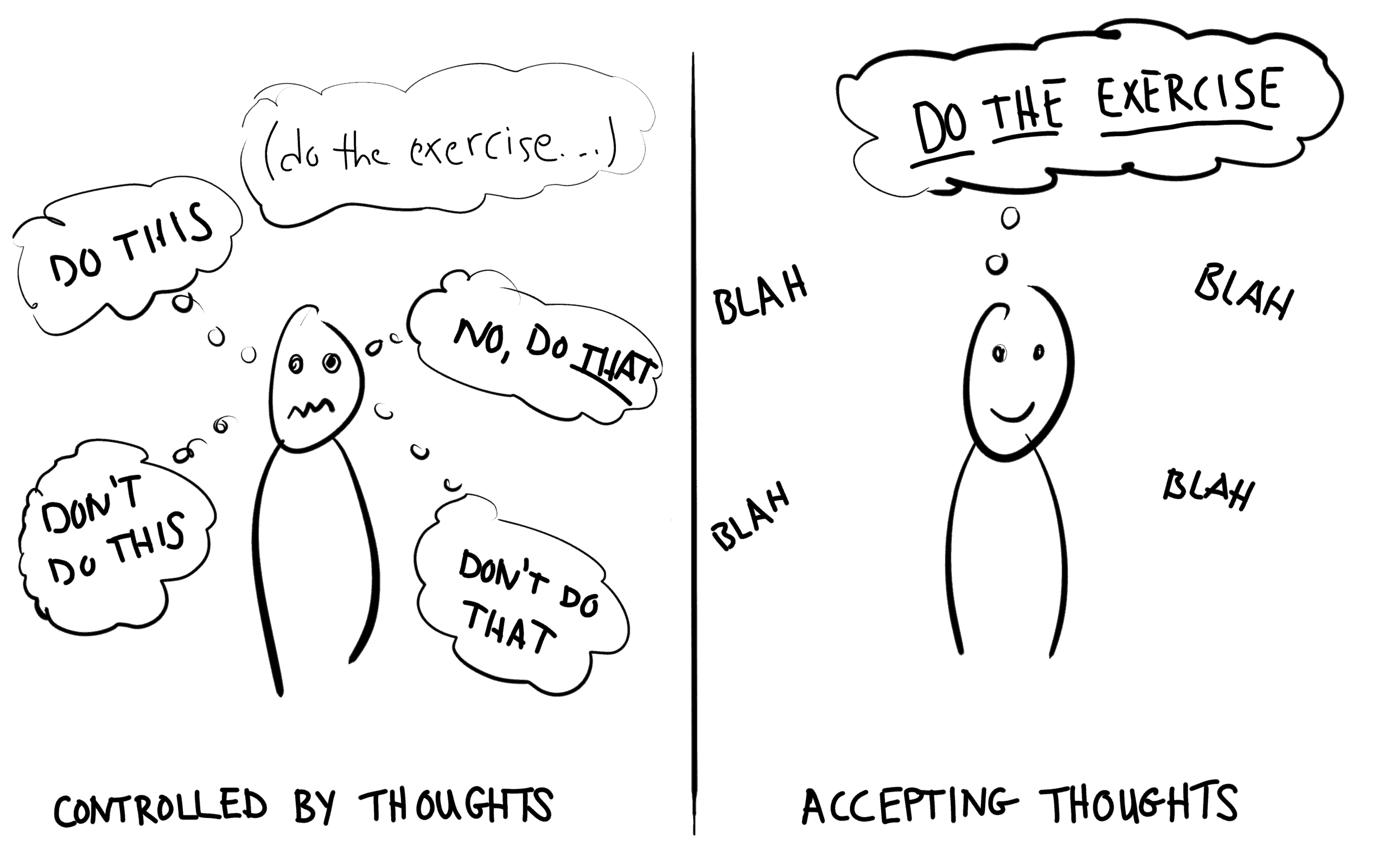
    What I didn’t realize at the time was that I was making my life difficult. Rather than beating myself up about overthinking, it’s possible to accept that thinking. Once that’s done, I can just get on with life.

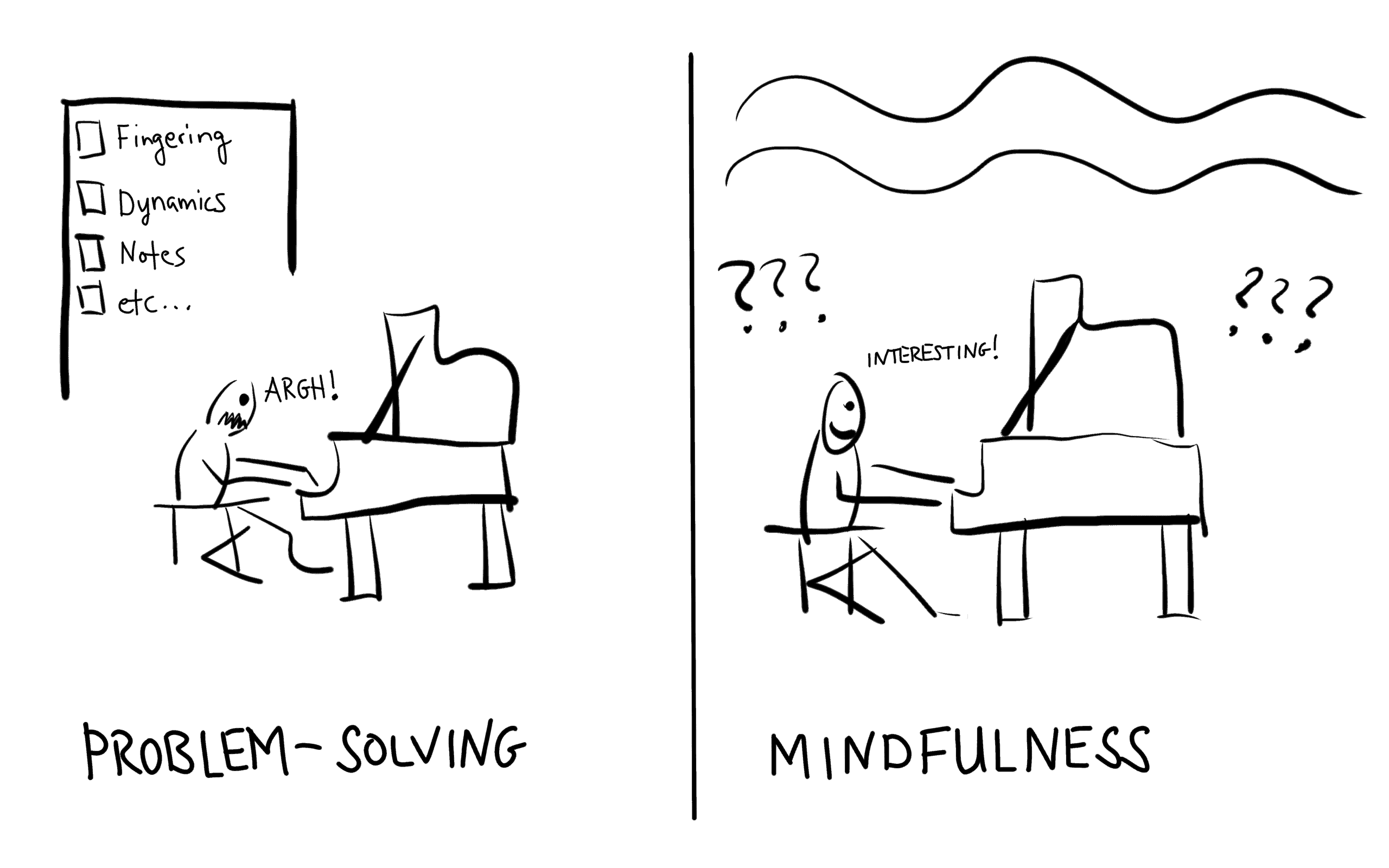
    This requires a radical shift in how you approach music, though. Instead of trying to solve problems, you need to care about whatever is happening in the moment.

    This is called mindfulness.

  • Hand Independence in Piano Playing

    Hand Independence in Piano Playing

    Solving your hand independence problem takes willingness to get a little bit uncomfortable. You’ve got to allow things to get mentally awkward. To give up your rigid need for control.

    Some pianists (“snowflake pianists”), simply can’t deal with the fact that their hands don’t feel independent of each other. They generally quit piano soon enough, but some of them go on to become advanced.

    Get my e-book

    I wrote this ebook because I want to share what I’ve learned about what’s wrong with the way the piano community treats “amateur” pianists. I don’t like it, and I want to change it.

    It is rare to see something written for serious adult amateurs, and by someone who went that route. I had it on as an audiobook while doing chores – the first chapter on various aspects regarding teachers, I was saying “right” and “certainly” out loud a few times. 😀 A lot of the things, I wished I’d heard this when I first started my first ever lessons some time ago; it took me years to at least partly find my way out of holes due to some of those things.

    Inge

    Amateur Pianist

    Even the advanced ones still struggle with basic stuff like:

    • One hand always seems to want to do whatever the other one is doing.

    • The two hands aren’t “lining up”.

    • One hand is more flexible and secure than the other one is.

    • You can play one hand at a time with no problem, but when you put them together, everything slows way down.

    • Sight-reading with both hands overwhelms you.

    Yeah, I get it. Figuring out how to play the piano with two hands doing different things is not always obvious. Most people are born with two hands, and we are not supposed to get overwhelmed using both of them. Sit down in front of a piano, and it stops feeling natural. 

    In this article, I’ll give you some tips that will help you conquer this problem. It will take practice, of course, but if you know where to direct your efforts, you’ll quickly start untying knots.

    (At least I’ll be able to tell the “snowflake pianists” I tried…)

    Tip 1: Deliberately decide to work on hand independence

    With the right kind of practice, you can solve these problems. So, before you expect any results, you must make a decision to practice hand independence. 

    If you don’t make this decision, then your practicing will be aimless.

    However, if you make a decision to work on hand independence, then you’ll be able to evaluate your practicing, and determine whether or not it’s working. That’s a good spot to be in, because then you can do more of what works and less of what doesn’t.

    How to begin practicing hand independence:

    Before you sit down to practice, remind yourself why you’re doing it. Write it down. Say it out loud:

    “I am practicing today because I want to learn how to develop hand independence.”

    Most pianists overlook this important step. Big mistake.

    Tip 2: Stop trying “shortcuts” that don’t work

    When we don’t get the results want, we try all sorts of things out of desperation. This wastes valuable time and energy, and makes us confused.

    Many pianists will try shortcuts such as:

    • Strengthening their fingers.
    • Stretching their fingers.
    • Trying harder.

    If your left hand feels weaker than your right hand, you don’t need to strengthen your left hand. It’s about coordination, not strength, even if it “feels” weak (think about how weak your arms feel trying to lift a heavy box when you don’t first have a solid footing).

    When the hands don’t seem equal or independent, it can even seem like there’s a physical problem. But, unless you have an injury or unusual anatomy, I doubt it’s a physical problem.

    Instead, realize that it’s a mental problem. Trying really hard is not necessary. Watch some great pianists on YouTube. They are not struggling, not trying hard. That’s because their coordination is good, not because they spent time strengthening their finger muscles.

    How to be more patient with yourself as you learn hand independence at the piano

    When you feel impatient, try to notice what you do to rush the process along. Remind yourself that there are no shortcuts and stop doing those things. You’re wasting your time and barking up the wrong tree.

    In the meantime, try to pay attention to aspects of your practicing that you are enjoying. When we fixate on what results we’re not getting, practicing stops being fun, and we stop doing it.

    Tip 3: Slow down and pay attention

    Go at the pace your body requires.

    Why is it so hard to play the piano with both hands? Like I said earlier, because you’re impatient. When you don’t let your mind and body dictate the pace, you get a traffic jam in your brain.

    This means you need to slow down and pay attention. Unfortunately, there are no quick fixes for sorting this out. That’s just not how it works. You must figure it out on your own.

    You might not know right away exactly why your right hand feels better than your left. But, if you persist with patience and awareness, you will eventually learn. It just takes time.

    This means that practicing piano is meditation. There’s no way around it. And, I’m talking about hardcore meditation, not the hippie version with crystals and incense.

    How to slow down and pay attention:

    When we are frustrated that our body isn’t doing what we want it to be doing, we tend to do two things: (1) speed up, and (2) stop paying attention. To gain better hand independence at the piano, we have to do the opposite of those.

    The key is in noticing when they start to happen. Pay attention to the feeling of the frustration. You want to view the frustration as a good thing. If you can do this, you won’t see any need to speed up or stop paying attention. (This is weird, but you can learn it through meditation).

    The frustration is good. It means that you care about getting good results at the piano. But, frustration makes learning harder.

    So, stop fighting the frustration. It will make learning easier.

    Tip 4: Unify the body

    Feel the beat in the whole body. Play both hands as one.

    When you start paying attention with mindfulness, you realize something surprising: you don’t need to have complete hand independence to play the piano.

    Both hands actually always do the same thing. In piano playing, your hands cannot move totally independently. After all, the body connects them together.

    Imagine you’re walking. Both feet move “independently”, and yet the whole body moves in one direction. It would be a big mistake to have your left foot moving in one direction and the right moving in another.

    Piano works the same way. The whole body plays the whole piece of music. Both hands move to the same beat. As in walking, it’s a mistake to try to keep everything independent. Instead, aim for unity.

    Another example: Imagine yourself walking and texting on your phone at the same time. Notice how the movements of your feet will influence the movements that you use for texting. Also notice how texting while walking will feel subtly different than texting while sitting. Let those differences happen, and don’t try to fight them.

    How to unify the body

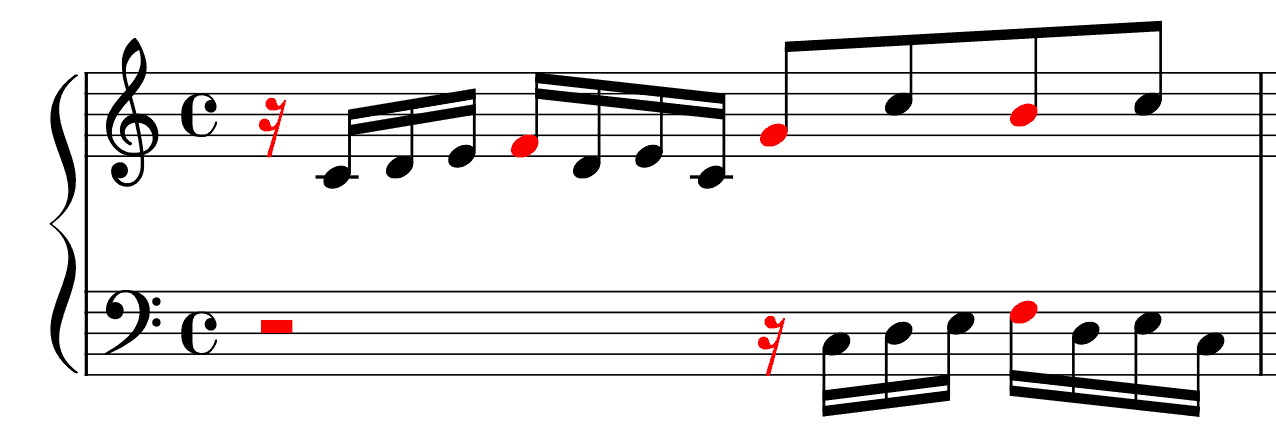
    Here is an exercise you can try. Play a piece with both hands, but only play the notes that land on the beats. This will encourage you to focus on the beat, and the beat will be the same in both hands.

    Play only the notes in red. Each one is a full-body action, both hands together. Use a metronome to force you to focus on the movement that happens on the beat.

    Tip 5: Prioritize what’s important

    Make a decision about what is important to you when you play, and don’t let the notes distract you from that.

    Suppose you are walking with a friend and you have an itch on your face. You will not stop walking to scratch the itch. You will keep walking, because you don’t want to get behind your friend, or make your friend wait for you. The walking is more important than the scratching. Because you have set your priorities, there is no problem doing both at the same time.

    When you play the piano, don’t let a difficult spot in one hand throw off the entire rhythm of the music. (That’s why it feels difficult to play the piano with both hands.)

    Set a priority for yourself which is as easy as walking, and let the little details will take care of themselves.

    Getting started with priority-setting

    To try this out, pick something that is really easy. For example, you can say “my priority is to make it to the end of the piece.”  Then, try playing the piece. You are free to make any mistakes you want, but at least get to the end.

    While you’re playing, you might find that your hands get tangled up. That’s fine. The rules do not say that you need to play all the notes correctly, only that you need to get to the end.

    Here are some other examples of priorities:

    • Play softly
    • Bring out the melody in the right hand
    • Keep a steady beat

    These priorities will take your focus off of hand independence while you play the piano, and put it on something you have more control over.

    Tip 6: Explore the body

    Instead of focusing only on the fact that your hands are getting tangled up, dig deeper into the body.

    In a passage where one hand seems to be written slower than the other, remember that neither is ever actually slower. The tempo is still the same in both hands. Feel this energy balanced throughout the body. There must be an constant, internal pulse that governs both hands. 

    When you can feel how your whole body responds to this pulse, it will be much easier to notice what causes problems. Remember that the body is a physical thing. It has mass, and is governed by the laws of motion. You must learn to respect this.

    How to get started exploring the body

    Start by exploring your instincts around the relationship between your hands. Notice what it feels like to move your torso around, and how that affects what your hands are doing. Do things feel independent, or do they feel tightly wound up?

    Play hands in parallel motion and contrary motion, and notice what happens. What does it feel like? Does one feel easier than the other? Does one hand feel better going in a certain direction?

    Play passages where one hand moves and the other doesn’t. Notice where you feel stuck or where you feel one hand trying to “pull” on the other.

    Tip 7: Feel the beat

    Instead of looking for “hand independence exercises,” take the opportunity to make any piano piece into an exercise to coordinate the left and right hand.

    A piece of music should have a steady beat. When the beat is not steady, you feel it, and the audience will hear it. So, this should always be your top priority.

    How to feel the beat:

    Always, start by making sure both hands are “doing the same thing.” That is, ensure that both hands are playing at the same time. Use a metronome, if necessary. You should feel the beat throughout your entire body. This is the essential first step in training your hands for piano.

    Once you’ve got the beat established, work on differentiating the hands. This means add the smaller details.

    You may find yourself getting stuck again, like your hands are not cooperating. Or, perhaps it’s just one hand that’s not cooperating. In either case, go back to making sure that the beat is consistent between both hands.

    Tip 8: Read hands together

    Instead of thinking of music as having a right hand plus a left hand, think of both hands together. Even when you’re reading a piece for the first time!

    Sight-reading always screws up the coordination between the hands for some pianists. Maybe you can read each hand independently with no problem, but putting them together causes everything to slow down. Or, one hand is fine, but the other isn’t.

    Remember that both hands must always move at the same time. It’s paradoxical, but this is how you actually achieve hand independence in piano playing. You cannot let one hand get ahead of the other. If treble clef is easier for you than bass clef, your right hand might get impatient waiting for your left. You, however, must wait patiently for both hands to be ready. If you can’t do this you should ask yourself why. Where are you in a hurry to go?

    When you are reading, your brain must process each beat before playing it. You can’t think of each hand separately, and move each hand separately. The entire beat (left hand plus right hand) is one action. It should all be comfortable, and it should all make sense to you.

    How to sight-read both hands:

    When you sight-read a new piece, make a resolution to play both hands. Try to zoom out a little bit and see both hands at once. Even if you make a mistake, keep going

    Set your priorities. Decide which musical elements are the most important ones. Let your whole body play those elements. Don’t get trapped into thinking that you need to play everything on the page. Remember that it must all fit into the structure of your body.

    This takes practice to do perfectly. But if you persist, you will make progress.

    Tip 9: Play Bach

    Try practicing Bach preludes, inventions, and fugues.

    Bach’s music will challenge your finger independence as well as your hand independence. Contrary to popular opinion, it does not need flexible or strong fingers. The challenge is all in your mind.

    Finger independence is basically the same issue as hand independence. Here, the whole hand must be unified. Even if the five fingers are playing different things, the hand as a whole is moving in one direction.

    How to approach Bach for hand independence:

    First, you should understand that Bach’s music generally consists of multiple simultaneous voices. Do you see that in the music? Can you hear it when you listen to a recording?

    As a pianist, it’s your job to express all of these voices at the same time. This is a really hard thing to do! However, with a lot of patience, you can master this skill. Don’t expect perfection at first.

    Play through a Bach piece, and try to mentally follow one voice at a time, from beginning to end. You can try singing along. Then, do it with another voice. 

    The whole aim here is to untangle yourself mentally. The physical stuff will follow from that.

    Tip 10: Mix up the dynamics

    Many pianists have a hard time playing different dynamics between the two hands. This is an essential skill, and if you struggle with it, you should make this a priority.

    As always, the beat needs to be the same in both hands. This is usually the problem (and fixing it is usually the solution…). If you have no unified sense of beat, it’s like you’re trying to micromanage each hand separately. This just overloads the brain.

    If you can play each hand at a different dynamic level, you will have significantly more control.

    Playing different dynamics in each hand

    First ensure that both hands can play together with no problem. 

    Next, experiment with “LH soft + RH loud”. You should think of this as a single action. If you find that doing this messes up your beat, you are not thinking of it as a single action.

    Likewise, experiment with “LH loud + RH soft”.

    Tip 11: Mix up the articulation

    Practice playing legato in one hand and staccato in the other.

    As with dynamics, this will help you attain significantly greater control. It will make it much easier to play music like Bach, where this level of control is required.

    The Solution:

    See the previous tip about dynamics. The concept is the same. You want to think of both hands as playing together. It’s just that one of them is legato, and the other is staccato. 

    Tip 12: Let the notes fall where they need to

    If you are playing a piece with polyrhythms, such as 3 against 2, or 11 against 7, or 25 against 8, or whatever, do not attempt to calculate mathematically how the notes should line up. Instead, decide where the beats are, and make sure that both hands are playing the beats at the same time. Let the other notes fall where they need to.

    The composer probably did not intend for you to count things precisely, anyway. 

    If one hand has 25 notes, and the other has 3, they are both playing at the same tempo. Sure, one has more notes, but the metronome clicks the same regardless. Feel the metronome in your body, not the notes.

    How to let the notes fall where they need to

    When you see a difficult rhythmic figure, try to get a sense of the overall shape of the thing. Then, when you play, make sure that you can:

    1. play the first note correctly, and
    2. keep a steady beat.

    For now, don’t worry about the other notes. Take your best guess, but don’t interrupt the flow. This is harder than it sounds, but it’s worth the practice.

    Be patient

    As with everything at the piano, hand independence is easy to fix if you practice the right way. Be patient with yourself, and with your body. When you let things happen as they must happen, you’ll see how to get out of your own way.

    It’s worth it, by the way. If you learn to play comfortably with both hands, you can expect the following benefits:

    • It just feels good when everything is working in a smooth and integrated way.

    • You’ll prevent injuries when your body moves with itself, rather than against itself.

    • Playing stops being stressful.

    • Fewer distractions.

    • Technical problems will fix themselves, since your body will be moving more efficiently.

    • Audiences can hear when your playing is comfortable, and when you’re struggling. No one wants to hear you struggle.

    Remember, this isn’t a physical problem. It’s is a problem you can solve with the right kind of mindful practice.

    Are you interested in learning more about how mindfulness can help you with piano playing? Check out my Five-Dollar Piano Lesson.

  • 9 Piano Sight-Reading Habits That You Should Stop Doing

    9 Piano Sight-Reading Habits That You Should Stop Doing

    Out of all of the skills related to piano, sight reading can be one of the most frustrating. Wouldn’t it be great if you could sight-read anything? Imagine that you could:

    • Play all the right notes and rhythms.
    • Sight-read at any tempo, fast or slow.
    • Feel calm and relaxed as you sight-read.
    • Sight-read in a way that sounds and flows like real music.

    In this article, I will list several habits that pianists frequently have, which actually make it harder to learn to sight-read anything. I hope you find this collection of piano sight-reading tips useful in your own practice.

    Get my e-book

    I wrote this ebook because I want to share what I’ve learned about what’s wrong with the way the piano community treats “amateur” pianists. I don’t like it, and I want to change it.

    It is rare to see something written for serious adult amateurs, and by someone who went that route. I had it on as an audiobook while doing chores – the first chapter on various aspects regarding teachers, I was saying “right” and “certainly” out loud a few times. 😀 A lot of the things, I wished I’d heard this when I first started my first ever lessons some time ago; it took me years to at least partly find my way out of holes due to some of those things.

    Inge

    Amateur Pianist

    Bad Habit 1:

    You make sight-reading difficult

    When you practice sight-reading on the piano, you fix your eyes on the music and struggle to get through.

    Many pianists have trouble understanding how to get better at sight-reading with ease. This is because they don’t make ease a priority. While sight-reading, you might find that:

    • Just looking at a complex score makes you feel confused and stressed.
    • Sight-reading at an uncomfortable tempo (either too fast or too slow!) makes you feel nervous.
    • You feel pain or fatigue.
    • You can’t really feel the music.

    This is often a sign that you aren’t making ease a priority.

    What to do instead:

    Remind yourself that music is supposed to be fun and that you can’t do better than your best. Pay attention to how things feel, not just whether you’re playing the right notes. When you look at a complicated score, view it like you would a map of a city. You don’t have to understand everything all at once. 

    Bad Habit 2:

    You’re not coordinated when you sight-read at the piano

    Your eyes move frantically up and down between the music and the keyboard. Your hands jerk around randomly as you struggle to find the right notes.

    Our education system teaches us to view things in black and white terms. In order to get a passing grade, we learn to do what is right and avoid what is wrong. When we take music lessons, we carry this attitude into our practicing. Through no fault of our own, we can end up viewing music reading in the same light as math or physics. This can have the effect of causing us to detach emotionally from the task, making things feel difficult and tiresome. Thus, for completely understandable reasons, many students totally ignore their musicality when reading.


    Furthermore, sight-reading is hard! As with all things piano, sight-reading asks us to bring our complete selves to the table. Our minds and our bodies must work in harmony to allow us to function as a unified whole. Specifically, you must coordinate:

    • Your eyes
    • The parts of your body that are directly involved in playing the instrument
    • The rest of your body
    • The instrument itself
    • The page turns

    What’s more, all of these must be coordinated with the beat, the musical intention, the conductor, the singer, etc.


    Once you come to terms with all of this, you will know how to get better at sight-reading.

    What to do instead:

    Let your body do what it needs to do. If your eyes want to move up and down, let them, but also encourage them to stay in one place long enough to feel the stress that comes from not knowing if you’re going to play the next note correctly.

    When you turn a page, do it in tempo. Page turns are part of the music as well.

    Bad Habit 3:

    You’re not reading the score the right way

    When you read music, you try to play everything exactly as it is written, no matter what. If you hit a wrong note, you stop and make sure you hit the right one before going on.

    If you wish to improve your piano sight-reading, your task is to understand how to read a score, so that you can extract all of the relevant details. That is, you are learning how to connect to the composer’s intention by absorbing this picture. You want to be able to extract as many of them as you possibly can, in real-time. In the end, you want to be able to do this quickly, allowing the music to simply flow off of the page and through your body.

    What is a musical score?

    • A visual representation of how the composer wants the music to sound. It’s more of a picture, or an outline, than a step-by-step recipe.

    • A description of the beats of music. (What pitches occur on each beat? How are the beats grouped into meter? What happens between the beats?)

    • An outline which marks the basic events occurring in the piece (repeats, phrases, accents, crescendos, fermatas, etc.)

    The score is not the music. It’s a picture of the music. Additionally, It is not, strictly speaking, a set of instructions for how to play (even though it may have some instructions in it).

    What to do instead:

    Remind yourself that you are making music, not following instructions. Do not stop to correct wrong notes. This is not correct, even if it’s what it says in the score, because “corrections” are not part of actual music!


    Bad Habit 4:

    You aren’t deciding what’s important

    You treat every detail in the score equally. Notes are just as important to you as rhythms, and articulations are just as important as dynamics.

    You can’t treat every detail equally, for several reasons:

    1. You often do not have time to absorb all of the details on the page. What you do absorb should be more important than what you don’t absorb.
    2. Your entire physical state must give preference to the important elements. For example, if your body is not generally “moving to the beat”, you will find it difficult to articulate the fingers properly.
    3. Thinking hierarchically makes it easier to understand what you are reading. For example, when you read a novel, it is useful to understand how the text is broken into paragraphs, words, sentences, chapters, etc., as this improves comprehension.
    4. With improved comprehension comes greater room for creativity. When you understand the basic building blocks in front of you, you can then assemble them in the order that makes the most sense to you.
    5. With creativity comes a more engaged performance. As a result, you will enjoy yourself more, and the audience will enjoy the performance more as well.
    This frees you to express music how you feel it. Like a painter bringing objects to the foreground or relegating them to the background, you create the sound world you envision. Your body is coordinated with the important elements of the music, so they come out in your playing. You are absorbed in the task, enjoying the process, and the audience will be moved by your performance.

    What to do instead:

    There must be a hierarchy to what appears in the score. What this means is that the elements higher up the hierarchy are more important than the ones further down. For this reason, a big part of your artistry is determining what you wish this hierarchy to be. However, it may vary from piece to piece.


    As an example, in order of most to least important:

    1. Beat and meter

    2. Phrases and cadences

    3. Rhythm

    4. Pitch

    5. Counterpoint

    I often think of music in this way, but there is space for individual variation and creativity. By focusing on the aspects of music that you find important, you will be able to read a piece in a way that is meaningful to you.


    Bad Habit 5:

    You aren’t practicing well

    For example:

    • When there is a trouble spot, you stop and figure it out before moving on. When things are easier, increase the tempo.
    • You deliberately read 1 or 2 measures ahead of where you’re playing
    • You let yourself “stutter” and “hunt around” for the notes as you play.

    When I learned to sight-read, I did not follow any formal strategies or use any “tricks”. Nonetheless, it took me less than a year after I began studying piano before I was what I would call “reasonably fluent” at reading both hands together. I am not saying this to brag, but to make the point that if you want to improve your sight-reading skills quickly, you can. I attribute my progress to the fact that I simply read a ton of music, without fear of making mistakes.

    What to do instead:

    Let me offer this basic method to get better at sight-reading:

    1. Decide what note gets the beat, and what basic physical action you will use to perform these beats.

    2. Choose a tempo and stick to it. Use a metronome.

    3. Decide on what is important, and what isn’t. When you play, prioritize what is important.

    4. Keeping your eyes on the music, play from the beginning to the end, without stopping. Try not to look at your hands (but it’s no big deal if you do).

    This is the basic formula, and you can vary it as needed. For example:

    • Change what you are prioritizing. For example, you may prioritize the bass line or one of the inner voices.

    • Change which durations you are playing. You may decide only to play the notes that fall on the quarter note beat, for example. Alternatively, you might play just the downbeat of each measure.

    • Play easier music, or harder music.

    • Play faster, or slower.

    Other suggestions:

    • Let yourself feel the beat as you read.

    • Try to make music.

    • Play the piece as you feel it should sound, even if it doesn’t come out exactly right.

    • Even if you don’t know the piece very well, you have the right to your interpretation. Trust your inner self to know what to do.

    • Try playing both hands, or at a tempo that feels a little too fast for you. Try to ease into this difficulty, noticing how your body wants to react.

    • Do not write in the pitches.

    • Understanding music theory can be somewhat helpful, but it is not the most important thing. You will recognize chords mostly by their shapes, not as much by their harmonic functions. However, you should be comfortable playing scales in the key signature that the piece is in. If you are trying to read accidentals while sight-reading at the piano, this will generally throw a wrench in the works.


    Bad Habit 6:

    You don’t play confidently and securely

    If the music is too hard for you, you slow it down. When it gets easy, you speed back up. After each note, you check to make sure it’s right before moving on.

    When you practice playing timidly and hesitantly, you will ingrain that way of playing into your system. This will not lead to confident music-making any time soon. Music that has constant stops and starts, or constant tempo fluctuations, does not sound like music. You don’t want to get into the habit of playing that way.

    What to do instead:

    If you don’t feel comfortable playing fast, then play slower. But, always play confidently and securely. Every beat that you play must be decisive and sure. Then, you go to the next beat and play that one as confidently as the previous one. Over time, you can then work on lining up your beats in tempo. Whatever you do, do not “stutter“.


    Bad Habit 7:

    You aren’t keeping a steady beat

    You get stressed out by complicated-looking rhythms and let them interfere with the pulse of the music.

    The rhythms will come eventually, once you learn to recognize the patterns. However, you will never be perfect at recognizing rhythms at sight. Music notation can, at times, be too confusing for this to work.


    So, do not let the rhythms interfere with the beat. The beat is the most important thing. Listeners will generally never mind an incorrect rhythm, but a missed beat is immediately noticeable.

    What to do instead:

    Keep a steady beat. This is the most important thing, always.

    Focus on getting the correct notes that fall on the beats. Do not worry about the notes that fall in between beats.


    Bad Habit 8:

    You don’t like the way you practice sight-reading

    Practicing sight-reading feels like a drag, and you have to force yourself to do it.

    As far as practice goes, the more you practice, the easier piano sight-reading will become. However, if your experience practicing sight-reading is less than exciting and engaging, you will not be motivated to do it. Pay attention to what encourages you to practice, and also to what discourages you.


    What might be stopping you from reading a lot:


    • Perfectionistic attitudes about correctness.

    • An approach to reading that causes physical discomfort.

    • A sense that you are “bad at this”, and have a huge deficiency to overcome.

    • Judgment from others about how good your reading is.

    • Reading music you dislike.

    • A busy schedule that limits practice time.

    • Tension and fatigue in your body.

    • A history of having difficulties in sight-reading and either being hard on yourself or being judged by others.

    If any of this applies to you, you should find ways of practicing that are more fun for you.

    What to do instead:

    You might try the following strategies:


    • Reading music you enjoy listening to.

    • Setting a goal such as “read through all the Mozart sonatas this weekend”, and just plowing through it.

    • Ignoring all of your mistakes (if you hate fixing mistakes).

    • Spending time diligently correcting all your mistakes (if you love fixing mistakes).

    • Focusing on physical sensation rather than correctness. Paying more attention to the feeling of the music, and the feeling of your body playing the instrument, rather than whether or not you are playing correctly.

    • Playing duets, chamber music, vocal music, etc.

    • Reading the easier parts and ignoring the harder parts.

    • Play with freedom like you did as a child. Ignore the hard parts!


    Bad Habit 9:

    You don’t sight-read enough music

    You sight-read one line of music a day, or you only sight-read when you first play a new piece you’re planning on memorizing.

    Surprisingly, sight-reading is closely related to memory. Pieces that are similar to pieces you already know are easier to read. This is because reading is basically pattern recognition. If you are not good at sight-reading, your priority must be reading lots and lots of music, so that your brain can collect a large number of patterns.

    Therefore, the more pieces you read, the better you will get at reading new pieces (especially those in the style of the music you are already familiar with). When I was learning to play the piano, I read a ton of music. Everything I could get my hands on. This paid off, big time.

    What to do instead:

    Your sight-reading will only improve if you treat it like anything else in piano. Sight-reading takes practice: a lot of it. You must spend many, many hours sight-reading, and make tons of mistakes. That’s how you learn.  So, play lots of music:


    • You can try sight-reading exercises if you find them useful.

    • Play music that is too easy, and also music that is too hard. 

    • Play music that is contrapuntal. Bach is always great for sight-reading. Play music that has 4-part harmony, such as in a hymnal. Train yourself to focus on the parts individually while you play. Start with just one part at a time.
    • Play music that is in the style in which you want to improve your sight-reading.

    You should play music that is of interest to you. Then, you will be more motivated to read it.

    How to Improve Sight-Reading at the Piano

    Generally, anything that gets you to read a lot is a good way to practice, and anything that prevents you from reading a lot is not.

    Increase the conditions that lead to more sight-reading. Work on eradicating whatever’s getting in your way. With practice, your sight-reading will improve.

    Practice everyday. Set a timer, if you need to. If you skip a day or two, do not beat yourself up about it.

    If you find yourself getting discouraged, pay attention to what is causing the discouragement. Focus more on what you find motivating. Remember that practicing is about you.

    Anyone can learn how to improve their piano sight-reading. There is no magic bullet here. Basically, you just need to read a lot. The suggestions I’ve given here aimed at making it more fun and engaging for you to read so that you will be more likely to do it, and so that you will pay more attention while you are doing it.

    Your turn

    Are there any other habits you have noticed that you have while sight-reading? Any other sight-reading tips for pianists, which you have found useful?

    I’m curious to know what has worked for you, and what has gotten in the way. Leave a comment below and let me know!

>