Fragments of past transmissions echo below.

Tag: seo

  • 13 Misunderstood Benefits of Playing Piano

    13 Misunderstood Benefits of Playing Piano

    In this article, I’m going to lay out 13 benefits of playing piano, along with a challenging reply to each. These are common reasons, and some of them may appeal to you. However, learning a musical instrument is hard, and if you find yourself practicing for the wrong reasons, you’re going to find it difficult to stay motivated.


    To look deeper into what benefits you can expect to get from piano study, try adopting the alternative mindsets I suggest below.

    1. I want to create beautiful music.

    Reply: Oh yeah? What happens when you don’t make beautiful music? You know you aren’t going to be very good at first, right? And even after studying for years, you will still sound quite bad at times. If you like listening to music, why not just pull up any number of world-class performances on YouTube?

    More sustainable alternative:

    I want to engage in the process of learning to make music. This process will take time and will involve playing music that sounds bad, and that’s actually the fun of it.

    Many piano students stress out over the fact that their playing sounds bad. Try instead to change your mindset about this. You’re a beginner. It will sound bad. 

    2. Piano is relaxing and my life is stressful.

    Reply: Sorry to tell you this, but playing a musical instrument can be stressful too. I wouldn’t exactly call it relaxing most of the time.

    More sustainable alternative:

    I am learning because I want to grow as a person. Stress is part of this process at times, and that’s not a problem.

    If you feel stressed out, remind yourself of why you’re doing this. Chances are, your focus has shifted away from your practicing, and you are fixated on a particular outcome (playing a difficult piece, doing well in a performance, etc.). And when you don’t achieve that outcome, it’s natural to become frustrated.


    This is normal. Try to view it as an opportunity to put your attention back on the here and now. 


    The stress is not a sign of a problem.

    3. I’m bored in my life and want more fun.

    Reply: Again, it’s not always fun. Some people even find it boring at times.

    More sustainable alternative:

    Activities become fun when I make the decision to care about them. This is an opportunity to learn something that will become ​mine​, and I will love it whether it’s fun or not.​​

    Piano might seem like a great amount of fun, until you try it. Then, it can turn into pure frustration!


    At that point, you have two choices: (1) quit and try to find your fun somewhere else, or (2) persist. 


    The choice is yours, but anything worth doing is going to be frustrating at times. The frustration is a sign that you care.

    4. I like to get good at things.

    Reply: Well, you’re probably not that great at it. And what are you going to do until you get good at it? Are you going to be constantly worrying about whether you are good yet? Of course you are.

    More sustainable alternative:

    I love having a beginner’s mindset, and being ​bad​ at things. This is what challenges me to stretch my mind in new directions.​​

    As the Zen teacher Shunryu Suzuki once said, “In the beginner’s mind there are many possibilities, but in the expert’s there are few.”


    Being a beginner is a rare opportunity to approach a subject with no preconceptions or biases. Try to make use of this. You don’t need to be really good at piano really quickly. Instead, try to enjoy the fact that you don’t really know what you’re doing. Take your time. Enjoy the scenery. If you practice this consistently, you may be surprised by how learning this skill is one of the main benefits of playing piano.

    5. I quit piano as a kid and want to make up for lost time.

    ​Reply: You took lessons 30 years ago and now you want to make up for it? I hate to break it to you, but you aren’t getting those 30 years back. They’re gone. If only you hadn’t quit, you’d be 30 years ahead now! Wow… This is supposed to be motivating for you?

    More sustainable alternative:

    That was then; this is now. No time like the present.

    You can’t change the past. If you’re upset because of lost time, try thinking about everything you ​have​ accomplished during that time. You are where you are now, for better or for worse, because of what has led you to this point.

    ​

    If you’re worried that you are too old to learn piano, you’re not alone. At the same time, this worry will only serve to get in the way of your practicing. Let yourself grieve for the lost time, and use that sadness to bring vitality into your practicing.

    6. I want to play with a choir/vocalist/rock band.

    ​Reply: ​​A worthy goal, but maybe you aren’t there yet. It could take a while, too. If you’re just starting out, it could take years, even. Keep it in the back of your mind, but you’re going to need something else.

    More sustainable alternative:

    I am really inspired when I watch skilled musicians play. Even though I can’t play like that, I can work to incorporate their ​qualities of playing​ into my own practice. 

    It’s so common to compare oneself to others. It’s also rarely useful. Piano is something that must be learned on your own.

    ​

    When you notice yourself comparing your playing to that of a professional’s, you may stress out over how much you’re falling short. Instead of judging yourself, try to notice how much you admire their playing, and why. Even if you’re a beginner, you can still learn a lot, and you should try to emulate what you can. For example, can you bring some of their energy, musical expressiveness, or willingness to risk making mistakes in public into your own playing?

    7. I like being pushed outside of my comfort zone.

    ​Reply: ​​No one likes being pushed outside of their comfort zone. That’s why they call it a “comfort zone.” Maybe you heard that it’s good to be pushed. But you don’t like it. That will motivate you for about 9 days…

    More sustainable alternative:

    I hate being pushed out of my comfort zone. But, I still practice, because that’s what pianists do. 

    Are you expecting that a “gung-ho attitude” to piano playing will keep you going forever? It doesn’t work in dieting or exercise, and it won’t work in music study.

    ​

    Instead of pushing yourself past your limits, try to accept the fact that you are a human being who is sometimes lazy. That’s normal, and perfectly fine. 


    Practice because you made a choice to practice, not because you ​need​ to improve. Sometimes it will feel comfortable, and sometimes it won’t.

    8. Improved hand-eye coordination.

    ​Reply: ​​Haha…I have been playing for years and I still sometimes feel like I have two left hands.

    More sustainable alternative:

    Practicing the piano will make me better at piano. I’m not expecting anything else.

    Piano practice might make you better at hand-eye coordination overall. But, don’t count on it. Instead, focus on the task at hand. What amount of hand-eye coordination is required to practice the piano in the way that you’re trying to practice?


    And when you do some other activity, focus on that activity.

    9. Increased confidence.

    ​Reply: ​​You’re joking, right? Walk up and down the halls of any music school and you will come across some of the most insecure people I have ever met in my life.

    More sustainable alternative:

    Sometimes I will feel confident, and sometimes I won’t. My goal is to develop self-acceptance, even when I don’t feel confident.

    Music requires you to bring your whole self to the table, including any personal insecurities. These insecurities can easily surface in a way that can make you feel decidedly not confident. 


    This is especially common at higher levels. Often, the better you get, the higher the level of competition, and the more reasons you have to evaluate yourself negatively.


    If you can conquer this, then yes, confidence may indeed be one of the many benefits of learning piano. But in the meantime, expect some ups and down. Try to go along for the ride.

    10. It will make me well-rounded.

    ​Reply: ​​So what, you are going to study an instrument for 2 months and then check it off your list, and move on to the next thing? Fine, but maybe you should save your money and time, and just check it off the list now. I won’t tell.

    More sustainable alternative:

    In the time I spend studying music, I will give it 100% of myself. Even if that’s only 2 months (or 2 hours). I know that anything less will not give me the results I’m looking for.

    I have nothing against trying out piano for a little while just to get a taste of it. If you do this, however, try to make a commitment to really experience it for that period of time. Study music for the benefits of playing music itself, not just for some idea of how it fits into the bigger picture of your life.


    For example, if you are an actor specializing in musical theater, you might decide to take piano lessons because it will give you a better understanding of music. That’s great. But when you sit down at the piano, you are a pianist, not an actor. Be a pianist, and do what your teacher tells you to do, even if you think “this isn’t important to me as an actor.”

    11. Others will be impressed.

    ​Reply: ​​Yes, some of them will be. But the better you get, the more you are going to try to impress people. If you get really good you will become a professional musician and surround yourself with people who take these skills completely for granted, and you will feel like it was all a waste.

    More sustainable alternative:

    When I play for others, it is only as a gift to them. I do not expect anything in return. They can be impressed or not, but this is not why I do it.

    Playing the piano can indeed be impressive. And, it can feel really good to get admiration from others. However, this can’t be your reason for doing it. Unless you are consistently spectacular, you will fail at this from time to time. 


    Furthermore, this attitude actually takes your attention ​away ​from the music. Music requires vulnerability and sensitivity. You must be focusing on what you’re trying to express. That can leave you open to rejection, which has to be OK with you.

    12. To develop self-discipline.

    ​Reply: ​​So you sign up for something you hate, just so you can learn how to force yourself to do things you hate? Sounds like a blast.

    More sustainable alternative:

    I know that if I feel like I’m having to force myself to practice, it means I’m going against my nature. Instead of developing self-discipline, I am working to develop self-compassion.

    Our culture teaches us this image of discipline as something you need to force yourself to do. This is counterproductive, because if you view it as a matter of willpower, you will fail once you run out of willpower.


    Instead, notice that your resistance to practicing is trying to tell you something important about yourself. When you approach practicing in a way that ​works for you, ​the resistance will melt away. This kind of “discipline” feels easy, because you are internally aligned with your own values.​​

    13. To become smarter/get higher test scores/awaken 100% of my brain and develop psychic powers

    ​Reply: ​​Great idea, start playing a musical instrument so that you can become good at something besides a musical instrument…

    More sustainable alternative:

    I am learning piano to make best use of the abilities I currently have. Music can challenge me in ways that very few other activities can, and this is part of the joy of being human.

    I hear this a lot from parents who want to give their kids an advantage in school, and from adults who want to stave off the mental effects of old age. These might indeed be real benefits of playing music, but they do not do music study justice.


    Piano playing is ​intrinsically ​rewarding. It doesn’t matter how old you are, or what kind of career you have or want. Studying the piano, like all art forms, is a celebration of what it means to be human. If you find yourself worrying that piano is not giving you the mental results you’re looking for, try to direct that worry into your practicing.

    Have I missed any other benefits of learning piano?

    Have you found any of these benefits of playing piano to be motivating? Do you find yourself motivated by something else entirely? I want to hear about it. Leave a comment below and let me know!

  • Hand Independence in Piano Playing

    Hand Independence in Piano Playing

    Solving your hand independence problem takes willingness to get a little bit uncomfortable. You’ve got to allow things to get mentally awkward. To give up your rigid need for control.

    Some pianists (“snowflake pianists”), simply can’t deal with the fact that their hands don’t feel independent of each other. They generally quit piano soon enough, but some of them go on to become advanced.

    Even the advanced ones still struggle with basic stuff like:

    • One hand always seems to want to do whatever the other one is doing.
    • The two hands aren’t “lining up”.
    • One hand is more flexible and secure than the other one is.
    • You can play one hand at a time with no problem, but when you put them together, everything slows way down.
    • Sight-reading with both hands overwhelms you.

    Yeah, I get it. Figuring out how to play the piano with two hands doing different things is not always obvious. Most people are born with two hands, and we are not supposed to get overwhelmed using both of them. Sit down in front of a piano, and it stops feeling natural. 

    In this article, I’ll give you some tips that will help you conquer this problem. It will take practice, of course, but if you know where to direct your efforts, you’ll quickly start untying knots.

    (At least I’ll be able to tell the “snowflake pianists” I tried…)

    Tip 1: Deliberately decide to work on hand independence

    With the right kind of practice, you can solve these problems. So, before you expect any results, you must make a decision to practice hand independence. 

    If you don’t make this decision, then your practicing will be aimless.

    However, if you make a decision to work on hand independence, then you’ll be able to evaluate your practicing, and determine whether or not it’s working. That’s a good spot to be in, because then you can do more of what works and less of what doesn’t.

    Before you sit down to practice, remind yourself why you’re doing it. Write it down. Say it out loud:

    “I am practicing today because I want to learn how to develop hand independence.”

    Most pianists overlook this important step. Big mistake.

    Tip 2: Stop trying “shortcuts” that don’t work

    When we don’t get the results want, we try all sorts of things out of desperation. This wastes valuable time and energy, and makes us confused.

    Many pianists will try shortcuts such as:

    • Strengthening their fingers.
    • Stretching their fingers.
    • Trying harder.

    If your left hand feels weaker than your right hand, you don’t need to strengthen your left hand. It’s about coordination, not strength, even if it “feels” weak (think about how weak your arms feel trying to lift a heavy box when you don’t first have a solid footing).

    When the hands don’t seem equal or independent, it can even seem like there’s a physical problem. But, unless you have an injury or unusual anatomy, I doubt it’s a physical problem.

    Instead, realize that it’s a mental problem. Trying really hard is not necessary. Watch some great pianists on YouTube. They are not struggling, not trying hard. That’s because their coordination is good, not because they spent time strengthening their finger muscles.

    When you feel impatient, try to notice what you do to rush the process along. Remind yourself that there are no shortcuts and stop doing those things. You’re wasting your time and barking up the wrong tree.

    In the meantime, try to pay attention to aspects of your practicing that you are enjoying. When we fixate on what results we’re not getting, practicing stops being fun, and we stop doing it.

    Tip 3: Slow down and pay attention

    Go at the pace your body requires.

    Why is it so hard to play the piano with both hands? Like I said earlier, because you’re impatient. When you don’t let your mind and body dictate the pace, you get a traffic jam in your brain.

    This means you need to slow down and pay attention. Unfortunately, there are no quick fixes for sorting this out. That’s just not how it works. You must figure it out on your own.

    You might not know right away exactly why your right hand feels better than your left. But, if you persist with patience and awareness, you will eventually learn. It just takes time.

    This means that practicing piano is meditation. There’s no way around it. And, I’m talking about hardcore meditation, not the hippie version with crystals and incense.

    When we are frustrated that our body isn’t doing what we want it to be doing, we tend to do two things: (1) speed up, and (2) stop paying attention. To gain better hand independence at the piano, we have to do the opposite of those.

    The key is in noticing when they start to happen. Pay attention to the feeling of the frustration. You want to view the frustration as a good thing. If you can do this, you won’t see any need to speed up or stop paying attention. (This is weird, but you can learn it through meditation).

    The frustration is good. It means that you care about getting good results at the piano. But, frustration makes learning harder.

    So, stop fighting the frustration. It will make learning easier.

    Tip 4: Unify the body

    Feel the beat in the whole body. Play both hands as one.

    When you start paying attention with mindfulness, you realize something surprising: you don’t need to have complete hand independence to play the piano.

    Both hands actually always do the same thing. In piano playing, your hands cannot move totally independently. After all, the body connects them together.

    Imagine you’re walking. Both feet move “independently”, and yet the whole body moves in one direction. It would be a big mistake to have your left foot moving in one direction and the right moving in another.

    Piano works the same way. The whole body plays the whole piece of music. Both hands move to the same beat. As in walking, it’s a mistake to try to keep everything independent. Instead, aim for unity.

    Another example: Imagine yourself walking and texting on your phone at the same time. Notice how the movements of your feet will influence the movements that you use for texting. Also notice how texting while walking will feel subtly different than texting while sitting. Let those differences happen, and don’t try to fight them.

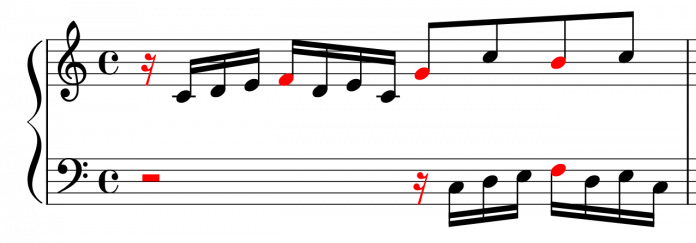
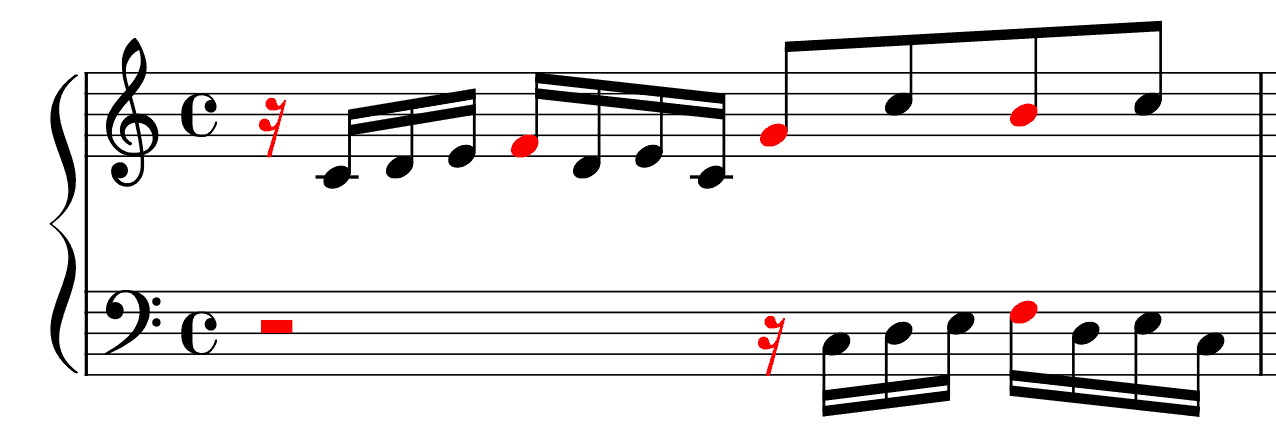
    Here is an exercise you can try. Play a piece with both hands, but only play the notes that land on the beats. This will encourage you to focus on the beat, and the beat will be the same in both hands.

    Play only the notes in red. Each one is a full-body action, both hands together. Use a metronome to force you to focus on the movement that happens on the beat.

    Tip 5: Prioritize what’s important

    Make a decision about what is important to you when you play, and don’t let the notes distract you from that.

    Suppose you are walking with a friend and you have an itch on your face. You will not stop walking to scratch the itch. You will keep walking, because you don’t want to get behind your friend, or make your friend wait for you. The walking is more important than the scratching. Because you have set your priorities, there is no problem doing both at the same time.

    When you play the piano, don’t let a difficult spot in one hand throw off the entire rhythm of the music. (That’s why it feels difficult to play the piano with both hands.)

    Set a priority for yourself which is as easy as walking, and let the little details will take care of themselves.

    To try this out, pick something that is really easy. For example, you can say “my priority is to make it to the end of the piece.”  Then, try playing the piece. You are free to make any mistakes you want, but at least get to the end.

    While you’re playing, you might find that your hands get tangled up. That’s fine. The rules do not say that you need to play all the notes correctly, only that you need to get to the end.

    Here are some other examples of priorities:

    • Play softly
    • Bring out the melody in the right hand
    • Keep a steady beat

    These priorities will take your focus off of hand independence while you play the piano, and put it on something you have more control over.

    Tip 6: Explore the body

    Instead of focusing only on the fact that your hands are getting tangled up, dig deeper into the body.

    In a passage where one hand seems to be written slower than the other, remember that neither is ever actually slower. The tempo is still the same in both hands. Feel this energy balanced throughout the body. There must be an constant, internal pulse that governs both hands. 

    When you can feel how your whole body responds to this pulse, it will be much easier to notice what causes problems. Remember that the body is a physical thing. It has mass, and is governed by the laws of motion. You must learn to respect this.

    Start by exploring your instincts around the relationship between your hands. Notice what it feels like to move your torso around, and how that affects what your hands are doing. Do things feel independent, or do they feel tightly wound up?

    Play hands in parallel motion and contrary motion, and notice what happens. What does it feel like? Does one feel easier than the other? Does one hand feel better going in a certain direction?

    Play passages where one hand moves and the other doesn’t. Notice where you feel stuck or where you feel one hand trying to “pull” on the other.

    Tip 7: Feel the beat

    Instead of looking for “hand independence exercises,” take the opportunity to make any piano piece into an exercise to coordinate the left and right hand.

    A piece of music should have a steady beat. When the beat is not steady, you feel it, and the audience will hear it. So, this should always be your top priority.

    Always, start by making sure both hands are “doing the same thing.” That is, ensure that both hands are playing at the same time. Use a metronome, if necessary. You should feel the beat throughout your entire body. This is the essential first step in training your hands for piano.

    Once you’ve got the beat established, work on differentiating the hands. This means add the smaller details.

    You may find yourself getting stuck again, like your hands are not cooperating. Or, perhaps it’s just one hand that’s not cooperating. In either case, go back to making sure that the beat is consistent between both hands.

    Tip 8: Read hands together

    Instead of thinking of music as having a right hand plus a left hand, think of both hands together. Even when you’re reading a piece for the first time!

    Sight-reading always screws up the coordination between the hands for some pianists. Maybe you can read each hand independently with no problem, but putting them together causes everything to slow down. Or, one hand is fine, but the other isn’t.

    Remember that both hands must always move at the same time. It’s paradoxical, but this is how you actually achieve hand independence in piano playing. You cannot let one hand get ahead of the other. If treble clef is easier for you than bass clef, your right hand might get impatient waiting for your left. You, however, must wait patiently for both hands to be ready. If you can’t do this you should ask yourself why. Where are you in a hurry to go?

    When you are reading, your brain must process each beat before playing it. You can’t think of each hand separately, and move each hand separately. The entire beat (left hand plus right hand) is one action. It should all be comfortable, and it should all make sense to you.

    When you sight-read a new piece, make a resolution to play both hands. Try to zoom out a little bit and see both hands at once. Even if you make a mistake, keep going. 

    Set your priorities. Decide which musical elements are the most important ones. Let your whole body play those elements. Don’t get trapped into thinking that you need to play everything on the page. Remember that it must all fit into the structure of your body.

    This takes practice to do perfectly. But if you persist, you will make progress.

    Tip 9: Play Bach

    Try practicing Bach preludes, inventions, and fugues.

    Bach’s music will challenge your finger independence as well as your hand independence. Contrary to popular opinion, it does not need flexible or strong fingers. The challenge is all in your mind.

    Finger independence is basically the same issue as hand independence. Here, the whole hand must be unified. Even if the five fingers are playing different things, the hand as a whole is moving in one direction.

    First, you should understand that Bach’s music generally consists of multiple simultaneous voices. Do you see that in the music? Can you hear it when you listen to a recording?

    As a pianist, it’s your job to express all of these voices at the same time. This is a really hard thing to do! However, with a lot of patience, you can master this skill. Don’t expect perfection at first.

    Play through a Bach piece, and try to mentally follow one voice at a time, from beginning to end. You can try singing along. Then, do it with another voice. 

    The whole aim here is to untangle yourself mentally. The physical stuff will follow from that.

    Tip 10: Mix up the dynamics

    Many pianists have a hard time playing different dynamics between the two hands. This is an essential skill, and if you struggle with it, you should make this a priority.

    As always, the beat needs to be the same in both hands. This is usually the problem (and fixing it is usually the solution…). If you have no unified sense of beat, it’s like you’re trying to micromanage each hand separately. This just overloads the brain.

    If you can play each hand at a different dynamic level, you will have significantly more control.

    First ensure that both hands can play together with no problem. 

    Next, experiment with “LH soft + RH loud”. You should think of this as a single action. If you find that doing this messes up your beat, you are not thinking of it as a single action.

    Likewise, experiment with “LH loud + RH soft”.

    Tip 11: Mix up the articulation

    Practice playing legato in one hand and staccato in the other.

    As with dynamics, this will help you attain significantly greater control. It will make it much easier to play music like Bach, where this level of control is required.

    See the previous tip about dynamics. The concept is the same. You want to think of both hands as playing together. It’s just that one of them is legato, and the other is staccato.

    Tip 12: Let the notes fall where they need to

    If you are playing a piece with polyrhythms, such as 3 against 2, or 11 against 7, or 25 against 8, or whatever, do not attempt to calculate mathematically how the notes should line up. Instead, decide where the beats are, and make sure that both hands are playing the beats at the same time. Let the other notes fall where they need to.

    The composer probably did not intend for you to count things precisely, anyway. 

    If one hand has 25 notes, and the other has 3, they are both playing at the same tempo. Sure, one has more notes, but the metronome clicks the same regardless. Feel the metronome in your body, not the notes.

    When you see a difficult rhythmic figure, try to get a sense of the overall shape of the thing. Then, when you play, make sure that you can:

    1. play the first note correctly, and
    2. keep a steady beat.

    For now, don’t worry about the other notes. Take your best guess, but don’t interrupt the flow. This is harder than it sounds, but it’s worth the practice.

    Be patient

    As with everything at the piano, hand independence is easy to fix if you practice the right way. Be patient with yourself, and with your body. When you let things happen as they must happen, you’ll see how to get out of your own way.

    It’s worth it, by the way. If you learn to play comfortably with both hands, you can expect the following benefits:

    • It just feels good when everything is working in a smooth and integrated way.
    • You’ll prevent injuries when your body moves with itself, rather than against itself.
    • Playing stops being stressful.
    • Fewer distractions.
    • Technical problems will fix themselves, since your body will be moving more efficiently.
    • Audiences can hear when your playing is comfortable, and when you’re struggling. No one wants to hear you struggle.

    Remember, this isn’t a physical problem. It’s is a problem you can solve with the right kind of mindful practice.

    But Enough Music

    Let’s talk about something that actually matters.

    > CONTINUE

  • 9 Piano Sight-Reading Habits That You Should Stop Doing

    9 Piano Sight-Reading Habits That You Should Stop Doing

    Out of all of the skills related to piano, sight reading can be one of the most frustrating. Wouldn’t it be great if you could sight-read anything? Imagine that you could:

    • Play all the right notes and rhythms.
    • Sight-read at any tempo, fast or slow.
    • Feel calm and relaxed as you sight-read.
    • Sight-read in a way that sounds and flows like real music.

    In this article, I will list several habits that pianists frequently have, which actually make it harder to learn to sight-read anything. I hope you find this collection of piano sight-reading tips useful in your own practice.

    Get my e-book

    I wrote this ebook because I want to share what I’ve learned about what’s wrong with the way the piano community treats “amateur” pianists. I don’t like it, and I want to change it.

    It is rare to see something written for serious adult amateurs, and by someone who went that route. I had it on as an audiobook while doing chores – the first chapter on various aspects regarding teachers, I was saying “right” and “certainly” out loud a few times. 😀 A lot of the things, I wished I’d heard this when I first started my first ever lessons some time ago; it took me years to at least partly find my way out of holes due to some of those things.

    Inge

    Amateur Pianist

    Bad Habit 1:

    You make sight-reading difficult

    When you practice sight-reading on the piano, you fix your eyes on the music and struggle to get through.

    Many pianists have trouble understanding how to get better at sight-reading with ease. This is because they don’t make ease a priority. While sight-reading, you might find that:

    • Just looking at a complex score makes you feel confused and stressed.
    • Sight-reading at an uncomfortable tempo (either too fast or too slow!) makes you feel nervous.
    • You feel pain or fatigue.
    • You can’t really feel the music.

    This is often a sign that you aren’t making ease a priority.

    What to do instead:

    Remind yourself that music is supposed to be fun and that you can’t do better than your best. Pay attention to how things feel, not just whether you’re playing the right notes. When you look at a complicated score, view it like you would a map of a city. You don’t have to understand everything all at once. 

    Bad Habit 2:

    You’re not coordinated when you sight-read at the piano

    Your eyes move frantically up and down between the music and the keyboard. Your hands jerk around randomly as you struggle to find the right notes.

    Our education system teaches us to view things in black and white terms. In order to get a passing grade, we learn to do what is right and avoid what is wrong. When we take music lessons, we carry this attitude into our practicing. Through no fault of our own, we can end up viewing music reading in the same light as math or physics. This can have the effect of causing us to detach emotionally from the task, making things feel difficult and tiresome. Thus, for completely understandable reasons, many students totally ignore their musicality when reading.


    Furthermore, sight-reading is hard! As with all things piano, sight-reading asks us to bring our complete selves to the table. Our minds and our bodies must work in harmony to allow us to function as a unified whole. Specifically, you must coordinate:

    • Your eyes
    • The parts of your body that are directly involved in playing the instrument
    • The rest of your body
    • The instrument itself
    • The page turns

    What’s more, all of these must be coordinated with the beat, the musical intention, the conductor, the singer, etc.


    Once you come to terms with all of this, you will know how to get better at sight-reading.

    What to do instead:

    Let your body do what it needs to do. If your eyes want to move up and down, let them, but also encourage them to stay in one place long enough to feel the stress that comes from not knowing if you’re going to play the next note correctly.

    When you turn a page, do it in tempo. Page turns are part of the music as well.

    Bad Habit 3:

    You’re not reading the score the right way

    When you read music, you try to play everything exactly as it is written, no matter what. If you hit a wrong note, you stop and make sure you hit the right one before going on.

    If you wish to improve your piano sight-reading, your task is to understand how to read a score, so that you can extract all of the relevant details. That is, you are learning how to connect to the composer’s intention by absorbing this picture. You want to be able to extract as many of them as you possibly can, in real-time. In the end, you want to be able to do this quickly, allowing the music to simply flow off of the page and through your body.

    What is a musical score?

    • A visual representation of how the composer wants the music to sound. It’s more of a picture, or an outline, than a step-by-step recipe.

    • A description of the beats of music. (What pitches occur on each beat? How are the beats grouped into meter? What happens between the beats?)

    • An outline which marks the basic events occurring in the piece (repeats, phrases, accents, crescendos, fermatas, etc.)

    The score is not the music. It’s a picture of the music. Additionally, It is not, strictly speaking, a set of instructions for how to play (even though it may have some instructions in it).

    What to do instead:

    Remind yourself that you are making music, not following instructions. Do not stop to correct wrong notes. This is not correct, even if it’s what it says in the score, because “corrections” are not part of actual music!


    Bad Habit 4:

    You aren’t deciding what’s important

    You treat every detail in the score equally. Notes are just as important to you as rhythms, and articulations are just as important as dynamics.

    You can’t treat every detail equally, for several reasons:

    1. You often do not have time to absorb all of the details on the page. What you do absorb should be more important than what you don’t absorb.
    2. Your entire physical state must give preference to the important elements. For example, if your body is not generally “moving to the beat”, you will find it difficult to articulate the fingers properly.
    3. Thinking hierarchically makes it easier to understand what you are reading. For example, when you read a novel, it is useful to understand how the text is broken into paragraphs, words, sentences, chapters, etc., as this improves comprehension.
    4. With improved comprehension comes greater room for creativity. When you understand the basic building blocks in front of you, you can then assemble them in the order that makes the most sense to you.
    5. With creativity comes a more engaged performance. As a result, you will enjoy yourself more, and the audience will enjoy the performance more as well.
    This frees you to express music how you feel it. Like a painter bringing objects to the foreground or relegating them to the background, you create the sound world you envision. Your body is coordinated with the important elements of the music, so they come out in your playing. You are absorbed in the task, enjoying the process, and the audience will be moved by your performance.

    What to do instead:

    There must be a hierarchy to what appears in the score. What this means is that the elements higher up the hierarchy are more important than the ones further down. For this reason, a big part of your artistry is determining what you wish this hierarchy to be. However, it may vary from piece to piece.


    As an example, in order of most to least important:

    1. Beat and meter

    2. Phrases and cadences

    3. Rhythm

    4. Pitch

    5. Counterpoint

    I often think of music in this way, but there is space for individual variation and creativity. By focusing on the aspects of music that you find important, you will be able to read a piece in a way that is meaningful to you.


    Bad Habit 5:

    You aren’t practicing well

    For example:

    • When there is a trouble spot, you stop and figure it out before moving on. When things are easier, increase the tempo.
    • You deliberately read 1 or 2 measures ahead of where you’re playing
    • You let yourself “stutter” and “hunt around” for the notes as you play.

    When I learned to sight-read, I did not follow any formal strategies or use any “tricks”. Nonetheless, it took me less than a year after I began studying piano before I was what I would call “reasonably fluent” at reading both hands together. I am not saying this to brag, but to make the point that if you want to improve your sight-reading skills quickly, you can. I attribute my progress to the fact that I simply read a ton of music, without fear of making mistakes.

    What to do instead:

    Let me offer this basic method to get better at sight-reading:

    1. Decide what note gets the beat, and what basic physical action you will use to perform these beats.

    2. Choose a tempo and stick to it. Use a metronome.

    3. Decide on what is important, and what isn’t. When you play, prioritize what is important.

    4. Keeping your eyes on the music, play from the beginning to the end, without stopping. Try not to look at your hands (but it’s no big deal if you do).

    This is the basic formula, and you can vary it as needed. For example:

    • Change what you are prioritizing. For example, you may prioritize the bass line or one of the inner voices.

    • Change which durations you are playing. You may decide only to play the notes that fall on the quarter note beat, for example. Alternatively, you might play just the downbeat of each measure.

    • Play easier music, or harder music.

    • Play faster, or slower.

    Other suggestions:

    • Let yourself feel the beat as you read.

    • Try to make music.

    • Play the piece as you feel it should sound, even if it doesn’t come out exactly right.

    • Even if you don’t know the piece very well, you have the right to your interpretation. Trust your inner self to know what to do.

    • Try playing both hands, or at a tempo that feels a little too fast for you. Try to ease into this difficulty, noticing how your body wants to react.

    • Do not write in the pitches.

    • Understanding music theory can be somewhat helpful, but it is not the most important thing. You will recognize chords mostly by their shapes, not as much by their harmonic functions. However, you should be comfortable playing scales in the key signature that the piece is in. If you are trying to read accidentals while sight-reading at the piano, this will generally throw a wrench in the works.


    Bad Habit 6:

    You don’t play confidently and securely

    If the music is too hard for you, you slow it down. When it gets easy, you speed back up. After each note, you check to make sure it’s right before moving on.

    When you practice playing timidly and hesitantly, you will ingrain that way of playing into your system. This will not lead to confident music-making any time soon. Music that has constant stops and starts, or constant tempo fluctuations, does not sound like music. You don’t want to get into the habit of playing that way.

    What to do instead:

    If you don’t feel comfortable playing fast, then play slower. But, always play confidently and securely. Every beat that you play must be decisive and sure. Then, you go to the next beat and play that one as confidently as the previous one. Over time, you can then work on lining up your beats in tempo. Whatever you do, do not “stutter“.


    Bad Habit 7:

    You aren’t keeping a steady beat

    You get stressed out by complicated-looking rhythms and let them interfere with the pulse of the music.

    The rhythms will come eventually, once you learn to recognize the patterns. However, you will never be perfect at recognizing rhythms at sight. Music notation can, at times, be too confusing for this to work.


    So, do not let the rhythms interfere with the beat. The beat is the most important thing. Listeners will generally never mind an incorrect rhythm, but a missed beat is immediately noticeable.

    What to do instead:

    Keep a steady beat. This is the most important thing, always.

    Focus on getting the correct notes that fall on the beats. Do not worry about the notes that fall in between beats.


    Bad Habit 8:

    You don’t like the way you practice sight-reading

    Practicing sight-reading feels like a drag, and you have to force yourself to do it.

    As far as practice goes, the more you practice, the easier piano sight-reading will become. However, if your experience practicing sight-reading is less than exciting and engaging, you will not be motivated to do it. Pay attention to what encourages you to practice, and also to what discourages you.


    What might be stopping you from reading a lot:


    • Perfectionistic attitudes about correctness.

    • An approach to reading that causes physical discomfort.

    • A sense that you are “bad at this”, and have a huge deficiency to overcome.

    • Judgment from others about how good your reading is.

    • Reading music you dislike.

    • A busy schedule that limits practice time.

    • Tension and fatigue in your body.

    • A history of having difficulties in sight-reading and either being hard on yourself or being judged by others.

    If any of this applies to you, you should find ways of practicing that are more fun for you.

    What to do instead:

    You might try the following strategies:


    • Reading music you enjoy listening to.

    • Setting a goal such as “read through all the Mozart sonatas this weekend”, and just plowing through it.

    • Ignoring all of your mistakes (if you hate fixing mistakes).

    • Spending time diligently correcting all your mistakes (if you love fixing mistakes).

    • Focusing on physical sensation rather than correctness. Paying more attention to the feeling of the music, and the feeling of your body playing the instrument, rather than whether or not you are playing correctly.

    • Playing duets, chamber music, vocal music, etc.

    • Reading the easier parts and ignoring the harder parts.

    • Play with freedom like you did as a child. Ignore the hard parts!


    Bad Habit 9:

    You don’t sight-read enough music

    You sight-read one line of music a day, or you only sight-read when you first play a new piece you’re planning on memorizing.

    Surprisingly, sight-reading is closely related to memory. Pieces that are similar to pieces you already know are easier to read. This is because reading is basically pattern recognition. If you are not good at sight-reading, your priority must be reading lots and lots of music, so that your brain can collect a large number of patterns.

    Therefore, the more pieces you read, the better you will get at reading new pieces (especially those in the style of the music you are already familiar with). When I was learning to play the piano, I read a ton of music. Everything I could get my hands on. This paid off, big time.

    What to do instead:

    Your sight-reading will only improve if you treat it like anything else in piano. Sight-reading takes practice: a lot of it. You must spend many, many hours sight-reading, and make tons of mistakes. That’s how you learn.  So, play lots of music:


    • You can try sight-reading exercises if you find them useful.

    • Play music that is too easy, and also music that is too hard. 

    • Play music that is contrapuntal. Bach is always great for sight-reading. Play music that has 4-part harmony, such as in a hymnal. Train yourself to focus on the parts individually while you play. Start with just one part at a time.
    • Play music that is in the style in which you want to improve your sight-reading.

    You should play music that is of interest to you. Then, you will be more motivated to read it.

    How to Improve Sight-Reading at the Piano

    Generally, anything that gets you to read a lot is a good way to practice, and anything that prevents you from reading a lot is not.

    Increase the conditions that lead to more sight-reading. Work on eradicating whatever’s getting in your way. With practice, your sight-reading will improve.

    Practice everyday. Set a timer, if you need to. If you skip a day or two, do not beat yourself up about it.

    If you find yourself getting discouraged, pay attention to what is causing the discouragement. Focus more on what you find motivating. Remember that practicing is about you.

    Anyone can learn how to improve their piano sight-reading. There is no magic bullet here. Basically, you just need to read a lot. The suggestions I’ve given here aimed at making it more fun and engaging for you to read so that you will be more likely to do it, and so that you will pay more attention while you are doing it.

    Your turn

    Are there any other habits you have noticed that you have while sight-reading? Any other sight-reading tips for pianists, which you have found useful?

    I’m curious to know what has worked for you, and what has gotten in the way. Leave a comment below and let me know!
  • How Long Does It Take to Learn Piano?

    How Long Does It Take to Learn Piano?

    When you start learning a skill like piano, it’s normal to wonder, “how long is this going to take me?” You’re impatient because it seems like it will take forever to learn piano. I want you to feel optimistic.

    In this article, I am going to put forth a few ideas that will help you answer this question for yourself. So, here are  6 questions you should ask yourself when you’re wondering how long this will take:

    Question 1:

    What does progress mean to me?

    How high are your standards for your piano playing? 

    Of course, the higher they are, the harder it’s going to be to reach them. So, ask yourself: why did I set them so high, anyway? Where did I learn to do that?

    How high are your standards for yourself?

    The more talented you are, the more you will realize how short you are falling of your standards, and the harder it’s going to be…

    Why it’s important:

    Only when you have a clear definition of “progress” will you be able to evaluate your progress realistically.

    Question 2:

    How much patience do I have?

    I wish there were a quick way to get good at piano, but I haven’t found a shortcut. Instead, what I have found are:

    1. Slow ways that work.

    2. Ways that will waste your time and make you so frustrated you will eventually quit.

    So, at best, it’s slow-going. This stuff is just really hard. Why do you think most people can’t do it? But you can do it, you know. It will just be slow. Like a lazy river.

    Why it’s important:

    Learning piano will take time. Learning to enjoy the slow pace will make things easier.

    Question 3:

    Do I feel guilty about wanting progress now?

    A beginning adult student said to me:

    “I think the biggest lesson for me is that this is going to take a long time. I like instant gratification, and the ego likes that too, right? But with continued effort, eventually, there will be music.”

    Yes, it might take a long time to learn piano, a long time before you sound good, and a long time before you are happy with your playing.

    Now, our culture teaches us that there’s something wrong with wanting instant gratification. 

    Is it possible there is one part of you who seeks instant gratification, and another who labels it as bad? Which part is the ego, and which part is the one who lives only in the moment, experiencing without evaluating? 

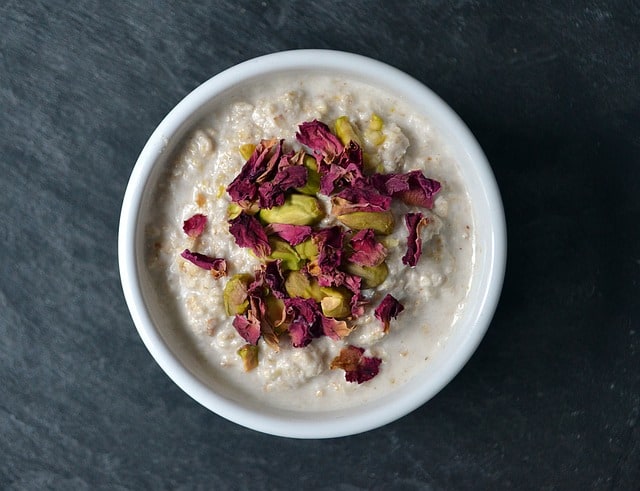
    Actually, I wonder if there is no gratification other than instant (it’s not like oatmeal). What is delayed gratification, apart from a story you are telling yourself about the future, about yourself and the meaning of your actions?

    When you were a child, did you have any problems seeking instant gratification? When did you learn it was a problem? Who told you this? Do you believe it 100%, or is there any part of you to whom it’s news, who maybe even feels hurt by it?

    If you’re not being gratified, why not? Really, pay attention to this. Is there anything there, in that space between when you try to play (and fail) and when you get frustrated with the whole thing? You’re allowed to be frustrated, you know. You’re allowed to want this to be fun.

    Why it’s important:

    Learning piano requires you to accept your feelings in the moment. Even if you’re feeling impatient.

    Question 4:

    Do I know how to make piano practice fun?

    It may take a long time to learn to play the piano well. In the meantime, can you make it fun? For example, can you find some pleasure in the physical movement, regardless of the sound? Or, can you find any satisfaction even in the ugly sounds, knowing that they are the result of your body’s own freedom? Even if you don’t play a note, can you find something right there, in that place where you know that you have the power to move as you see fit, or not, depending on your whim?

    If none of that works, can you just stand up and scream? Would that be fun?

    What would it look like if you didn’t label it? If you played an exercise, messed it up, got frustrated, and just kept going? Is it even the playing that frustrates you? Maybe it’s just when you’re in the shower thinking about playing? It’s so easy to label the whole thing. But frustration happens at a specific moment in time. What is triggering it?

    Can you just make it fun? Just take it. It’s yours, believe it or not.

    Does your hand hurt? Then stop doing whatever you’re doing that makes it hurt.

    There are two common objections I hear to this kind of thinking:

    1. “But then I won’t play it right.”

      Yeah, you won’t. But your hand won’t hurt anymore either. You decide.

    2. “But if I don’t work hard and make sure it’s right, I’ll never get better.”
      ​
    3. Why do you want to get better, anyway? You’ve already said you want instant gratification, and if working hard is preventing you from getting your gratification, how much do you really want to work hard and get it right, anyway? If you don’t really care about that, why are you telling yourself you do?

    Why it’s important:

    If you practicing is fun, you will want to practice. If it’s not, you won’t. So, you should focus on making practicing fun.

    Question 5:

    Am I practicing well?

    Let’s suppose you are my piano student. If you ask me, “am I progressing fast enough?”, I would answer:

    “I can assure you that you are progressing exactly as you should be given the amount of practice done between lessons, the level of willingness during lessons, and the degree to which practice reflects the exercises that are done during lessons.”

    As a teacher, my responsibility is to my student. Unfortunately, this is difficult when money is involved, because I want paying clients. However, as much as I might wish I could, I cannot magically cause you anyone to improve at piano. I have no minimum expectations as far as “progress” goes. My job is to make the student aware of cause and effect, and I trust that they will make the best use of this awareness that they know how to.

    If you are teaching yourself, the same holds true. That is, the rule of cause and effect still applies. Except now, you have to be your own teacher. 

    The amount of time is takes to get good at piano will be reduced if:

    Why it’s important:

    How you practice just as important as how much you practice (if not more important).

    Question 6:

    Am I appreciating the journey?

    It takes a long time to learn a musical instrument such as piano, time which is measured in years, not weeks. So, if you judge the success of your practicing based only on the amount of progress you make, there will always be a feeling of failure.

    The process of piano practice itself must be enjoyed and appreciated for what it is. Even with no visible progress in the way of piano playing (the worst-case scenario), studying the piano will still teach you:

    • Appreciation of music

    • How to handle distractions

    • How to express music using the skills you do have

    • How to stay out of your own way

    • How to understand why you practice or why don’t practice

    • What frustrates you about playing

    • What you enjoy about playing

    What I have found personally is that sometimes these lessons need to be learned before noticeable “progress” occurs. 

    But, don’t discount them. These are valuable lessons! So, try to enjoy learning them.

    Why it’s important:

    Piano can teach you a lot. The more you pay attention to how many different things you are learning, the more progress you will feel you are making.

    So, how long does it take to learn piano?

    If you’re still asking this question, I can’t blame you, because I didn’t answer it. 

    The fact is, there’s no answer to the question of how long it will take to get good at piano. It’s entirely subjective, and every pianist comes from a different place. It’s a bit like asking “how long does it take to clean a house?” That would depend on how clean you want it, how much dirt there is, how fast you are at cleaning, what kind of cleaning supplies you have, etc.

    Your turn

    Spend some time with these questions. Choose one everyday, and ask it before you practice. As you are practicing, just notice what shows up.

    Then, comment below and let me know!
>