STATUS: INACTIVE // READ-ONLY

Category: Meditation

  • How Meditation Can Save the World

    The meditation world has been dominated by non-threatening, gentle idiots who are more than happy to encourage the ignorant masses to zone out and relax (which is what the ignorant masses want).

    (Don’t forget that meditation teachers pretend to be happier than they are because they feel social pressure from their friends to fit in.)

    Canceled meditators have insight

    My prediction is that in the next couple of years, people who have been victims of cancel culture will be speaking out more. Lots of them have real insight, but up to now, have been afraid to share their insights.

    Meditation matters more today because we’re in a time of greater diversity and interconnectedness. There is no way to make everyone’s verbal system line up with everyone else’s. So, it’s more important than ever that we learn how to attain some degree of equanimity that can absorb those shocks until culture can learn to synchronize on its own.

    The pandemic has caused so much disconnection and fighting online.

    I’m hopeful that one day we’ll figure out how to create a critical mass of enlightened people who can influence the culture to become more tolerant.

    Practice is more important than beliefs

    We’re wasting too much time in the meditation world arguing over stupid things, too much time trying to convince people to look at things a certain way.

    None of that’s important. People will always have their own unique ways of looking at things based on their own personal learning histories.

    Instead, we should be practicing: giving practical exercises and doing them.

    It’s not about “self-care”

    Looking at Instagram, meditation people seem to be talking about “self-care” and “fully showing up for yourself.” This feels untrue to me because there is no self. It encourages people to engage in emotional avoidance.

    That’s fine and all, but it’s not meditation. Meditation is about observing sensory phenomena as they are. Don’t get it confused with psychotherapy or assertiveness training or anything like that. They’re totally separate. Meditation requires you to accept even the parts of you that aren’t interested in self-care.

    People are anxious about this because they’re becoming aware of how society has been controlling them and they want to break free.

    It’s about untying knots

    Yet, I have high hopes for meditation because of the potential for it to untie knots in the human mind, to increase empathy and compassion and save the world.
  • I’m not lazy…why can’t I meditate?

    “I’m not a lazy person. Why can’t I meditate?”

    “How much is a reasonable amount of work to put into meditation before I’m able to see any results?”

    I meditated on and off for years. It didn’t seem like it was doing anything for me. It was too hard to sit still.

    Here’s the thing:

    When you sit and you’re thinking, “I’m not making any progress. Nothing’s changing”…and you get worked up because of that..then that needs to be the object of your meditation because that’s what’s getting in your way.

    It’s not like doing a handstand where you can see it, take a photograph of it, post it on Instagram and everybody can see that you mastered it. It’s not that kind of thing.

    But, if that’s the minimum condition for you to think you’ve made progress, then THERE’s your issue.

    Meditate on not wanting to meditate. You don’t have to “figure it out.” Just sit there and say, “I’m going to spend 5 minutes sitting here” and see what happens.

    If those 5 minutes go by and it’s easy, great. However, if after 30 seconds, you say “I’m wasting my time. I have more important things to do. This isn’t going anywhere…”, then sit with that feeling until the timer goes off.

    This will destroy your mind. Every cherished ideal, everything about yourself that you identify with, will be shredded to pieces.

    That’s a good thing, but it’s confusing. Everything you think is true right now will be called into question, and you’ll have to renegotiate all of it.

    It’s fun.

  • Instagram boddhisatvas

    The boddhisatva vow is about not letting yourself get enlightened until others are enlightened first.

    I bet the guy who came up with this concept was obsessing over the same problems I obsess over.

    When you have an urge to share something, you find that you can also opt to embody it instead. But then you lose the urge to share it (because when you embody something, you stop wanting to talk ABOUT it).

    What happened to that guy after he got enlightened?

    Maybe he never bothered to go back and correct himself.

    Maybe he said, “let those Instagram/TikTok boddhisattvas 2,000 years from now wrestle with this. It will be good for them.”

    What does it mean to serve others?

    Here’s the question on the table: do you trust your true nature or not?

    FACT: You’re not being tested.

    There’s no great teacher in the sky. You can’t do this through an act of will alone. That’s the lesson you need to learn.

    It ain’t that complicated.

    If you don’t let yourself synchronize, you miss an opportunity to learn from pain. But…if you force yourself to synchronize, you miss an opportunity to learn from freedom.

    So…what should you do?

    Again, do you trust your true nature? At the end of the day, THAT’S what needs to be reconciled.

    You can’t do it through an act of will or intellect. You have to trust that the environment you’re in is going to teach you.

    You can’t be both the student and the teacher at the same time. Let the teacher be the teacher. When the student is ready, the teacher will be appear, or whatever they say.

    The environment will train you. Aim for synchronicity with the environment. That’s the goal.

    But…maybe you think that’s dangerous. You think if you synchronize with your environment, you’ll just spend the whole day playing video games.

    Maybe…but, do you trust your true nature?

    If not, then when stuff happens, you’ll get upset. But, that’s its own issue. It’s not exempt from any of this. Nothing is.

    Take your pick. It’s up to you.

    You decide.

  • Why You Don’t Need to Argue with Your Mind

    Every time you complain about anything, it’s because you have a problem just sitting.

    Try it. Seriously.

    Just sit and see what comes up.

    Someone left this comment on one of the lessons of my No Problem meditation course.

    “The problem is not, not being able to just sit. The problem is the guilt tripping that has been conditioned into us/me that isn’t easy to stop in my head. Trying to convince me that I am not here to sit around, that I am not making any money while sitting around, that I am not helping anybody by just sitting around, that I am wasting my time just sitting around.”

    This is such a common issue, and one that I have faced myself so many times.

    When we try just sitting without doing anything, all kinds of stories show up in our heads. These stories try to get us to move our bodies in certain ways.

    For example:

    • If the story tells me meditation is a waste of time and I should be making money instead, I will move my body off the cushion and over to the computer (or wherever I think I’m going to get the money).
    • If the story tells me I’m bad at meditation and I can’t do it, I will move my body over to the TV, where I won’t hear those voices of self-doubt.
    • If the story tells me I can’t meditate while the upstairs neighbors are making so much noise, I will move my face into an expression of disgust, which will make it uncomfortable to breathe in a seated position, which will eventually get me off of the cushion as I prepare to fight my neighbors.

    It’s all physical.

    This is how you fight stories. With your body.

    Don’t argue with them. No need to do that.

    Look at how they affect you physically.

    “Just Sitting” is the test of how well you can do that. If you can sit in the presence of your stories, you know they aren’t controlling you, no matter how much you might “believe them”.

    I hope this inspires you to look closer at what you’re expecting to get out of meditation.

  • Why it’s good to be angry

    Why it’s good to be angry

    Come on, I want to see you get angry. I want to see you get obnoxious. We need more obnoxious people. People are too tame.

    Everyone wants to agree all the time. Agreement doesn’t get you anywhere. Especially when you’re upset about something!

    This is the creative force within you. Stop ignoring it. It has to come out. You’re not going to get what you want until it comes out. You’re not going to have the impact on the world that you know you need to have, until it comes out.

    Stop waiting. Just do it. Right now.

    I posted this video back on April 16, 2020. I’m still angry. You should be, too.

    Over the past several months, I’ve posted many angry videos, and I’m happy about all of them. Each and every angry video and post has freed up mental space for other stuff. If you don’t move past the anger, you can easily get stuck there. Forever.

    “Moving past” the anger doesn’t mean repressing it and pretending it doesn’t exist. It means letting it do its thing, with your voice and with your body.

    I’m a big fan of doing this through social media videos. Yeah, I know it’s scary. Our society doesn’t encourage us to be angry.

    Screw that.

    It’s true, some people might not like you for it. But you know that what’s inside you is going to come out, one way or the other.

    The world needs more obnoxious people

    Especially ones who are aware they are being obnoxious.

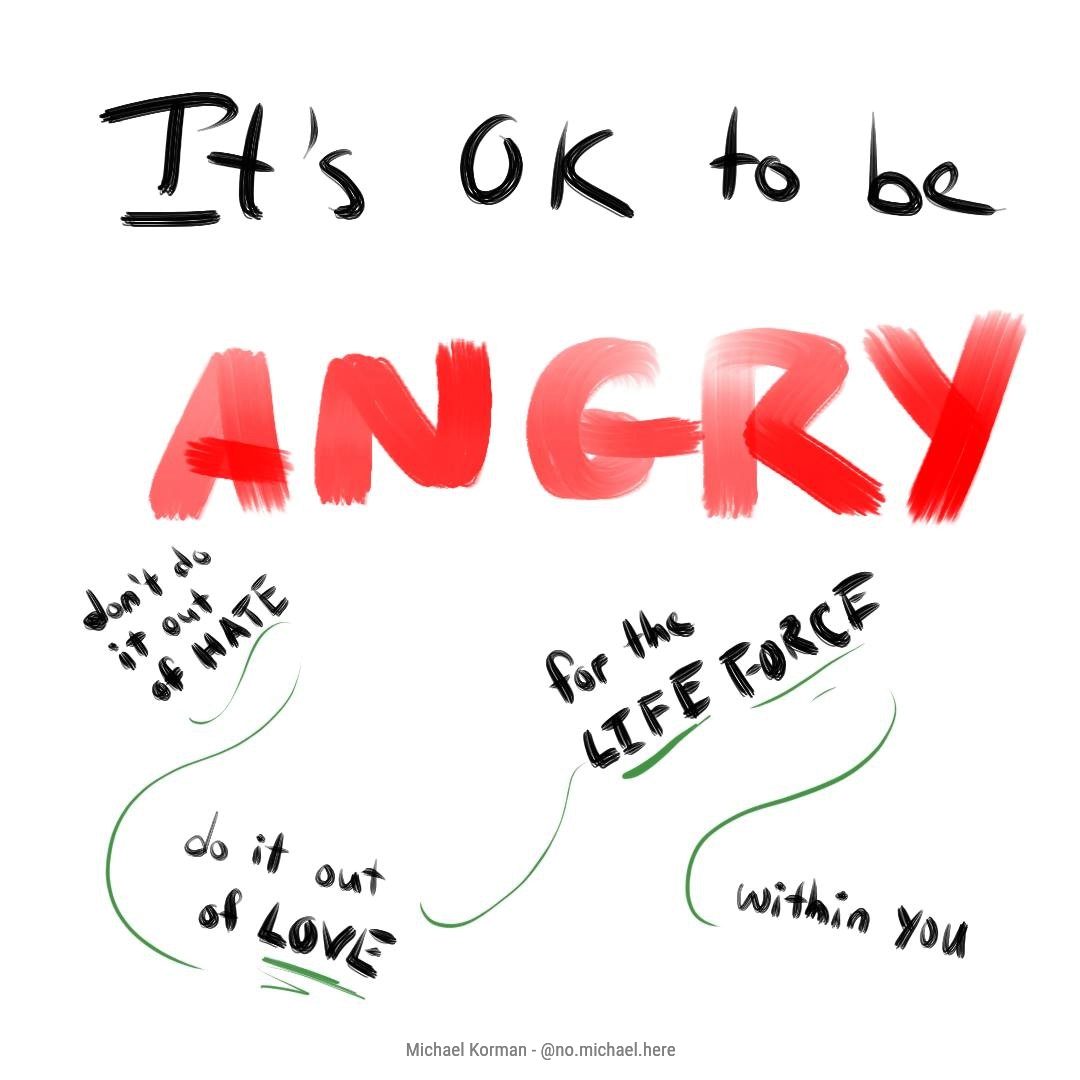
    It’s OK to be angry. The anger is a sign that there’s something really really important to you here.

    You can be angry without blaming others. Do you know the difference? Deep down inside, how do you view the people who have wronged you?

    It’s OK to play out violent fantasies in your head. You’re doing it anyway, whether I tell you it’s OK or not. Don’t play them out in real life. But in your head, do it. Do it until you have no more hatred toward that person.

    It will happen. The hatred will disappear. You’ll be surprised at what was fueling it in the first place.

    This isn’t about standing up for yourself. Please don’t stand up for yourself.

    It’s about taking a stand for yourself (and everyone else).

    It's OK to be angry. Don't do it out of HATE. Do it out of LOVE for the LIFE FORCE within you.

    Anger doesn’t mean you’re meditating wrong

    Meditation is about equanimity. Noticing things without reacting to them.

    Does that mean it’s morally wrong to be reactive? Should you try hard not to get angry with people? Is it a sign of progress in meditation when you are less angry?

    No, no, no.

    Some people will tell you those are true. If you’re looking to get rid of your anger and become totally imperturbable, you should go listen to what they have to say. (I guess you should, anyway. Personally, I doubt it will work. But, please try it and let me know what you discover.)

    The type of equanimity I’m interested in is the one where you’re OK with whatever happens. That means being OK with being reactive. Being OK with being angry. Being OK with making little progress in meditation.

    That’s how I practice: whatever comes up, I notice it and let it come and go on its own.

    Often, that’s confusing, especially when I’m really happy to see something bad go away.

    Unfortunately, the things that disappear always come back.

  • I don’t understand why I should meditate everyday

    I got a question:

    “Why should I meditate everyday?”

    Good question, thanks for asking.

    You should meditate everyday because, if you don’t, you will suck at meditation. It’s a skill that takes practice. It’s not something you do once and then you’re done. You must spend many hours on it.

    Let’s make it concrete.

    There’s a blog article by Ben Fishel titled “A Ph.D. in Happiness: What 10,000 Hours of Meditation Actually Does to Your Brain.” You can look it up on Google and read what he says.

    He breaks down what might happen after a certain number of hours. For example:

    • After 100 hours of meditation, you can expect “less stress and anxiety, improved immune system and energy”.

    • After 1,000 hours of meditation, you can expect “almost superhuman focus compared to coworkers, increased capacity to experience love”.

    • After 5,000 hours of meditation, you can expect “much of your ego will dissolve, much more control over automatic reactions, boredom won’t occur”.

    His words, not mine.

    My words are:

    I don’t care if you meditate everyday, or if you get your 10,000 hours in all at once and then quit forever.

    But, the clock is ticking.

    —Michael

>