STATUS: INACTIVE // READ-ONLY

Category: Piano and Music Practice

  • How to Play with Two Hands at the Same Time

    First, it’s normal to have trouble with this. Patting your head and rubbing your stomach at the same time screws up nearly everyone.

    Piano’s the same. Playing each hand on its own works fine. But, when you try to put them together, all hell breaks loose. Your left hand wants to do what your right hand is doing, or vice versa.

    It’s like none of the work you did with each hand on its own counts for anything.

    That’s because there’s a huge gap in difficulty between two of the steps:

    1. Play left hand by itself. (easy enough)
    2. Play right hand by itself. (easy enough)
    3. Play both hands together. (omg wtf!!!)

    When you do it this way, there’s no smooth progression.

    It’s as if you go from kindergarten to 1st grade and then skip directly to university. It would be a shock to your system and you’d fail.

    Not that you’re genetically incapable of succeeding at university. You’re just incapable right now, because you haven’t gone through the steps leading up to it.

    You skipped steps, so there was a difficulty gap that overwhelmed you.

    That’s why you can’t learn a piano song in three steps like that.

    You’re skipping way too much.

    The way to fix this is to add steps in between 2 and 3 that will make it into a smooth climb. But, those in-between steps are far from obvious.

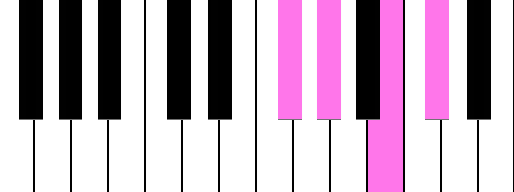
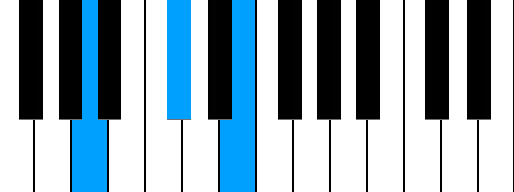
    For example, take the song “Golden Hour” by JVKE:

    Your left hand plays these notes.
    Your right hand plays these notes.

    But, how do you play them at the same time?

    You can’t just throw them together and pray for the best. You’re skipping steps if you do it that way.

    There’d be a huge difficulty gap.

    You’ve got to break it down into more than three steps.

    You need to be patient. It’s not possible to jump immediately to playing both hands together the way you want to. You’ve gotta go through 2nd-12th grades before you can enter university.

    Are you on board with that?

    Your next step won’t feel like university.

    It won’t be impressive. But, it’ll be easy enough that you can do it. Then, we’ll go to the step after that, and the next, and so on, until we get to the final destination.

    So, without further ado, here’s the next step:

    Play both hands together, but play one note at a time.

    Words can only explain so much.

    It’s easier to see it in a video:

  • The piano world isn’t suited to computer science majors

    “Michael, I like what you’re saying about how the piano world isn’t suited to CS majors. I’m a CS major and I’ve felt this myself. But, I kinda have some doubts. Like…don’t I have to be diligent to get good at piano? I mean, classical music is complicated. There’s a lot of detail.”

    I get your concern. There is indeed a lot of detail in classical music. It takes time to get good at it.

    But no, you don’t have to be diligent. I bet you got that idea from people who pride themselves on being diligent (and there’s no shortage of those in the piano world).

    You learned to speak your native language without being diligent. You learned all sorts of skills. No, laziness is the way to go.

    Embrace your laziness. It’s your greatest gift.

    “I heard that I need to avoid bad habits and that’s why I’m physically uncoordinated at the piano. But, I have some doubts about this. It seems reasonable that I’d be OK making mistakes…that’s how you learn, after all. Still, people are so insistent that bad habits must be avoided at all costs.”

    Yeah, of course, they’re insistent. They’re trying to justify why they suck. Their explanation is that way back in the mists of time, they got off on the wrong foot.

    No, they suck because they’re doing it wrong. They could change if they wanted to, but change it scary. Better to say change is impossible.

    “Then, why do I have trouble with piano technique? I heard you say it’s because I’m not committing to basic physical actions and a willingness to make mistakes. That sounds good to me…but I’ve heard so many other teachers talk about complicated movements and techniques. I’m torn.”

    You’re torn because you want results and you’re hearing mixed messages. That’s understandable.

    I suggest you try committing to basic physical actions and a willingness to make mistakes, and see what happens. They’re not mutually exclusive. You can even do the complicated movements while keeping those simple commitments.

    Get yourself lined up internally.

    “I took piano lessons in the past, and my teacher was always frustrated because I wasn’t musical enough. She kept trying to get me to ‘feel the phrase’ and I had no clue what she was talking about. But, there must be truth in what she’s saying. After all, I’m a logical, intellectual person. How do I make sense of this?”

    Most piano teachers are not logical, intellectual people. In fact, they see those traits as negative. So, of course, they’re going to talk to you that way.

    That’s their own insecurity speaking. Don’t get sucked into it.

    You have strengths and you should use them. Your way of conceptualizing things can be intellectual and logical. You don’t have to pander.

    By the way, it’s not true that you’re not an emotional person. All people are. You just somehow learned not to see yourself that way. The life force inside you is there either way, even if other people don’t recognize it. You can trust it.

    “What you just said sounds a bit New Agey to me. I mean, I like the idea of something being inside me even if other people don’t recognize it, but I’m skeptical about ‘life force’ and words like that.”

    It’s fine to be skeptical. They’re just words. Don’t take them too seriously.

    Do the exercises. Practice. Let your mind decide for itself how to talk about your reality.

  • Falling apart when playing the piano for an audience

    It’s OK to fall apart when performing for an audience. In fact, this is the only way you can learn not to fall apart.

    Seriously. You’ve got to go into that scary place and renegotiate whatever you find there. It’s the only way: through the fire and over the bridge and on we go to Grandma’s house.

    Maybe you think I’m being idealistic. Maybe you hate when I make assumptions about what you’re thinking.

    Doesn’t matter. What matters is only your own willingness to explore your fear.

    What makes me so confident?

    I’ve fallen apart before, I’ve been afraid to fall apart, and I know what the fear does. All the tension, all the anticipation, the hesitation, the aversion…all a result of trying not to fall apart.

    What’s the big deal? What happens if you fall apart?

    I have no idea, and you don’t either. The only way to find out is to experience it.

    Your mind is telling you a story, but you don’t know the reality until you experience it. Pay attention and notice what your mind says. Is the story even complete and coherent?

    This is piano technique, not psychology.

    The mind and body are one (there’s some new-age BS for you).

    One time, I was playing for an opera rehearsal. I was filling in for the usual pianist and I was sight-reading the score. At one point, I made some mistakes and the conductor looked at me impatiently and said “come on, Michael, get it together.” I felt embarrassed and angry.

    It didn’t make me play better.

    I want you to try it

    You don’t need to be convinced of anything here. My words aren’t intended to convince you. They’re intended to inspire you.

    I want you to try it. Put yourself in a situation where you might fall apart and see what happens. How far can you let yourself go?

    • Play for your friends.
    • Play for your teacher.
    • Play for teachers you don’t know.
    • Play for strangers on the Internet.
    • Play live on Instagram.
    • Play for your smartphone camera and never share it with anyone.
    • Play for a paying audience.
    • Play for a non-paying audience.

    Each of these experiences will provoke different stories and sensations in your reality. Even the same type of experience on different days will be slightly different.

    The goal is flexibility

    Throw yourself into the fire and learn how to swim. You’re more capable than you realize.

    But, if you’ve lived a life of fear, hesitation, and doubt, you’ll never know. You’ve been protecting yourself your whole life, staying small, out of the way, hidden, safe.

    Why? So you don’t offend anyone? So no one has to suffer the pain of hearing you fall apart?

    What part of you can’t stand it? Who’s that little kid inside you who needs protection?

    “Fear” isn’t a bad word.

    It’s OK to be afraid. It’s even OK to succumb to the fear. If that’s what you need to do to feel safe, that’s what you need to do. I’m not trying to take that away from you. In fact, I want to validate it, to let you know it’s perfectly fine to live in fear.

    It’s also OK to stand up to the fear. You can thank it for doing its job and reassure it that you’ve got it from here.

    One time, I took a placement test for an aural skills class. It was online, and I did some sight-singing exercises over Skype. I sucked. I felt so embarrassed. I said to the teacher, “I was feeling anxious, and I think I would have done better if I weren’t so anxious. May I try again?”

    She said no and I felt frustrated and even more embarrassed.

    Your experiences define you, but the stories you tell about them don’t

    The stories are arbitrary.

    I can sit here and type whatever I want. I can reach into my memory bank, pull at these loose threads of narrative, and see what I grab onto. They’re purely functional, purely pragmatic.

    The stories serve a purpose when they serve a purpose and don’t mean anything otherwise. They’re just stories showing up in the moment.

    You can choose which ones define you.

    And, if that’s too overwhelming, that’s fine, no problem. Sometimes you have to feel into them, to let them take root and grow and see where you find yourself.

    So, perform for others

    Let yourself fall apart.

    Let the pieces put themselves back together however they want. Every experience you have will give your mind new opportunities that make useful stories.

    Every time you fall apart, you’ll learn something new about what that experience is like. You’ll learn what causes the falling apart and what needs to happen to put yourself back together.

    It will happen automatically. The part of you that’s looking to be held together will make sure of it.

    You only need to provide the willingness.
  • I Hate Listening to Music! (but, I love playing it)

    I’m lying to you. I don’t hate listening to music.

    But, I kinda do…

    (huh?)

    Wait…I’m still lying to you.

    The truth is, I haven’t played music much over the past few months.

    (But, I do like it. Honest.)

    “Michael…what are you talking about?”

    I have no clue. I’m trying to figure it out as we speak.

    (Wouldn’t it be awesome if this topic were socially acceptable and something I could have already figured out when I was a kid?)

    OK, let’s see…

    • I don’t like going to concerts.
    • Rock concerts are too loud.
    • Classical concerts are too boring and have too many rules.

    When I was a kid, before I ever played the piano, I listened to music. I was inspired by George Winston’s piano playing. I used to fantasize about playing like him while listening to his CDs.

    But, I never listened to music the way the other kids did. It wasn’t to fit in or to be cool or to keep up with the latest fashions. Even in the classical music world, I never cared about fashion. Sometimes I listened to music, sometimes not.

    Playing music is a different story. I love touching the piano, moving my body, training myself.

    This is separate from “music”. It’s a tactile, energetic thing.

    Why can’t we all just get along?

  • Button-Pushing vs. Music

    The conversation went something like this:

    OP: Do you think I’ll pass my exam? (posted video)

    Me: Maybe you’ll pass, I have no idea. But, this isn’t music. It’s button-pushing. Play with the metronome and you’ll see where you’re deficient.

    OP: Thanks. I’m confused about how to count the beat with my mind.

    Me: Don’t try to count the beat in your mind. Count it with your body. Practice like this. (posted my video)

    Someone else: Michael, “button-pushing” is mean and besides, there’s lots of distractions. Counting out loud will be fine.

    Me: Counting out loud is a waste of time if you aren’t feeling the beat in your body.

    OP: Thanks. I’ll try to feel the beat. I think all the notes are played as 1 beat in your video.

    Me: There are 4 beats in each measure. Sometimes, there’s one note per beat (quarter notes), and sometimes 2 notes per beat (eighth notes). But always 4 beats in the measure. Don’t call them “half notes”, because that’s something else.

    OP: How do I use my body? Is it one beat every time you drop your wrist?

    Me: Yes, every drop is one beat. However, I’m not dropping my wrist. I’m dropping the entire forearm.

    OP: Thanks! It feels good. Highly recommended!

    Someone else: your a bit of a fool Michael. Plus i looked up your videos of your playing. Yes even the lady gaga one you did your ok player at best your just ok. So maybe worry more about your own playing

  • How to Cure Perfectionism in Your Music Practice

    Musicians who identify as “perfectionists” should understand the following about what perfectionism is and how to cure it.

    Perfectionism is an anxiety disorder. It’s a form of obsessive-compulsive disorder (OCD).

    By “anxiety disorder”, I mean you’re afraid of making mistakes, and furthermore, this fear is making it hard for you to practice.

    Here’s the problem: even if you know you shouldn’t be afraid of making mistakes, it’s still going to get you. That’s because this anxiety disorder is deeply conditioned into your nervous system.

    The mere thought of making a mistake is enough to scare you.

    Logically speaking, “mere thoughts” shouldn’t be scary. After all, they’re only images and sounds, raw sensory experiences.

    But, few of us have been taught to see them that way. Instead, we see them as elaborate stories that are true. Our minds interpret them this way automatically.

    The only cure for an anxiety disorder is exposure therapy. That’s when you deliberately expose yourself to the thing you’re afraid of.

    So, if you want to cure perfectionism in your music practice, you’ve got to expose yourself to the fear of making mistakes, and the thought of making mistakes. All those sensory experiences must become comfortable for you.

    Good luck with that, when the fear of mistakes makes you want to run and hide…

    Now, I’m guessing you’re not literally running and hiding. Instead, you’re doing it subtly, deep inside your body. It manifests itself as an internal tension, barely visible to the naked eye.

    Maybe when you were a kid, you did run and hide. But now, no. You sit there and deal with it. Not happily, but you still deal with it (maybe even reaffirming to yourself and others that you should just suck it up…again, not happily…you can feel it in your body, deep inside…).

    Exposure therapy is necessary to untangle this. But, it’s scary.

    So, how do you get to the point where exposure therapy is possible?

    You must learn to see the thing you’re afraid of as being only sensory experience.

    For example, if you’re afraid to perform in front of a potentially-disapproving audience because you’re afraid of criticism, you can learn to see the fear of criticism as merely images and sounds in your head and sensations in your body. Once you see it this way, it’s much easier to be willing to expose yourself to it.

    We all know it’s hard to deal with rejection. But, when that fear of rejection is seen to be merely a story told by the mind, it becomes much easier to handle.

    Even better, when that story is seen to be merely images and sounds (still frames from a movie), nobody would have a problem dealing with it.

    The good news is that this skill can be learned.

    How? By practicing meditation. Meditation teaches you how to view your experiences as sensory phenomena.


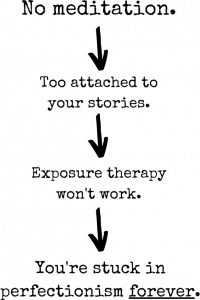
    So, this is the point of meditation: it makes it easier to do exposure therapy. If you don’t meditate, you’ll have a hard time seeing your stories as stories (you’ll be too attached to them). Then, you won’t allow yourself to entertain the thought of making mistakes while playing, and you’ll be a rigid perfectionist forever.

    That’s no fun.

>