STATUS: INACTIVE // READ-ONLY

Category: Piano and Music Practice

  • Teach Yourself Piano

    Your success in teaching yourself to play the piano will depend on 3 important factors:

    Motivation

    You need to be in this for the right reasons. Learning a musical instrument is not easy, and it will take time.

    The Right Exercises

    You must train yourself in the correct way. It is always better to be working on the right thing than to be working hard on the wrong thing.

    Sustained Effort

    If you put in the right kind of effort, over time you will succeed. Don’t make the mistake of quitting too early.

    Get my e-book

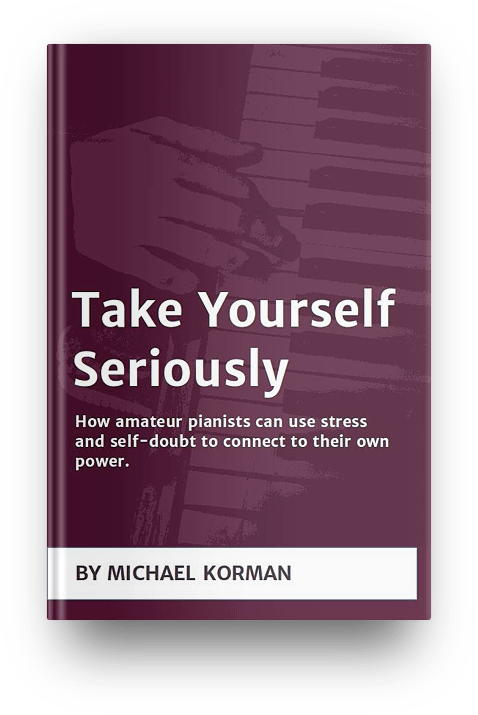
    I wrote this ebook because I want to share what I’ve learned about what’s wrong with the way the piano community treats “amateur” pianists. I don’t like it, and I want to change it.

    It is rare to see something written for serious adult amateurs, and by someone who went that route. I had it on as an audiobook while doing chores – the first chapter on various aspects regarding teachers, I was saying “right” and “certainly” out loud a few times. 😀 A lot of the things, I wished I’d heard this when I first started my first ever lessons some time ago; it took me years to at least partly find my way out of holes due to some of those things.

    Inge

    Amateur Pianist
    Frequently Asked Questions about Learning Piano

    Can anyone learn to play the piano?

    If you’re asking if you’re talented enough, the answer is “yes.” Provided you are physically capable of playing the piano, you will learn if you do the right things. Yes, of course, some people will learn faster than others.

    Am I too old to learn piano?

    Does it matter? You are whatever age you are, and you’re not getting any younger. If you enjoy playing the piano, then play. It doesn’t matter how much time you have “wasted”. That time is gone, and you will never get it back. What matters is the present moment, because this is the only moment you have to make decisions about how you want to spend your time.

    Is it hard to play the piano?

    This depends on what you are trying to achieve. Rather than think of things in terms of “hard” or “easy”, think instead in terms of specific results. You should understand that anything is possible, if you put in whatever work is necessary.

    Ask yourself the following questions:

    • What kind of music do I want to play?
    • How well do I want to play it?
    • How much time am I able to dedicate to piano practice?
    • How much frustration can I handle?
    • How long do I expect it will take to achieve my goals?

    How long will it take to learn the piano?

    It depends on many things. I know people who have spent years in piano lessons, and are still beginners. And, I know people who have been able to play at a professional level after only a few years. How long it takes will depend on (just to name a few factors):

    • What you mean by “learn the piano”
    • How much time you spend on piano practice
    • What specifically you do during that practice time
    • Any habits you have which might get in the way of good practicing
    • Any habits you have which might help good practicing

    How should I start learning the piano?

    Do what you’re interested in. Follow your curiosity.

    Also, check out my course.

    That doesn’t seem very specific. Can’t you offer something more concrete?

    If you’re looking for book recommendations or a step-by-step plan, that’s hard for me to give. I would have to know more about you, to know what you need.

    Also, you should understand that I am only going to teach what I know. That may or may not be what you need, and it is biased toward my own interests. This is true of all teachers, and you should keep that in mind when talking to teachers.

    How should I learn to read music?

    Learning to read music is like learning to read a language. It will take you a while to master it. If you expect that you are supposed to understand everything all at once, you will only get frustrated.

    The basic rules of music notation are simple. But, you will need to read many pieces of music before they really start to make sense. So, make that your priority. 

    What do I need to learn in order to be able to play the piano?

    It depends on what you want to do, exactly. Are you interested in:

    • Learning a few popular songs to impress your friends?
    • Filling in for the organist at church?
    • Giving a solo classical recital from memory?
    • Composing your own music?
    • Playing chamber music?
    • Exploring as much of the vast solo classical repertoire as you can?
    • Improvising jazz?
    • Applying to a degree program in piano?
    • Teaching piano?

    Each of these goals requires you to learn a large set of skills. It is worth getting very specific on what you want to accomplish. Then, you can work backwards from there, and figure out what you don’t know.

    Do I need a piano teacher?

    Many pianists attest to the fact that they could not have gotten where they are without a teacher. Likewise, many pianists are happy learning on their own. Consider the following questions:

    • What exactly are you expecting a piano teacher to help you with?
    • Do you enjoy teaching yourself new things?
    • Thinking about teachers you’ve had in other subjects, what did you like/dislike about them?
    • If you’ve taken piano lessons in the past, what has worked? What hasn’t worked?
    • If you’ve tried teaching yourself piano, what has worked? What hasn’t worked?

    There are many different ways of teaching piano. Different styles of teaching are better suited for some types of students than others. So, there are a lot of variables here.

  • Mindfulness for Musicians

    As kids, we learn to judge ourselves. This is a normal part of growing up in our culture and going to school. But, it makes it hard to learn piano.

    The cure is mindfulness.

    Concentration

    Stay focused on the piano, not on what other people are thinking about you.

    Awareness

    Tune into your body so you can play fast and without mistakes.

    Non-judgment

    Let mistakes roll off your back so you can play without crashing and burning.

    Wait, what’s mindfulness?

    Mindfulness is popular these days. That’s good because it makes you play the piano better.

    Here’s how Jon Kabat-Zinn (meditation teacher) defines “mindfulness”:

    “Mindfulness means paying attention in a particular way: on purpose, in the present moment, and non-judgmentally.”


    If you’ve done meditation, this will be familiar to you. But, most musicians haven’t a clue.

    Why is mindfulness useful for piano?

    It’s all about learning to see how the mind and body work together. 

    Concentration. Anyone who’s ever tried playing an instrument knows how annoying distractions are. It doesn’t matter if those distractions come from the physical world or the mental world. They’re still distractions and you’re going to have a hard time playing as long as they’re throwing you off.

    Awareness. To play piano fast and without mistakes, you’ve got to be in touch with your body. The only way to get there is by paying attention. With awareness, you’ll be able to move your body efficiently and easily.

    Non-judgment. Piano is really hard and no one masters it overnight. So, if you’re stressing out about your mistakes, you’re being too hard on yourself. That’s normal, but it gets in the way. Fortunately, you can learn to stop judging yourself.

    Two myths about mindfulness

    “The purpose of mindfulness is to help you relax.”

    No, the purpose is to help you pay attention. It might even make it harder to relax. If there’s a lot of stressful stuff going on, paying attention to it could make you feel worse. That’s part of the game.

    “Mindfulness is supernatural woo-woo.”

    Yes, it’s true that religions and New Age hippies have used mindfulness forever. That’s because it works. It’s a basic human thing. But that doesn’t mean it’s supernatural.

    How to get started with mindfulness

    There is only so much that can be conveyed through writing. In other words, you need to experience mindfulness in order to truly understand it. So, here is an exercise I urge you to try.

    Exercise

    1. Choose two pieces: something fairly difficult that you struggle with, and something easy that you know well.
    2. Take a seat on the piano bench. Breathing through your nose, notice the feeling of the air entering and leaving with each breath. This is not an exercise in deep breathing; your task is only to notice the breath as it is.
    3. Play the difficult piece, keeping your attention on the breath. If your mind wanders, gently bring it back. Notice what causes your focus to leave the breath. Your task is to try to keep it there 100% of the time (you will definitely fail at this, but try anyway). If your attention wants to go to the music, bring it back to the breath.
    4. Now, play the easy piece, again focusing on the breath.

    Notice where your mind wants to go. No judgment.

    You don’t need to do anything else. Your experience is your teacher.

    This is really hard stuff.

    Just notice.

    What’s so different about a mindful approach to music?

    Many people benefit greatly from a traditional approach to music lessons. However, a mindful approach is based on something quite different. Let me give a few examples of how a mindful approach to piano lessons differs from the traditional approach. I urge all teachers and students to explore these issues in their own lessons, whether or not you wish to change your entire approach.

    Non-judgmental observation

    The core concept in mindfulness is paying attention. This is done entirely without judgment, if possible.

    OK, this is never possible. Our minds judge, whether we like it or not. Yet, we can still become aware of this judgment, and watch what it’s doing to us.

    If we immediately judge our observations, without taking this time, we will always be slaves to our reactions.

    Learning requires change.

    Attitude toward mistakes

    You don’t need to avoid mistakes. This is paradoxical, as of course the goal of piano lessons is usually to learn to play better. However, learning often happens best by making mistakes and observing the consequences.

    Ironically, many times our efforts to avoid mistakes actually prevent learning. We end up paying more attention to avoiding the mistake than to the consequences of our actions! Clearly, awareness of these habits is extremely valuable in making rapid progress.

    Mistakes, therefore, provide valuable data and should be actively sought out, not avoided.

    Lack of a strict curriculum

    Each student is on a different point in his or her path at any given moment. This changes day to day, and is difficult to predict. Additionally, it is often impossible to compare one student with the next in any meaningful way. Also, it’s hard to know in which order a student will learn specific skills. So, the teacher must be paying attention at all times to what is happening on this day, right now, and assign exercises accordingly.

    Relationship between teacher and student

    The relationship between the teacher and the student is crucial to the success of lessons. In traditional education, the teacher is an authority, on a totally different level than that the student. This makes sense, as the teacher knows more about the subject matter, and is hopefully able to better understand what’s going on with the student.

    Nevertheless, the teacher should approach the lesson with the same attitude her or she expects of the student: one of playful curiosity. As a teacher, I am learning to teach the student, in the same way that the student is learning to play a piece of music. This “symmetrical” relationship is vitally important, if both parties are to be truly in the present moment. The teacher must strive to understand why the student is behaving as he or she does, give the student room to be an individual, and accept that there are many things unknown to both.

    Skill vs. awareness

    The conventional attitude toward learning is that the goal is for the student to acquire skills. That seems like common sense, but my viewpoint is different. A mindful focus is always on building awareness, with the intention that the skills will follow automatically. For example, when learning to walk up and down stairs as children, no one teaches us exactly how to move our arms and legs. Rather, we grope around, noticing the effect different actions have on our movements, and eventually we figure it out. Is there any chance you will forget? Did it feel like effort?

    Language and rules

    In our culture, we tend to view language as expressing truth. For example, we learn rules such as “you should work hard” and “do unto others as you would have them do unto you.” As musicians, we learn “relax your arms as you play” or “put your first finger on the A key.”

    In fact, these rules may help playing. However, in a mindful approach, we evaluate rules based on whether or not they are useful, rather than true. Rules generally do serve a purpose, or they would have never been invented, and we would have never learned them. Nonetheless, we must always be paying attention to the present moment, which may differ considerably from whatever was going on when the rule was originally learned.

    Exercise

    What rules do you notice yourself following as a musician (or even in your daily life)? Where did you learn them? Can you think of a situation in which the rule is definitely helpful, and one in which it is definitely not helpful? Try to notice without judgment.

    Resources

    Books related to mindfulness for musicians

    The Perfect Wrong Note: Learning to Trust Your Musical Self by William Westney is a must-read.

    Barry Green’s The Inner Game of Music has some useful exercises. The book upon which it is based, Timothy Gallwey’s The Inner Game of Tennis, is definitely worth reading.

    Books on meditation

    For an introduction to meditation for beginners, I recommend Wherever You Go, There You Are: Mindfulness Meditation in Everyday Life, by Jon Kabat-Zinn.

    Interested in going much deeper into how the mind works? Check out The Mind Illuminated: A Complete Meditation Guide Integrating Buddhist Wisdom and Brain Science for Greater Mindfulness, by John Yates. Do not let the “Buddhist” in the title scare you; the author is a neuroscientist, and takes a very practical approach.

    Mobile apps

    Insight Timer is a very handy app for meditators. It tracks your progress, and also has access to numerous guided meditations and audio courses.

>