Fragments of past transmissions echo below.

Tag: cp teach yourself howto

  • How to Learn Anything

    Learning a skill does not have to be so complicated.

    It’s true that some might be harder to learn than others. If you want to learn to fly a plane, or do brain surgery, or install power lines, yeah, you might need careful supervision.

    But learning to play a musical instrument?

    It’s not that hard.

    I’d put it in the same category as learning a language (which practically every human being on the planet has done at least once), or learning to draw (which most kids love doing until they’re taught that they’re “bad at it”), or learning to play a video game.

    Kimon Nicolaïdes, in his excellent book The Natural Way to Draw, writes:

    “The sooner you make your first five thousand mistakes, the sooner you will be able to correct them.”

    If I had to give a two-step, comprehensive plan for learning a musical instrument, it would be this:

    1. Make as many mistakes as possible.
    2. Pay attention to what happens while you make each mistake.

    “Pay attention” means asking yourself questions like:

    • What else is happening while this mistake happens?
    • What happens after the mistake?
    • What happens before the mistake?
    • How do I know it’s actually a mistake?

    This is not the same thing as trying to fix mistakes.

    (If you are curious to learn more about how to pay attention to mistakes, check out my free online course.)

    OK, I want to hear your objections to this. What am I missing? What are your reservations and hesitations about adopting this attitude?

  • How to Play the Piano for Your Voice Students

    How to Play the Piano for Your Voice Students

    Many singers and voice teachers struggle to play the piano. This is a shame, because piano skills will make you a better singer, and a better teacher. How can you learn your own music quickly without playing the piano? How can you teach choir or accompany voice students without playing the piano?

    In this article, I will answer some common questions I hear from singers regarding their piano playing. I will address the unhelpful mindsets that lead to these difficulties, and I will provide a way of looking at things which will be more helpful.

    What I want to do in this article is to take my insights as a pianist, and use them to give you power. You can take this advice into piano lessons, or learn on your own.

    Now, let’s look at some of the biggest frustrations I hear from singers who struggle with piano. 

    How do I get started learning the piano?

    If you want to improve your piano playing, most pianists will tell you to study with a teacher. This is not a bad idea, but there are downsides. First of all, lessons cost money. Second, a teacher who does not have experience with singers may not understand you very well.

    If you’re a total beginner on the piano, you should first think about why you want to learn. 

    For example, you may want to learn piano…

    • to help you learn your music,

    • to accompany yourself,

    • to accompany your students, or

    • to test out your plan for world domination before taking it global.

    The more specific you can get, the better.

    Don’t waste your time in piano method books. If you want to learn piano to help with your singing, then that is the music you should be working on. 

    If you do get a piano teacher, try to find one who is also a singer, or who has a lot of experience working with singers. The reason for this is that pianists and singers often look at music in completely different ways (not always a good thing!). However, you do want everything to be about what is useful and interesting to you personally.

    You could start by going through vocal pieces and work on being able to play the bass line while you sing. Don’t be a perfectionist about this; try to keep the music going. 

    Old mindset:

    I don’t know why I want to learn piano. I’ll let the teacher tell me.

    New mindset:

    I have specific reasons for wanting to learn. I will gear everything I do in that direction.

    Music for the piano is too overwhelming compared to vocal music!

    The thing I love about the piano is its immense versatility and the wide variety of its repertoire.

    As a pianist who works with singers, I’m often amused by how rarely singers understand the downside of this.  Consider the fact that if you’re a soprano, you’re expected to know a ton of standard repertoire written for soprano. If you’re a baritone, you likewise have another mountain of standard rep.

    On the other hand, the pianist knows all of the standard soprano rep, plus all of the baritone standard rep, plus that of all the other voice types, plus violin, viola, flute, trombone, choir, and so on. Oh, and of course you know the standard rep written for piano, right?

    So, generally speaking, it’s not possible to practice all this music to perfection. That would take a lifetime or more.

    In the meantime, you can learn as much as you can, in as many diverse styles as you can. To start with, improve your sight-reading. Learn to fake it. Keep in mind that you don’t get there by perfecting every single note. Rather, you learn to make split-second decisions about how you want the music to go, based on listening to that piece, and other pieces of that style.

    And, you trust yourself to make music.  You might know more than you think.

    If it “doesn’t sound good,” you have two choices:

    1. Take responsibility for asking “what exactly don’t I like about how it sounds?”, or
    2. Let it go. 

    Old mindset:

    Music is overwhelming and I just don’t know how it could ever be possible to learn enough to make it sound good.

    New mindset:

    I will never learn everything there is to know about music. Instead of obsessing over that, I will jump in and trust myself to make art.

    One note about chords: You may find it useful to stop thinking about “chords”. As a singer, you sing one melody line at a time. It’s the same on the piano (that is, chords consist of separate voices). So, when you read music, read the voices, not the chords. As you do this, notice how some voices are more important than others.

    I get stressed out accompanying my voice students on the piano.

    I hear this a lot: “I want to accompany my voice students during lessons, but the piano part is too hard!”

    As a voice student, I have taken lessons with teachers who struggle with this. It’s not a pretty sight.

    My opinion is this: as a teacher, you should focus on your student, not on your piano problems. The last thing you want is to be feeling like you’re screwing up the student!

    Your job as a teacher is to help your student learn to sing. Specifically, you are not responsible for creating a complete musical work of art in the voice lesson. Always remember that the piano part and the vocal part are two separate parts

    Now, if you want to take a stab at playing the real piano part, don’t let me stop you. But please, don’t bite off more than you can chew. If the student needs a steady beat, then play a steady beat. If the student needs to hear the harmonies, then play a simple bass line or chords. If the student needs to the interplay the vocal and piano parts, simplify it so you can get the basic idea across. Or, sing the piano part.

    Whatever you do, you must not struggle with the piano!

    You don’t need to play everything that’s written there. This is not a performance of yours. Don’t be a hero.

    Make it simple.

    Old mindset:

    I need to devote lots of attention to the piano part. This is a performance of mine as well. To be able to sing, the student needs to hear every note.

    New mindset:

    My job is to help the student learn to sing. The voice lesson is not a musical performance. The piano part and the vocal part are two separate parts, interacting with each other. As long as there is a steady beat, we will be “together”.

    Piano technique is too difficult!

    If you have a problem in your piano technique, you will find it difficult to play with speed or fluidity. You may also struggle to control your hands. Dynamics can be a problem, such as when trying to play with contrasting touches in both hands.

    If you’re anything like me, you may find that sight-reading to be easier than technique. It may seem like your brain is going about 20 times faster than your hands. Or, you may be the opposite.

    If you are experiencing tension, keep in mind that tension is under your control

    In the case of injuries that make it difficult to play, make sure you see a doctor. 

    Old mindset:

    If I can’t play fast or fluidly, I just need to try harder. I need to push through the pain. 

    New mindset:

    Speed and fluidity are the results of getting out of my own way. If there is pain or difficulty, I am trying way too hard. If I can’t control my hands, I should try trusting them instead.

    How can I ever get good at the piano when my hands are so small?

    Many singers believe that their small hands get in the way of piano playing. They freak out at the sight of huge chords or big stretches, and immediately blame their anatomy.

    Yes, it is easier to play big chords with big hands. Still, remember that not every note in the chord is equal. The fact that they are all the same size and color on the page does not mean they are equally important.

    Don’t stretch to reach every note. Instead, decide which notes are most important, and play those comfortably. Then, try to fit in as many of the others as you can.

    My hands are on the larger side, and I leave out notes all the time. Above all, I’m not willing to sacrifice musical flow (or physical comfort) just so I can say “I played it exactly as written.”

    People with small hands may be at a disadvantage a tiny percentage of the time, but it’s very rarely a big deal.

    Old mindset:

    People with small hands are at a disadvantage. The way you play chords is you look at all the notes and you put a finger over each one.

    New mindset:

    Not all notes in a chord are equal. To play a chord, I will be aware of which notes are most important and put my center of gravity over those notes. Whatever is left over goes to the remaining notes.

    I can read the notes, but I always get tripped up by fingering.

    The piano has 88 keys, and yet the human body typically has about 10 fingers. As a result, it can seem as if you need to be totally, completely clear about which finger goes over which key.

    Let me try to put an end to this stress. As an example, when you walk up the stairs, do you agonize over which foot goes on which step? When you type on your computer, do you care about which finger goes over which key?

    Most of these problems disappear by playing larger patterns, shapes, and gestures.

    Play the shapes, not the notes. Look at the contours, not the black dots.

    Trust your hands to find the right fingers.

    Old mindset:

    The way you play is that you read the notes and figure out what finger goes over which note.

    New mindset:

    The way you play is that you read large patterns, shapes, gestures. You find a starting point and you trust that your hands will land in the right place.

    It is so hard to coordinate both hands together!

    It may seem like there’s a disconnect between the way your mind perceives the shape of the music on the page and what’s on the actual keyboard in front of you.

    Vocalists have to worry about only a single melodic line, and they sing only one note at a time. In comparison, piano music can be extremely intimidating.

    In contrast, when you first approach piano, it may seem as if you are being asked to sing two (or more!) songs at the same time.

    So, you learn one, no problem. Then, you learn the other, also with no problem. And then you try putting them together…

    Let’s back up a second and ask: are singers actually only doing one thing at a time?

    Of course not. Yes, you’re singing one pitch at a time, but you also have to coordinate diction, breathing, resonance, physical gestures, dynamics, and so on. Yet, this doesn’t seem to provoke quite the same degree of anxiety that two hands at the piano does. Why is that?

    Stop thinking of your two hands as completely separate activities. Instead, you must find a way to combine them into a coordinated whole (like you combine the text with the pitch). That is, they must be inseparable, because the beat goes through your whole body.

    (and, don’t try to keep track of everything!)

    Read more about hand independence

    Old mindset:

    I need to look very carefully at the music, make sure my left hand is right, make sure my right hand is right, etc.

    New mindset:

    I need to look at the music as a whole. Feel the body as a whole. Always move both hands together.

    I can’t keep my eyes on the music while I play, and I keep losing my place.

    If you’re not comfortable at the keyboard, you might be really tempted to keep one eye on your hands. 

    As a result, you may lose your place in the music, and get stressed out by moving your head up and down non-stop. So, if you’re accompanying a student, you may find that you are struggling to pay any attention at all to the student. 

    It is quite understandable that you want to look at your hands. After all, if you don’t, you might find that what you’re playing bears no resemblance to what’s printed on the page. However, this habit will become a crutch that you will never get rid of unless you make a forceful effort.

    Stop thinking about “hand-eye coordination”. Instead, think of “body-mind coordination”. 

    Old mindset:

    Right notes are more important than anything else.

    New mindset:

    I will play wrong notes when I don’t look at my hands. But that is how I will learn to play without looking. When I look up from my hands, I can be more present with the student. I can also be more aware of the music, as well as whatever else is going on in the room or in my body.

    I can’t stay focused under pressure.

    Playing an instrument requires concentration. As a kid, your teachers may have scolded you for not “paying attention” or “staying focused”. Yet, we each have varying levels of concentration ability. In fact, “trying” to concentrate often makes the problem worse.

    Fortunately, concentration is a skill you can get better at. For example, one way to do this is through mindfulness.

    If you have trouble rebounding from mistakes, check out my free online course How to Make Mistakes Without Getting Completely Derailed.

    Old mindset:

    I need to try harder to pay attention and stay focused.

    New mindset:

    I accept that I will always have an easier time paying attention to things that I find fascinating.

    I just can’t find the time to practice.

    Assuming you have access to a piano, you may have trouble finding time to practice (you don’t need a great piano, if you have access to no piano at all, you may want to work on this first…).

    You may have tried dedicating yourself to many different things over the course of your life. For example, you might have invested in gym memberships, diets, self-help programs, and so on. Now, if you’re like most people in our society, you have a long string of these failed projects in your past. And, each one seems to be evidence that “committing to something is a really big deal.”

    When you carry this attitude into piano practice, it is no wonder that you feel there’s not enough time right now.

    Now, I’m not saying you can “master piano in 21 days” or anything like that. What I’m saying is that if you want to learn, do it. And, if you try learning, and it doesn’t work, fine. Most importantly, don’t beat yourself up about this. Instead, take it as an opportunity to learn something yourself.

    (The desire for instant gratification doesn’t have to be a bad thing.)

    Old mindset:

    It’s not worth trying unless I have a completely clean plate and I feel super-motivated. Anyway, I am not self-disciplined enough to stick with it.

    New mindset:

    If I feel motivated, I’ll do it. If I don’t, I can drop it. My life will never be empty enough where I will feel like I can completely devote myself to anything. It is not reasonable to expect that I can exert willpower over any length of time. I’ll be curious and self-compassionate, and investigate whatever gets in the way.

    I’m too old to get better at piano.

    (I’ve wasted too much time!)

    Maybe you have friends who started piano earlier than you did and are much better than you. Or, perhaps you think you’re just too old, you can’t teach an old dog new tricks.

    If you’re always comparing yourself to how good you “should” be, it’s no wonder you don’t feel like practicing. Certainly, if you’re not getting enough instant gratification, you’re not going to stick with it.

    Whatever you are today is the result of what has come before. But, the past is the past, and you can’t do anything about it. 

    And, always remember: saying “yes” to one thing means you have to say “no” to a whole bunch of other things.

    (and, you’re not too old.)

    Old mindset:

    I wasted a lot of time. Practicing the piano just makes me feel worse about myself.

    New mindset:

    I didn’t waste time. Instead, I spent it doing other things. Yes, practicing the piano makes me feel worse about myself, but so what? Why does it do that? This is interesting to me, but it doesn’t mean I’m doing anything wrong. Rather, it is something to investigate and explore. What past events may have led to this?

    I can’t play in front of others…I get too nervous.

    When someone is listening, you may find it impossible to focus on the music, because you are so nervous. Even a voice student of yours might make you nervous (read what I wrote above about “accompanying students”).

    As children, we get reprimanded by our teachers for making mistakes, and our peers tease us for not fitting in. As a result, the mere thought that someone else might be watching us can be enough to put us into “performance mode.”

    This does not help us stay focused on what we’re doing.

    Old mindset:

    It matters what other people think. For example, it is bad to make mistakes in front of others. Or, if I don’t feel confident, it means there’s a big problem.

    New mindset:

    Because of my past, I do care what other people think. However, it’s not good or bad. Instead, I recognize it and accept it. At the same time, I want to play the piano, and this is a completely separate issue. So, I have a choice to make. Play the piano and accept feelings of anxiety, or avoid the piano and avoid the feelings. It is my choice. Yes, I may make mistakes because of the anxiety, but this normal. It’s not a “bad” thing; just something to factor into the decision.

    How can I read both treble and bass clef at the same time?

    (that damn left hand!)

    Piano music is more complex than vocal music. Instead of a single staff, piano music has two staves. As as a result, this can be enough to cut your reading speed in half (or more)!

    As a singer, you may find that you are somewhat fluent in treble clef, but bass clef causes you to really freak out. So, you might turn to one of the following strategies while reading both clefs:

    • Transposing (reading bass clef as if it’s treble clef, but moving everything up a third)

    • Counting lines and spaces (“all cows eat…what again?”)

    • Closing the music and binge-watching Netflix

    Getting fluent in bass clef is going to be a matter of lots of practice. This is because you need to get to the point where translating from the page to physical action happens automatically.

    However, there are a couple of things to keep in mind:

    • You don’t need to slow down. Instead, simplify the music. Specifically, don’t try to play more than you can handle.

    • The bass clef is often more important than the treble clef, especially in vocal music. Keep in mind that the singer is singing the treble part, so you should focus more on the bass part.

    Old mindset:

    I need to read one clef at a time, very carefully. I am too slow at this.

    New mindset:

    I can see the music as a whole. Speed is independent of how well I can read. Yes, I may make mistakes, but that’s part of the learning process. My treble clef reading is better than my bass clef reading, so yes, my bass clef notes are going to suck. But, I can also devote more attention to them, because they’re actually more important.

    This advice also applies in more difficult sight-reading situations: open scores, complex inner voices, etc

    Always focus on what is important, and make it simple. Seriously, if you feel overwhelmed, you’re pushing too hard.

    Read more about sight-reading

    Some key signatures are too hard!

    I’m guessing you learned that key signatures tell you which notes to raise or lower by a half step. As a result, you think that the idea is to keep track of which lines and spaces have sharps or flat.

    That’s not the best way to look at it.

    Yet, it’s understandable. This is because your teacher may have gotten on your case for every accidental you missed.

    The key signature tells you what scale the piece uses. So…you need to know the scales.

    There’s not much of a shortcut to this, but at least now you know what has to happen.

    Old mindset:

    Some key signatures are easier than others. I’m just not good at the hard ones.

    New mindset:

    Key signatures are not about “remembering which notes are sharp or flat”. They are about which scale the piece uses. Either I can play all the scales comfortably, or I can’t. If I can, then I just need to trust myself to read the key signature and go for it. If I can’t, then that’s what I need to work on. Either way, there is absolutely no reason to stress out about this.

    I have too many painful memories from piano lessons as a child.

    Many children have difficult experiences with piano lessons. I’m glad I never went through the traditional piano curriculum as a young child. If I had, I would not be playing today.

    We pull kids out of their natural habitats and subject them to relentless criticism. Teachers demand perfection and obedience. Piano study becomes “rule-following”, and bears little resemblance to actual music-making.

    It is no wonder that someone with this past would be eager to look the other way every time they come across a piano.

    Old mindset:

    The feelings I get from these memories are bad, and I need to avoid them. I should also avoid activities that trigger those feelings.

    New mindset:

    The feelings I get from these experiences are not “good” or “bad.” They are just reactions. I could just as easily tell a story about how those feelings are evidence of how much I care.

    Conclusion

    Piano and singing may seem like they have many differences, but music is music. Pianists have a way of looking at music that can be useful for singers. As a result, piano skills can make singers more capable singers.

    If you want to improve your piano skills, you can

    I hope that this article has given you a more flexible perspective on what is possible.

    Now, I need your help: If you’re a classical singer, I want to know more about your struggles with learning music. If you could spare a few minutes to take a brief survey, I would greatly appreciate it. Just click on the button below to go to the survey.

  • Playing Piano Without Mistakes

    Playing Piano Without Mistakes

    Wouldn’t it be great if you never had to worry about making mistakes while playing the piano? Memory slips, wrong notes, and many other hazards constantly plague pianists, but there are solutions to these problems if you are willing to adopt a flexible mindset.

    In this article, I will list several reasons why you are having trouble playing the piano without mistakes, and what to do about them.

    And, I will show you why sometimes the best thing to do is nothing at all.

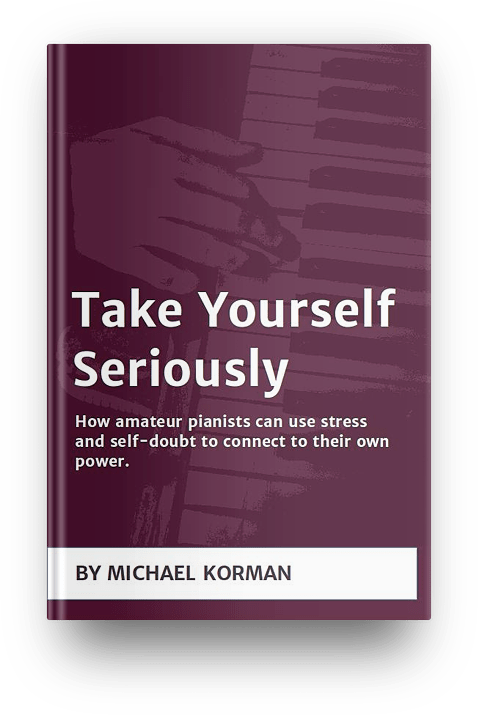
    Get my e-book

    I wrote this ebook because I want to share what I’ve learned about what’s wrong with the way the piano community treats “amateur” pianists. I don’t like it, and I want to change it.

    It is rare to see something written for serious adult amateurs, and by someone who went that route. I had it on as an audiobook while doing chores – the first chapter on various aspects regarding teachers, I was saying “right” and “certainly” out loud a few times. 😀 A lot of the things, I wished I’d heard this when I first started my first ever lessons some time ago; it took me years to at least partly find my way out of holes due to some of those things.

    Inge

    Amateur Pianist

    Let me stop right here, and make something very clear:

    I DON’T CARE ABOUT YOUR MISTAKES!

    You are a human being, and human beings make mistakes. There is nothing wrong with that, and nothing that needs to be fixed. The only conversation I will entertain is how to fix mistakes because fixing mistakes is fun, and playing with mistakes is also fun. Got it?

    If you disagree, try to remember what it was like being a kid, when mistakes were fun.

    Before trying to fix mistakes

    First, ask yourself:  “am I sure that this is a mistake?”

    Sometimes, we assume it’s wrong just because something feels off, or because someone told us it was wrong, or because we’re used to making the mistake in the past.

    Second, ask yourself: “am I sure I can fix this?”

    If you know exactly how to fix it, great. Just do it, and stop reading here. On the other hand, if you think you know how to fix it, but the
    fix doesn’t work, then…you don’t know how to fix it.

    If you don’t know how to fix it,  first try to understand why it’s happening.

    OK, now let’s get to the list:

    1. You don’t understand the music

    If you don’t understand the music itself, you are likely to make mistakes while playing the piano. If I asked you to navigate from one end of a foreign city to the other, without a map, how successful would you be?

    The Solution:

    Make sure you understand the music. That is, analyze the score, and try to understand why it’s written the way it is.

    Do you understand how the piece is put together? Could you talk me through it, like a tour guide?

    How about the purpose of each note, each chord? Can you tell me where phrases begin and end? Are you following where all the melodies lead? Do you know where the beats are?

    2. You don’t understand the movement

    Do you know how to move your body the way the music requires?

    If so, and it’s still not working, you need to look further into what exactly it is about the relationship between your body and the piano that you are not seeing.

    Repeating the wrong thing over and over will not fix it. Only understanding will. (However, repetition is often necessary to let the mind calm down to the point where understanding can present itself.)

    The Solution:

    Pay attention to any physical problems in your playing. If there are any moments where things feel awkward, tight, tense, or painful, you will have a greater chance of making a mistake. Be ruthless about this.

    3. You’re distracted

    Human beings are not robots. The mere fact that we told ourselves to complete a task is no guarantee that we will be directed toward that task without interruption. Distractions can come from the external world, in the form of unfamiliar pianos, noise from the audience, movements that catch our eye, etc. And they can come from the internal world as well, in the form of thoughts about our performance, our self-concept, what we had for dinner last night, how much we like this piece, or how much we are worried about the passage coming up, etc.

    The Solution:

    You need to practice in a way that takes distractions into account. Practice when you are tired or stressed out. Seek out unfamiliar pianos in unfamiliar environments, and practice on them.

    4. You don’t practice long-term

    If I wished to learn Chinese within the next ten years, I would practice very differently than if I had an upcoming trip to China next week. In the former case, I would immerse myself in the language, listening to spoken dialogue and reading texts that I comprehended very little. Eventually, I would understand more, and within 10 years, given enough practice, I would be fluent in Chinese. In the latter case, however, I would not have time for this, and would instead probably concentrate on memorizing specific phrases that I anticipate needing for my trip.

    In music, the same thing happens. Ideally, I want my practicing to be oriented long-term. I want to get things to the point where mistakes simply don’t happen while playing piano because the correct way is completely obvious. In long-term mode, I would not care about a specific performance or a specific mistake.

    However, if I need to learn a piece by next week, my priorities would change. In short-term mode, I would be more interested in fixing specific mistakes, so that a given performance is successful.

    These are two very different ways of practicing. One does not lead to the other. However, it may be worthwhile to develop strategies for each.

    The Solution:

    In terms of long-term practicing, the following will reduce mistakes over time:

    • Sight-reading a lot of music.
    • Listening to a lot of music.
    • Analyzing a lot of music.
    • Paying close attention to your performance habits and working on eliminating the harmful ones, and increasing the helpful ones.
    • Finding an approach to practicing that encourages you to face whatever you are consciously avoiding. 

    Changing your long-term practice strategies is the only way to figure out how to stop making mistakes on the piano.

    5. You don’t practice short-term

    When you have a performance coming up, the objective may not be only to “play well”, but also to “avoid playing badly”. This will require hunting down specific mistakes and taking steps to reduce the chances of their occurrence.

    The Solution:

    Let me stress that I don’t believe piano practice must
    include this mindset. If you are not performing, is it necessary to spend time fixing mistakes that are of little interest, when that time might be better spent on working through a new piece? I have never “corrected” many of the mistakes I made in pieces I played as a beginner, but I guarantee I would not make those same mistakes again.

    That said, if you want to hunt down specific mistakes, try the following strategy:

    1. Play through the piece. Do not stop when you make a mistake.
    2. After you have played the piece, make note of one mistake.
    3. Play again.
    4. If the mistake is still present, great. What we want to do now is zoom in on it.

      We want to capture it so that we can study it more closely. We could:

      • Reduce the size of the section you are playing so that it includes just the mistake.
      • Slow down the tempo to a point where the mistake still occurs but you can understand it better.
    5. The object here is not to eliminate the mistake. It is to find out what we need to do to make the mistake.

    6. If the mistake disappears, try to bring it back. For example, you could:
      • Increase the tempo.
      • Expand the section you are playing.
      • Play for someone else, or record yourself.

    If you aren’t sure if there was a mistake while playing the piano, assume there wasn’t. Always focus on that which you do see.

    6. You think you fixed your mistake

    The truth is, the mistake will never go away. Under the right conditions, it will come back. Your job is not to eliminate it, but rather to understand it so that you know exactly which conditions will cause it, and can adjust accordingly. Many pianists get frustrated when a mistake they had believed to have been eradicated suddenly reappears. If this happens, understand that it only means you don’t fully grasp the situation, not that you did anything “wrong”.

    The Solution:

    Remind yourself that mistakes are part of learning piano. Every mistake is an opportunity to learn more.

    Then, when you play, adopt the attitude that mistakes are part of the experience of playing piano. They are not a sign of a problem. Do not stop.

    When you work on fixing the mistake, do not be so eager to mark it as “done”. Understand that it is likely to return. Stress-test your fixes. If you can play correctly at a slow tempo, play faster. Try to prove to yourself that the mistake is still there, not that it’s gone.

    7. You think you understand the mistake and don’t need to fix it

    You may think you understand the mistake and move on prematurely. You may recall your teacher saying “play that note with your 4th finger”, and assume that because you didn’t use your 4th finger, you “get” why the mistake happened. But, do you understand why you didn’t use the 4th finger? Is your teacher even right about this?

    Stick around and watch the mistake until you see what’s going on. Only then will you have a chance at correcting it  naturally. If you are relying on mental rules to tell you what to do, you don’t get it yet. It’s like reaching out for a glass of water. You don’t need to recall a teacher’s advice to know how far to reach. If it is not automatic, it’s not yet a part of you.

    The Solution:

    Make it a priority to observe mistakes while playing the piano. See how many times you can make the same mistake. If you know how to fix the mistake, but it’s still happening anyway, remind yourself that you don’t know how to fix it, and that this is great! This is why practicing is fun.

    8. You’re spending too much time trying to fix the mistake

    You may wonder: how will mistakes be corrected if I don’t correct them?

    True, if you don’t take the time to identify each of your mistakes and understand its cause, it will never be corrected.

    On the other hand, if you correct your mistakes, you will be
    constantly chasing yourself in circles, and never build a strong foundation upon which to base anything.

    This is a paradox.

    The way to resolve it is to commit to doing one thing at a time, observe the results dispassionately, and adjust your course as needed, based only on results, and not on your level of worry.

    Ludwig van Beethoven

    “To play a wrong note is insignificant; to play without passion is inexcusable.”

    Ferdinand Ries, a student of Beethoven’s, tells a story about how the master prioritized mistakes:

    “When I left out something in a passage, a note or a skip, which in many cases he wished to have specially emphasized, or struck a wrong key, he seldom said anything; yet when I was at fault with regard to the expression, the crescendi or matters of that kind, or in the character of the piece, he would grow angry.  Mistakes of the other kind, he said, were due to chance; but these last resulted from want of knowledge, feeling, or attention.  He himself often made mistakes of the first kind, even when playing in public.”

    The Solution:

    You may try to correct the mistake. Do not try to correct it. Simply observe it. Get to know it in its natural habitat. If it doesn’t disappear, you probably haven’t gotten to know it well enough!

    “Are you saying I should just ignore my mistakes?”

    No, I’m saying you should work on one thing at a time. By all means, notice them. Write them down. But when you practice, work on one thing at a time.

    Some of those mistakes will be fixed simply by noticing them.
    Some, you will not know how to fix anytime soon.

    “If I keep hitting wrong notes on the piano, won’t it become impossible to eliminate them?”

    I will say a few things in response to this:

    • If you don’t know exactly how to fix the mistake, you are already repeating whatever behaviors led to the mistake in the first place. Those behaviors may even be present in everything you play, whether the notes are right or wrong.
    • Do you know why you are making the mistake? Do you know what reward you are getting from it? We don’t do things simply because we have repeated them, but rather because those things have been reinforced. Habits can be learned in a single repetition.
    • As I mentioned above, you will never eliminate it from
      your brain. Your only hope is to build something new.
    • This may be something you have done thousands of times in the past. A few more will not make a difference.
    • Do not worry about this problem. Worry only about understanding the mistake, not about eliminating it.

    9. You don’t want to fix the mistake

    You may not truly attempt to bring the mistake back. It is natural not to want mistakes to occur, and to try to prevent them. This may, however, get in your way. I’m serious when I say you should try to bring the mistakes back. When you increase the tempo, don’t do it by one click. Double the tempo. If you play from memory, don’t stop when you aren’t sure of the next note. Let your hands play and watch what they do.

    The Solution:

    Many pianists will tell me: “What you are saying is obvious. Of course, you shouldn’t fixate on mistakes, but merely take steps to correct them. Why make a big deal out of this?”

    This may seem obvious, but watching the way most musicians practice, you would never know it. We obsess over our mistakes in many subtle ways, and we continue to repeat strategies that have no hope of working.

    As a result, fixing mistakes is simply not fun, and musicians try to avoid noticing mistakes because they don’t want to have to get dragged into trying to fix them.

    Everyone does this. This is why I place so much emphasis on learning how to let go of things. When we are free of these traps, we have much more energy and time left over to pursue what we are actually interested in doing.

    When fixing mistakes is approached from a place of playful curiosity, we have a much better chance of being successful, and of enjoying the process.

    10. Your expectations about mistakes at the piano are too high

    The danger in practicing for short-term performance is that we often tend to fixate on mistakes that we cannot possibly fix within the given time-frame. Thus, it is thus crucial to set realistic expectations. If instead of correcting mistakes, we can often increase our chances of success in other ways.

    These options are often available to you, and often they are not. For example, you may not have control over what piece you are permitted to play, or how well you sleep, or how much time you have to practice. Always, it is better to focus on what you have control over and accept what you don’t.

    The Solution:

    Instead of trying to fix your mistakes, try some of the following options:

    • Play a piece that is easy enough that you are likely to play without mistakes.
    • Simplify the piece to the point where it is easier to play correctly.
    • Learn how to make peace with any mistakes that you make during the performance, and the fact that you are a fallible human being.
    • Reduce factors that are likely to lead to mistakes (get a good night’s sleep, spend time on the piano you will be performing on).
    • Refuse to play altogether.

    11. You’re trying to do something else entirely

    Many pianists assume that if a mistake occurs, it must be
    “corrected” immediately. There are, however, dangers in “correcting mistakes”.

    It’s hard to fix things when you aren’t OK with them first. Work on accepting mistakes. Make friends with them and see them for what they are. Then, when you get to know them, you can decide if you want to keep them around.

    The Solution:

    It is natural not to want mistakes to occur, and to try to prevent them. This may, however, get in your way. I’m serious when I say you should try to bring the mistakes back. For example, when you increase the tempo, don’t do it by one click. Double the tempo. Or, if you play from memory, don’t stop when you aren’t sure of the next note. Instead, let your hands play and watch what they do.

    Don’t change course too quickly. 

    Is playing piano without mistakes even a worthwhile goal?

    That’s for you to decide. Let me ask a few questions:

    • Why play the piano?

    • Why correct mistakes?

    • Why play well?

    • Why not play badly?

    • Can you enjoy playing the piano if you are making mistakes?

    Ask yourself these questions and see what your mind tells you.

    Many beginners wonder if professional pianists make mistakes. Of course, they do…all pianists make mistakes. That’s just part of being human. So, is the goal of completely eliminating mistakes even possible?

    Your turn

    Have you noticed any of these habits in your piano playing? Do they lead to mistakes? Leave a comment below and let me know!

  • How to Practice the Piano

    How to Practice the Piano

    When you practice the piano, do you just sit down and play, hoping that you won’t make any mistakes? This is common but counterproductive.

    I am quite familiar with the experience of being a student in a lesson and feeling like I have no clue how to fix everything, how to please the teacher, or what the heck I’m supposed to be doing right now. Teachers don’t help matters by encouraging the student to focus on whatever the teacher or student is most worried about. So, it is no wonder that students often don’t have a clear idea of what they are supposed to be focusing on while playing the piano, and seem to lack the ability to focus on anything.

    In this article, I will explain why pianists generally don’t practice very well, and I will describe 4 specific things you can focus on while practicing piano.

    Wrong ways to practice

    There are two big mistakes pianists make all the time:

    What NOT to do while practicing piano

    • Chase feelings

    • Chase mistakes

    Chasing feelings

    Sometimes, we try to reproduce a feeling we experienced in the past. For example, if I played well at home and felt confident and in control, I might try to achieve this same feeling in my lesson.

    Chasing mistakes

    When we are practicing, we might have an intention to work on one thing, and then change focus when we notice another mistake that begs for our attention.

    This is also counterproductive.

    Don’t focus on the thing you’re trying to fix

    Surprisingly, it can be a mistake to focus on the thing you are trying to correct. For example:

    • To find a good fingering, don’t focus on the fingering while you play (try not to even write in fingerings).
    • To correct wrong notes, don’t focus on the notes while you play. 
    • To avoid rushing, don’t write “don’t rush!” in the music and trying to heed this advice while you are playing.

    It is only natural to want to try to fix our mistakes. However, it just makes it worse. Instead, focus on something simpler, with an eye toward trying to identify what is causing you to make the mistake, rather than trying to fix it. Trying to fix mistakes themselves often leads to frustration and a feeling of effort and is generally not the most efficient way of fixing problems.

    When you practice the piano, pick one thing to fix your attention on for the duration of the session. This can help you understand better where you are avoiding putting your attention, and why. 

    What TO do while practicing piano

    • Focus your attention on one thing at a time

    So, what should you focus your attention on?

    Focus point #1: The metronome

    Many pianists who are not used to the metronome find it stressful. The only way to deal with this is to get used to it. 

    Practice tips:

    Listen to the clicking of the metronome, and listen to how your playing aligns with it. If you are not with the metronome, listen to that as well. There is no need to fix it. Check out my post on how to use a metronome.

    Focus point #2: Your arms

    It can be very useful to think of piano playing as being about dropping the arms onto the keyboard. Here, you can focus on the feeling of release in the arms with each beat. This makes thinking about technique much simpler than having to worry about the tiny movements of the fingers.

    Practice tips:

    As you play, focus on how your arms drop onto the keyboard with each beat. Even if you make mistakes, make sure that rhythm in your arms is not interrupted. Keep the attention on the dropping. Not on the lifting. Not on the notes.

    Focus point #3: Your body

    Piano playing is a whole-body activity. It’s not just about your arms. So, the more awareness you can gain of your full body, the more awareness you will have of your piano playing.

    Practice tips:

    The breath can be a remarkably reliable indicator of your physical state in general. When we feel anxiety, we tend to hold our breath, or otherwise interrupt it suddenly. If you keep your attention on the breath, it is amazing what you will become aware of.

    Focus point #4: The sound

    Normally, our brains interpret sound coming out of the piano as music. If the music sounds right, we get lost in it, much in the same way as we get lost in the imaginary world of a good novel or film. If the music sounds wrong, it can make us feel physically uncomfortable and anxious. It is good that we can experience both of these possibilities, but they also take our attention away from the task at hand. 

    Practice tips:

    Try focusing on the sound, not on the music. If you play a wrong note, hear it without reacting to it, without trying to correct it. If a chord progression captures you and makes you feel excited, don’t react to it, but rather try to hear it as simply sound, with zero emotional content.

    Creating a piano practice routine

    In a given practice session, you might combine all 4 of these focus points, spending a certain amount of time on each. 

    Here is a sample piano practice routine (1 hour):

    1. 1

      Choose a piece to work on for the entire practice session.

    2. 2

      Play the technically difficult sections, focusing only on the rhythm in the arms (15 minutes).

    3. 3

      Play the entire piece over and over, focusing on the breath and whatever other bodily sensations show up (15 minutes).

    4. 4

      Spend the remaining time listening to the sound as you play, noticing whatever feelings it provokes in you (15 minutes).

    You can also develop similar routines to help you practice scales or other technical exercises.

    Feel free to mix things up as much as you are able to. Studies show that interleaved practice can be quite effective. 

    Your turn

    The most important thing is that you have a clear sense of what you expect as you practice the piano. So, give it a try. Take a few suggestions from this article, build a practice routine for yourself, and let me know how it goes!

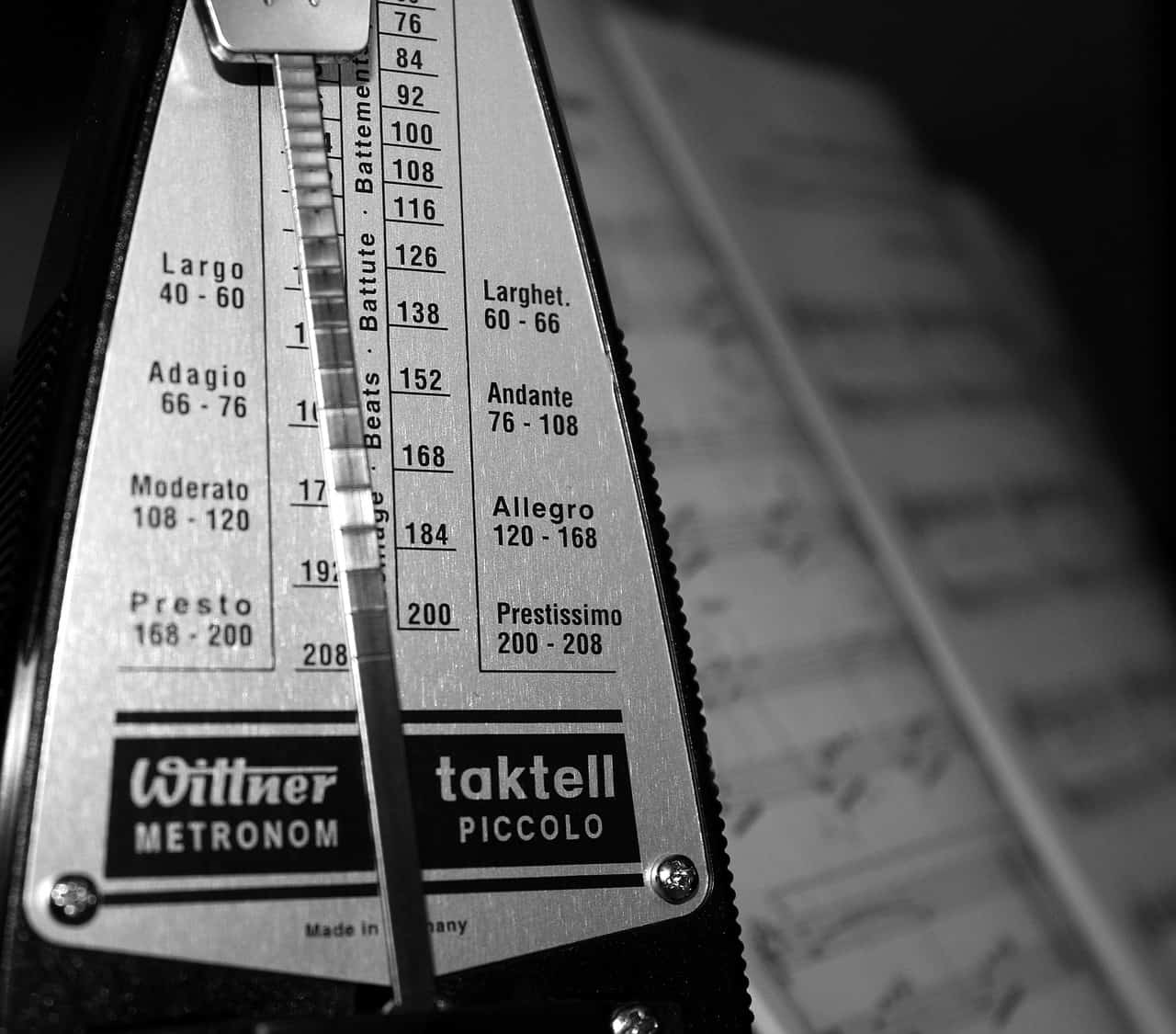
  • How to Use a Metronome

    How to Use a Metronome

    At first, most musicians despise the metronome. That’s normal because this mechanical device makes it impossible to ignore flaws in your playing. At the same time, this is precisely why you should learn how to use a metronome.

    In this article, I will address a few common arguments against practicing with the metronome. Also, I’ll give some practice tips which will help you learn to see how the metronome makes practicing easier and more relaxing, once you get over the initial hurdles. Finally, I will give some advice on how to find the best metronome for piano practice.

    Argument 1: The metronome only has one purpose.

    The metronome has many purposes. It can help you solve a variety of problems, and is useful in a variety of circumstances.

    For example, it can be used to:

    Thus, I am tempted to say that if you don’t use a metronome regularly in your practicing You’re Doing it Wrong, but I’m sure that would be unfair. The purpose of a metronome is to help you keep one foot in the “real world.” So, don’t ignore how much benefit you can get from it!

    Practice tips:

    If you aren’t accustomed to practicing with a metronome, or if you only pull it out once in a while, try practicing with it more frequently. Have it running the whole time, while you practice for 20 minutes (set a timer). Notice what it does for you. What does it make easier? What does it make harder?

    Argument 2: The metronome is only for beginners who can’t keep time.

    No one has a problem “keeping time.”

    The same beginners who struggle mightily to count to the number 4 in a piano lesson have no problems performing complex dance moves with their friends or singing along to their favorite songs on the radio. Additionally, they have no problems walking, talking, playing video games, or any of the other thousands of tasks that call for highly trained and coordinated senses of rhythm and timing.

    The reason they seem to lose all of this in a piano lesson is only that they are distracted. That is, they are trying to do many things at once (play the right notes, read the symbols on the page, please the teacher, prevent themselves from screaming in frustration) and they are caring very much whether they are doing them well. Yes, that messes up your sense of time. So, the purpose of the metronome is to bring you back into the present.

    Finally, it is not only beginners who get distracted. However, maybe you’ve learned to hide it. That is, you’ve learned to play reasonably in tempo, despite your distractions, your anxieties, your fears, and your insecurities. However, are you paying any price for that?

    Practice tips:

    If you find that you have a problem keeping time, experiment with letting go of this. Instead of trying harder to play in tempo, rely on the metronome guide you. Trust it to keep the tempo, and focus your energy on playing comfortably. Let it be your teacher.

    Argument 3: The metronome is too stressful.

    If you think the metronome is stressful, you are probably taking it way too seriously. In reality, the metronome can be a calming, soothing force.

    Practice tips:

    Don’t try to follow the metronome. That is where the stress comes from. Instead, let it click in the background. Sometimes you’re with it, sometimes you’re not. Does it matter? Is it going to yell at you if you deviate from its tempo?

    If you feel rushed by the metronome, can you let it go?

    Argument 4: The metronome leads to mechanical playing.

    On the contrary, I believe that it can be an incredibly useful tool for developing musicality. That’s because the purpose of the metronome is not to learn musicality per se, but rather to learn control and poise. Once you have control, you can express the music however you see fit.

    It is musicians who cannot play with a metronome, and instead base all of their movements on escaping their internal anxieties, who end up playing inflexibly and mechanically.

    Practice tips:

    Use the metronome to help you get to a point where you can play mechanically. Once you are at this point, notice what freedom this gives you in being able to play expressively.

    Don’t rely only on your feelings while practicing to tell you whether this is working. Instead, record yourself. Does your “expressive” playing sound expressive? Does your “mechanical” playing sound mechanical? Use your ears to guide you, not just your thoughts about how you “should” be practicing.

    Argument 5: I don’t have a metronome.

    If you don’t have a metronome, you should get one. Luckily, this isn’t a hard problem to solve. There are many types, at all different price points, including free apps for your phone.

    You don’t need anything fancy, but here are some factors you should consider when shopping around:

    • Price

    • Volume level: Make sure it gets loud enough!

    • Ease of use: It should be easy to change the tempo quickly. I prefer the kind with dials as opposed to up/down arrows. I don’t like digital displays, because it just takes too long to read them. 

    • Portability: If you travel with it, it should be something that you can easily throw into a bag (both in terms of size and durability).

    Best Metronomes for Piano Practice

    Digital

    This is my personal favorite. This is the only metronome loud enough to hear and melodious enough to make me enjoy listening to its click.

    App

    Simple Metronome

    I have been using Simple Metronome on my Android phone for a few years. Many mobile metronome apps are cumbersome to use or have too many ads. I find that Simple Metronome lives up to its name. I still prefer the real thing with a dial, but this is the second best.

    Your turn

    Now that you’ve read these tips, take out your metronome and practice. Don’t be satisfied doing things the same way you’ve always done them. Try a new way of using the metronome!

    And, leave a comment below and let me know how it goes for you. I’d love to hear how this article is helping you with your practicing.

>