STATUS: INACTIVE // READ-ONLY

Blog

  • How to Cure Perfectionism in Your Music Practice

    Musicians who identify as “perfectionists” should understand the following about what perfectionism is and how to cure it.

    Perfectionism is an anxiety disorder. It’s a form of obsessive-compulsive disorder (OCD).

    By “anxiety disorder”, I mean you’re afraid of making mistakes, and furthermore, this fear is making it hard for you to practice.

    Here’s the problem: even if you know you shouldn’t be afraid of making mistakes, it’s still going to get you. That’s because this anxiety disorder is deeply conditioned into your nervous system.

    The mere thought of making a mistake is enough to scare you.

    Logically speaking, “mere thoughts” shouldn’t be scary. After all, they’re only images and sounds, raw sensory experiences.

    But, few of us have been taught to see them that way. Instead, we see them as elaborate stories that are true. Our minds interpret them this way automatically.

    The only cure for an anxiety disorder is exposure therapy. That’s when you deliberately expose yourself to the thing you’re afraid of.

    So, if you want to cure perfectionism in your music practice, you’ve got to expose yourself to the fear of making mistakes, and the thought of making mistakes. All those sensory experiences must become comfortable for you.

    Good luck with that, when the fear of mistakes makes you want to run and hide…

    Now, I’m guessing you’re not literally running and hiding. Instead, you’re doing it subtly, deep inside your body. It manifests itself as an internal tension, barely visible to the naked eye.

    Maybe when you were a kid, you did run and hide. But now, no. You sit there and deal with it. Not happily, but you still deal with it (maybe even reaffirming to yourself and others that you should just suck it up…again, not happily…you can feel it in your body, deep inside…).

    Exposure therapy is necessary to untangle this. But, it’s scary.

    So, how do you get to the point where exposure therapy is possible?

    You must learn to see the thing you’re afraid of as being only sensory experience.

    For example, if you’re afraid to perform in front of a potentially-disapproving audience because you’re afraid of criticism, you can learn to see the fear of criticism as merely images and sounds in your head and sensations in your body. Once you see it this way, it’s much easier to be willing to expose yourself to it.

    We all know it’s hard to deal with rejection. But, when that fear of rejection is seen to be merely a story told by the mind, it becomes much easier to handle.

    Even better, when that story is seen to be merely images and sounds (still frames from a movie), nobody would have a problem dealing with it.

    The good news is that this skill can be learned.

    How? By practicing meditation. Meditation teaches you how to view your experiences as sensory phenomena.
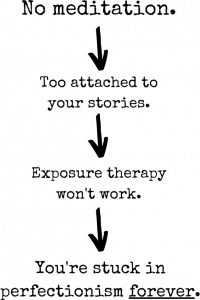
     

    So, this is the point of meditation: it makes it easier to do exposure therapy. If you don’t meditate, you’ll have a hard time seeing your stories as stories (you’ll be too attached to them). Then, you won’t allow yourself to entertain the thought of making mistakes while playing, and you’ll be a rigid perfectionist forever.

    That’s no fun.

  • When deep practice makes you feel like a failure

    I gotta get something off my chest. It’s about deep practice.

    Deep practice is the kind that involves real introspection.

    • Paying close attention to your physical movements.
    • Noticing your thoughts.
    • Being aware of your habits.

    Deep practice is required if you want to change things.

    • Exercises that involve reconditioning basic movement patterns.
    • Adjusting what you eat to have better health.
    • Changing habits that aren’t working as well as you want them to.

    Sounds fantastic, doesn’t it?

    However, deep practice is off-limits to many people, and that’s not fair.

    When you look closely at yourself, you will see problems. Furthermore, since you’re a smart person, you’ll know there’s a problem.

    Yet, you’re powerless to change it. That’s because you recognize that deep practice is hard work.

    But here’s the thing…

    “Hard work” doesn’t come easily to everyone.

    Some people are diligent and conscientious and can change routines merely through an act of willpower (or so they think). Others can’t.

    Yet, the diligent-conscientious people have a monopoly on deep practice.

    They’ve somehow convinced the rest of us that there’s something deeply wrong with us if we can’t maintain deep focus on our deep selves for extended periods of time at will.

    As a result, when we look deeply, we freak out. We’ve been taught that when we notice a deep problem, we’re responsible for fixing it (after all, that’s what a diligent-conscientious person would do).

    So, we avoid practicing deeply.

    This is horribly unfair.

    You should have the right to look deeply at your own habits, even for a moment.

    Even if you never change anything, you should still have the right to look.

    (who knows what you’ll find?)


    —Michael

  • Why your body hurts when you play the piano

    Your body doesn’t hurt because you were taught wrong.

    It hurts because you’re doing it wrong.

    You are the only one who can fix it. There’s no teacher out there who can fix it for you.

    It doesn’t matter what a teacher says to you. At the end of the day, you are the one who has to fix it.

    Teachers are only going to reference their checklists and make sure your body “looks” correct based on their interpretation of the checklist.

    But, it’s easily possible that you could “look right” and still be screwing yourself over. After all, these things happen deep inside your body.

    It’s not intellectual. It’s physical.

    There’s a reason piano teachers spend so much time arguing over which virtuosos have the “correct posture” and which don’t. It’s because there are many ways to do it right.

    Every point in the body is physically connected to every other point. When you move one part, all the others move. You can’t isolate them.

    The only way to prevent injuries and get rid of pain and fatigue is to find a way of playing that works for the body as a whole.

    —Michael

  • Loving and Accepting Yourself – Practical Tips

    “I suck at piano and I know I should give myself more love and acceptance. But, I don’t know how.”

    Usually, these problems can be sorted out by getting clear on what exactly you’re trying to do and why you’re trying to do it. So, let’s unpack this a bit.

    I’m going to define three words: “love”, “acceptance”, and “compassion”:

    • Love is when you encourage something you want more of. Like watering a plant.
    • Acceptance is when you stop fighting something you don’t like.
    • Compassion is when you recognize suffering and wish it were gone.

    You can love (encourage) the parts of you that are responsible for sucking at the piano. For example, suppose you suck at piano because you just started playing last week (because you enjoy picking up new skills every week). You can have fun playing the piano for a week and then love yourself by letting yourself pick up a new skill next week.

    (Why would you love yourself for sucking at piano??? Don’t you want to be good at piano?)

    You can accept the fact that you suck at piano. This doesn’t mean you’re happy about it and it doesn’t mean you can’t try to get better. It just means you stop expecting yourself to be better than you are. And, it’s done concretely: if you accept how much you suck, you won’t hide from it. So, for example, you’ll let yourself perform on the piano, even if you suck.

    Also, you can accept the thought “I will always suck at piano” without accepting the reality of it. Thoughts aren’t reality. They’re just images and sounds.

    You can have compassion for your suffering. Meaning, you wish you suffered less than you do. This is recognition of the suffering. (Most people don’t go that far. They just wish they were better at piano without recognizing the suffering.)

    In conclusion, love, acceptance, and compassion are three different skills and you should practice them independently.

    Whatever you do, make sure it’s practical, not philosophical.

    —Michael

  • #28 – Anti-Perfectionism and Real Life

    #28 – Anti-Perfectionism and Real Life

    Self-Defined Human
    Self-Defined Human
    #28 – Anti-Perfectionism and Real Life
    Loading
    /

    Why it’s easier to perform well in real life than when you’re practicing. Anti-perfectionism. Different types of personalities. Sometimes adrenaline is what makes you do a good job. It’s just conservation of energy.

  • Why it’s easier to push yourself when the stakes are high

    At my last workshop, this question was asked by Rachel, an opera singer:

    “In performance, the stakes are higher. In practice, it’s hard for me to prioritize. There’s like a roadblock in my practicing, but in real life I’d handle it better.”

    It’s normal for real-life performance situations to make us perform better. More is on the line. There’s adrenaline.

    Your performance in real life matters. So, you block out distractions. You let yourself take risks. Because you have to.

    The SELF turns OFF and you become absorbed in the task.

    When you’re practicing, however, it’s a different story…

    There’s no urgency, so you take your time.

    Everything becomes future-focused (because the present doesn’t matter so much), and the SELF turns ON.

    These are not ideal practice conditions.

    Athletes train themselves past the point where they know they will have to perform.

    Training should be difficult so that performance is easy.

    —Michael

>