STATUS: INACTIVE // READ-ONLY

Blog

  • How to Speak Snowflake

    How to Speak Snowflake

    In today’s inflammatory social media environment, it can be difficult to understand the language of snowflakes. Since it’s based entirely on blame and shame, they don’t talk about themselves…only you.

    Nonetheless, like all human language, Snowflake is fundamentally designed to express the needs and feelings of the speaker.

    I thought I’d give a brief guide to some of the essential words and phrases.

    What the snowflake says: “Justice”
    What you should hear: “Revenge”

    What the snowflake says: “You’re gaslighting me.”
    What you should hear: “I have a different interpretation of the events than you do.”

    What the snowflake says: “You have no empathy.”
    What you should hear: “I don’t know how to express myself clearly.”

    What the snowflake says: “You’re being unkind.”
    What you should hear: “It’s your job to make me feel safe and happy.”

    What the snowflake says: “You’re projecting.”
    What you should hear: “I know you are, but what am I?”

    What the snowflake says: “Fairness”
    What you should hear: “Revenge”

    What the snowflake says: “You’re just trying to get attention.”
    What you should hear: “I want to say “shut up”, but I’m too nice.”

    What the snowflake says: “You’re just seeking validation.”
    What you should hear: “I want to say “shut up”, but I’m too nice.”

    What the snowflake says: “You’re arrogant and condescending.”
    What you should hear: “Keep talking. My anger feels good.”

    What the snowflake says: “You’re a narcissist.”
    What you should hear: “I’m envious of you, but I hate myself too much to say so.”

    What the snowflake says: “You’re being rude.”
    What you should hear: “I would lynch you if I could, but for now I’ll just shame you.”

    What the snowflake says: “Learn to read the room.”
    What you should hear: “I hope you die alone and friendless.”

    That should be enough to get you started. If you’ve come across any variations or regional dialects, please let me know.

    I hope this handy translation guide will get you thinking about the correspondence between what you mean and what you say.
  • Why it’s good to be angry

    Why it’s good to be angry

    Come on, I want to see you get angry. I want to see you get obnoxious. We need more obnoxious people. People are too tame.

    Everyone wants to agree all the time. Agreement doesn’t get you anywhere. Especially when you’re upset about something!

    This is the creative force within you. Stop ignoring it. It has to come out. You’re not going to get what you want until it comes out. You’re not going to have the impact on the world that you know you need to have, until it comes out.

    Stop waiting. Just do it. Right now.

    I posted this video back on April 16, 2020. I’m still angry. You should be, too.

    Over the past several months, I’ve posted many angry videos, and I’m happy about all of them. Each and every angry video and post has freed up mental space for other stuff. If you don’t move past the anger, you can easily get stuck there. Forever.

    “Moving past” the anger doesn’t mean repressing it and pretending it doesn’t exist. It means letting it do its thing, with your voice and with your body.

    I’m a big fan of doing this through social media videos. Yeah, I know it’s scary. Our society doesn’t encourage us to be angry.

    Screw that.

    It’s true, some people might not like you for it. But you know that what’s inside you is going to come out, one way or the other.

    The world needs more obnoxious people

    Especially ones who are aware they are being obnoxious.

    It’s OK to be angry. The anger is a sign that there’s something really really important to you here.

    You can be angry without blaming others. Do you know the difference? Deep down inside, how do you view the people who have wronged you?

    It’s OK to play out violent fantasies in your head. You’re doing it anyway, whether I tell you it’s OK or not. Don’t play them out in real life. But in your head, do it. Do it until you have no more hatred toward that person.

    It will happen. The hatred will disappear. You’ll be surprised at what was fueling it in the first place.

    This isn’t about standing up for yourself. Please don’t stand up for yourself.

    It’s about taking a stand for yourself (and everyone else).

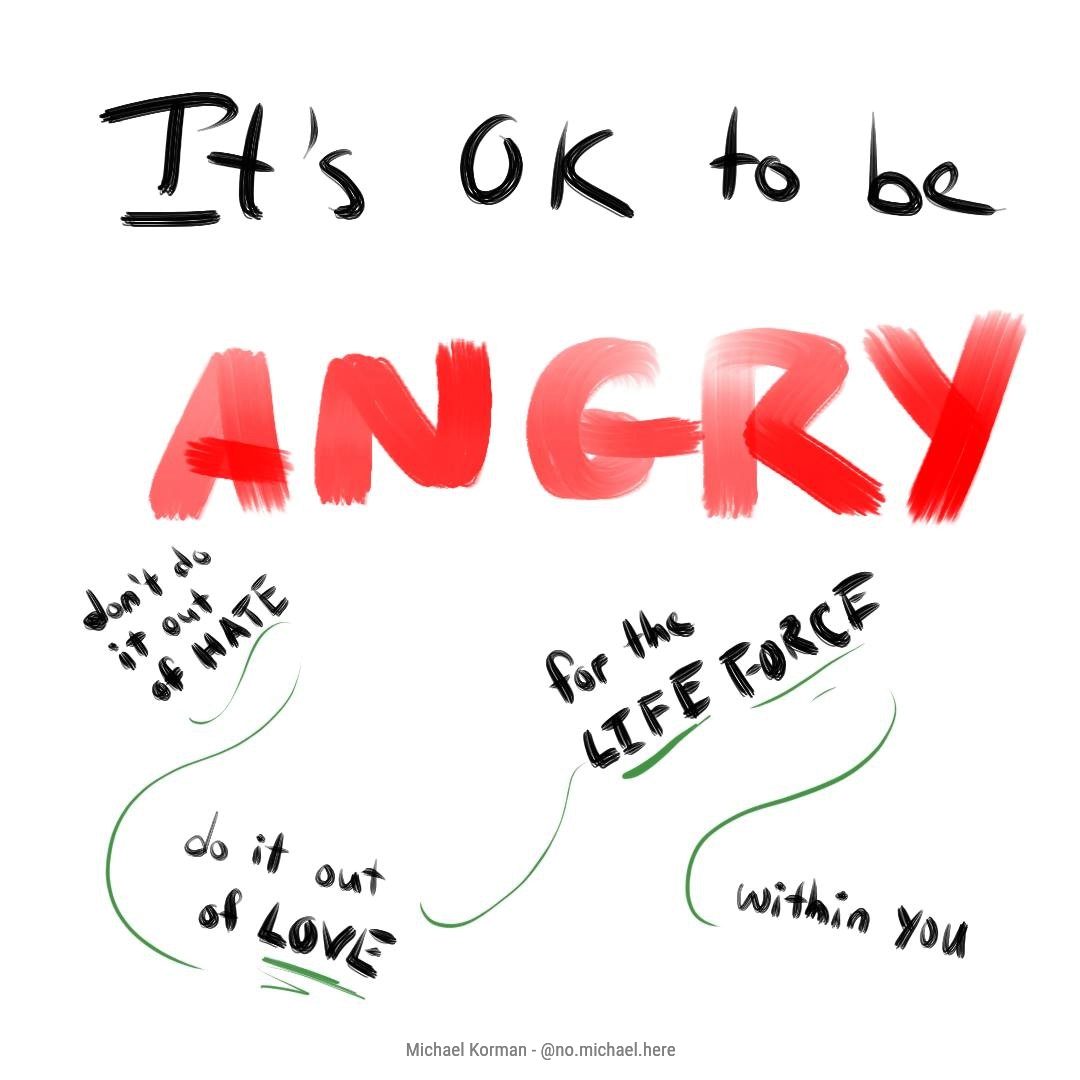
    It's OK to be angry. Don't do it out of HATE. Do it out of LOVE for the LIFE FORCE within you.

    Anger doesn’t mean you’re meditating wrong

    Meditation is about equanimity. Noticing things without reacting to them.

    Does that mean it’s morally wrong to be reactive? Should you try hard not to get angry with people? Is it a sign of progress in meditation when you are less angry?

    No, no, no.

    Some people will tell you those are true. If you’re looking to get rid of your anger and become totally imperturbable, you should go listen to what they have to say. (I guess you should, anyway. Personally, I doubt it will work. But, please try it and let me know what you discover.)

    The type of equanimity I’m interested in is the one where you’re OK with whatever happens. That means being OK with being reactive. Being OK with being angry. Being OK with making little progress in meditation.

    That’s how I practice: whatever comes up, I notice it and let it come and go on its own.

    Often, that’s confusing, especially when I’m really happy to see something bad go away.

    Unfortunately, the things that disappear always come back.

  • 6 Steps to Learning Piano Without a Teacher

    6 Steps to Learning Piano Without a Teacher

    How to improve piano skills without a teacher

    Ask this question in a Facebook group and you’ll be admonished by hordes of piano teachers that it’s impossible to improve at the piano without a teacher.

    What does your own experience tell you? Have you ever, without a teacher:

    • Changed a light bulb?
    • Sent an email?
    • Cooked dinner?
    • Made your bed?

    Of course, the teachers are going to tell you it’s impossible.

    (Follow the money. 💰)

    Ready to ignore the naysayers? Great! Here are the 6 steps you should follow:

    1. Improvise freely

    Give it a beginning and an ending. No correcting mistakes. No hesitating. No stuttering. No matter what. Enjoy whatever happens.

    Sit at the piano and play whatever your hands want to play. Trust them to do the work. It’s fine to judge them, but don’t try to stop them. Get comfortable with that first.

    This is useful if you feel bored by the music you’re working on. Keep experimenting. Remember that it’s called “playing the piano” and not “working the piano.”

    It’s also useful if you’re scared to play without looking at music.

    (This is a better use of your time than mindlessly scrolling social media.)

    2. Sit on the bench, doing absolutely nothing

    Feel what it’s like to physically sit there, not playing, not hearing anything. This is called “meditation.”

    3. Sight-read

    From beginning to end. No stopping. No hesitating. No correcting mistakes. No stuttering. Full tempo.

    Make it fun. If it’s not fun, you won’t do it.

    Tip: Feeling dispirited after seeing little progress after a year of practice? Don’t measure your practice time in years. Measure it in hours. You need more hours.

    4. Play hard music

    With zero expectation of playing it “well”. Go for it. Pretend to be a great virtuoso, even if it’s all wrong.

    When I was in college, I had a roommate who was on the golf team. Every morning, he woke up at 5:00 to run with the team.

    For GOLF!!??

    Well, yeah. Training should be hard, so that performance is easy. Play hard music so easy music feels easy. If you’re always performing at the edge of your ability, you’ll never play well.

    “But, shouldn’t I practice the piece only in small sections until I’m confident enough to put it all together?”

    Practicing the piece in small sections is the standard advice you hear from every piano teacher. Ignore it. Build mental resilience by playing all the way through.

    “I like to challenge myself to play some pieces that are at least slightly above my level, so when I’m able to master it I know I have improved.”

    I don’t care. Play pieces with no intention of mastering them. That’s a different mindset and it will open doors.

    5. Record your playing and post it online

    Not to ask for feedback, but rather to get uncomfortable. This is called “exposure therapy”.

    If you already do this, increase the frequency. Instead of once every 3–4 months, do it once a month. But, I would do it once a day… (and you will too if you’re serious about this.)

    6. Play from memory

    Especially when you don’t feel confident. If you get lost, improvise. Play for your phone, or for an audience.

    If you’re a timid performer, this will get you used to being watched.

    Learn ALL the skills

    Practice these, and also practice their opposites. Master all the skills.

    To build your confidence, make mistakes on purpose to get over your fear of being wrong. If you always avoid mistakes, you’ll never learn how to recover from them, and then you’ll hate performing.

    Go outside your comfort zone. Only look at your left hand while playing. Then, only look at your right hand. Then, look at a point off in the distance. Each one gives you a totally different experience.

    If it’s not fun, you won’t do it and won’t improve. Learn to enjoy frustration. Be an artist and turn your difficult emotions into creations.

    Find your own way of practicing that contradicts everything I’m saying here. Argue with me about it (you’re wrong, anyway).

    Push yourself.

    Tell the gatekeepers and naysayers to get lost.

  • Why you’re intimidated by yoga classes

    You might think it’s because you’re inflexible and out-of-shape. Yeah, that’s not it.

    Yoga classes are intimidating because there’s something off about what’s going on there.

    Look behind the scenes, and you might notice:

    1. The teacher (who only has 200 hours of training) is following a recipe from a book. Also, they have less insight about your body than you do. How much insight do you think the book has about your body?
    2. The other students aren’t even following the instructions. They move like a synchronized dance team, and yet we all know they can’t possibly be breathing together. No, something else is forcing them to move together. (btw, the teacher isn’t inhaling while saying “inhale”. That would sound weird.)
    3. You yourself have been trained to focus on “am I doing it right?” according to external standards. When you’re worried about looking bad, it’s no wonder there’s a fear of failure. (The poses were designed for flexible people, you know.)

    Yet, the ideas behind yoga are simple. They’re the same ideas you find in meditation.

    Last year, I wasn’t a qualified yoga teacher. But, I wanted to say some stuff about yoga.

    I had gone to yoga classes taught by lots of teachers, and none of them seemed to have the level of insight that I had about my body.

    Those yoga teachers with their 200-hour certifications had no qualms about posting yoga stuff.

    Why did I???

    No good reason.

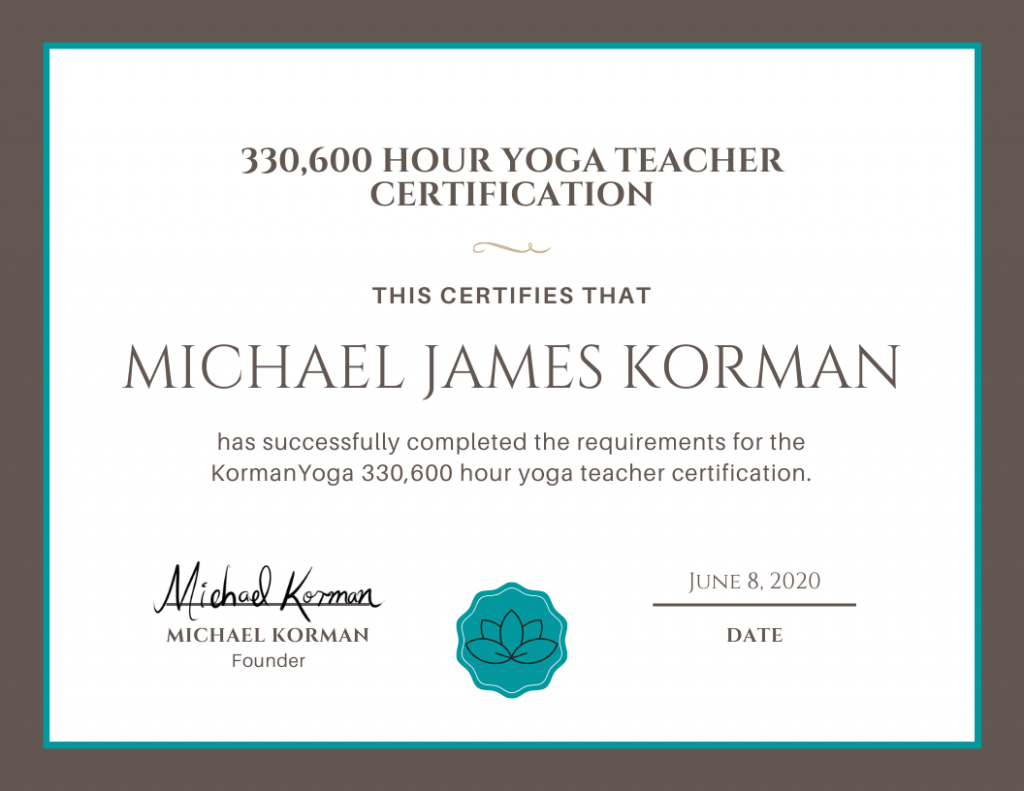
    So, I decided to qualify myself as a yoga teacher. I invented a school of yoga (KormanYoga), and authorized myself as the sole teacher.

    Instead of a paltry 200 hours, I gave myself credit for 330,600 hours (approximately the number of hours I had been alive up to that point).

    330,600 Hour Yoga Teacher Certification. This certifies that Michael James Korman has successfully completed the requirements for the KormanYoga 330,600 hour yoga teacher certification. Signed, Michael Korman, Founder. June 8, 2020.

    After all, it’s my life experience that gives me the insight I have.

  • #29 – When Insight Strikes, with Blake Shields Abramovitz

    #29 – When Insight Strikes, with Blake Shields Abramovitz

    Self-Defined Human
    Self-Defined Human
    #29 – When Insight Strikes, with Blake Shields Abramovitz
    Loading
    /

    Blake Shields Abramovitz is a meditation teacher and an actor, and this is a followup to our conversation from October of 2020, which you can hear in Episode 7: When Meditators Get Cancelled.

    In this episode, we talk about piano playing, awakening, multiple selves, what happens as you go down the path of insight, psychedelics, and acting.

    I hope you enjoy it.

    0:01:50 – Cancel culture at meditation centers, freedom of speech
    0:11:50 – Piano teachers giving Michael a hard time (again), mob mentality
    0:16:25 – Michael’s piano playing ability, what role piano plays in Blake’s life
    0:19:51 – Breaking the rules in piano playing, how Michael developed his way of playing
    0:23:36 – Why singing is hard to learn
    0:29:10 – How singing leads to awakening
    0:35:07 – How to talk about awakening with people who haven’t had experiences like that
    0:38:16 – The wisdom function
    0:41:54 – Michael’s nostalgia for a creative period of time
    0:47:08 – What intentions do piano teachers have?
    0:54:04 – What if you just mess around on the piano? Multiple selves
    0:56:47 – The Karate Kid
    0:58:58 – Technical meditation vs. intellectual meditation
    1:07:11 – Going down the road of insight, getting less attached
    1:10:10 – Moments when things shifted for Blake
    1:13:38 – What’s the deal with psychedelics?
    1:45:48 – Acting
    1:54:47 – Meditation for actors

  • Here’s the thing with writer’s block

    Writer’s block is a huge con.

    You think the idea is: “I’m trying to write something, but I don’t know what to write. There’s a block.”

    Yeah, that’s not it. Writer’s block happens because you’re afraid of something.

    What is it? Could be anything:

    • “I won’t express myself very well.”
    • “I’ll be misunderstood.”
    • “What will (someone specific) think of me?”

    Only you would know.

    But, that’s the thing you’re calling “writer’s block.” That’s what’s getting in the way. It’s a fear of what would happen if you let the skill of writing express itself.

    It’s not a block. It’s fear.

    “No, Michael, it’s not fear. It’s just that I’m not always in the mood to write. Sometimes it’s just not the right time.”

    No, it’s fear.

    You are more than capable of writing even when you’re not in the mood and when it’s not the right time. But, you’re afraid of what will happen if you do.

    If you’re not aware of your fears, if you’re saying “I’m not afraid of anything. I just don’t have any ideas,” that’s the con.

    That mind says, “I just don’t have any ideas. It just seems like there’s a void. A blank spot where it seems like there should be ideas.”

    That’s fear.

    I go through this every day. When I go to write something, I might not have an idea about what to write about.

    “I don’t know” = FEAR

    But, you don’t have to know what you’re going to write about.

    Let me come up with an idea for a post right now. What’s the topic? I don’t know. But, I’m not going to accept that. I’m going to say the topic is going to be:

    “HOW TO WRITE AN INSTAGRAM POST.”

    That’s the topic. I’m going to make a post about how to write an Instagram post.

    Now, there’s fear that comes up. I chose that topic out of the Void. I’m taking the universe and forcing it to collapse itself, forcing it to get clear on what it wants to do.

    For more help with writer’s block, see my workshop Getting Unstuck on Writing.

>