STATUS: INACTIVE // READ-ONLY

Blog

  • If you think there’s no wrong way to meditate, you’re doing it wrong.

    Of course there’s a right way.

    Why would you bother meditating if there weren’t a right way? Why would you need to practice? Why would anyone teach meditation?

    If there were no wrong way, you could pick absolutely any activity you want and call it “meditation”, and you’d be meditating correctly.

    Do that if you want, but you’ve made the word “meditation” useless.

    (Oh, by the way, maybe you’d find it easier to meditate everyday if you knew when you were doing it right or wrong…)

    —Michael

  • quit mousing around

    I had no heat for several days. It was obnoxious and I had to leave my apartment.

    I felt like I was living out of a suitcase. I guess I was.

    What if you literally could live out of a suitcase?

    Imagine eating breakfast in your suitcase. Brushing your teeth in your suitcase. Sleeping in your suitcase.

    If you were a mouse, you could do that.

    It makes me think of The Witches by Roald Dahl (one of my favorite books as a kid).

    If you’re not familiar with it, I won’t spoil it. But, there are humans who get turned into mice (yes, by witches).

    Life as a mouse would be different, that’s for sure.

    Meditation is awesome.

    “Michael, what does meditation have to do with this???”

    Well, if you’re a meditator, you’re capable of imagining what it’s like not to be human.

    “But, I don’t meditate and I can still imagine what it’s like not to be human…”

    That’s what you think.

    “I don’t get it.”

    Not everything has to be gotten. Sometimes it’s enough just to leave it right where it is.

    “So, what are you trying to say?”

    Exactly.

    “This is too frustrating for me.”

    Great! You seem to be getting in touch with something important.


    —Michael

    P.S. That’s why meditation classes have been canceled this week. They will resume shortly.

  • My toe is teaching me about my attention

    I think I might have broken my toe today. Not quite sure, but it hurts.

    I stubbed it on a yoga mat. How is that even possible?

    (I have no idea how that’s possible, but it happened. Don’t worry, I moved the mat so it will be less likely to happen again.)

    Now, I’m worried about walking. It hurts when I walk. I keep imagining the shards of bone digging into the inside of my toe.

    This happened once before. It took a while to heal. I still cringe when I think about it.

    As I’m sitting here typing, I can feel it throbbing and tingling. I can also feel my attention looping up and down from my head down to my toe and back up again.

    It’s a cycle. Up and down.

    This is what happens when you’ve spent many, many hours paying attention to your attention.

    Try it, right now. Close your eyes and ask yourself: “what part of my body am I currently aware of?” Wait for an answer to show up, then ask again. Track the movement of your attention as it moves through space like this.

    By “paying attention to your attention”, I’m talking about meditation, of course. At the end of the day, that’s the point of mindfulness meditation: to understand how the attention works.

    I’m starting to get it, but I’m not there 100% yet. I wish I had learned to meditate a long time ago. Better late than never. The upside is that because I’ve gone so long without getting it, I know where the common stumbling blocks are.

    It’s hard to understand. Most people completely suck at it.

    (Probably because they don’t see the need to practice. But, once you see how your frustrations are because of your attachment to what the attention is doing, the need for practice becomes obvious.)

    If you’re interested in learning how your attention works, come to a KorMeditation Group Class. I’ll guide you through the process of meditating the way I do it.

    You don’t need any experience, but you do need to think that “serious meditation” sounds appealing.

    —Michael

  • Never do for others what they can do for themselves

    I was walking on the sidewalk this morning and I saw an older woman with a cane walking towards me.

    In these COVID times, you can’t fit two people on the sidewalk at once, so one of us had to move into the street.

    I started to move, but she was faster. So, I kept walking along on the sidewalk, and let her walk in the street.

    I felt guilty about this, but then I remembered a rule I heard people who work in nursing homes are supposed to follow: never do for others what they can do for themselves.

    Even though it was harder for her than for me, she had no problem moving off the sidewalk and into the street. Why should I deprive her of that opportunity?

    That would be abusive.

    I’m serious. She would miss out on being able to practice moving quickly and being alert for traffic, just so…what? So that I could feel like I did the right thing? That trade isn’t worth it for me.

    This is how I look at teaching. My job isn’t to fix anything for you. It’s only to give you the tools you need to fix it yourself. (Or, to realize that the problem is unfixable, and stop trying to fix it).

    A teacher should be trying to create experiences for students where the student can’t help but learn.

    No one should have to try to learn.

    The experience itself is the teacher.

    That’s the attitude I put into the self-paced meditation course No Problem. It will give you experiences, and you will learn, like it or not.

    —Michael

    P.S. If she got hit by a car, would I be writing a different email? Not sure. Good thing I don’t need to find out.

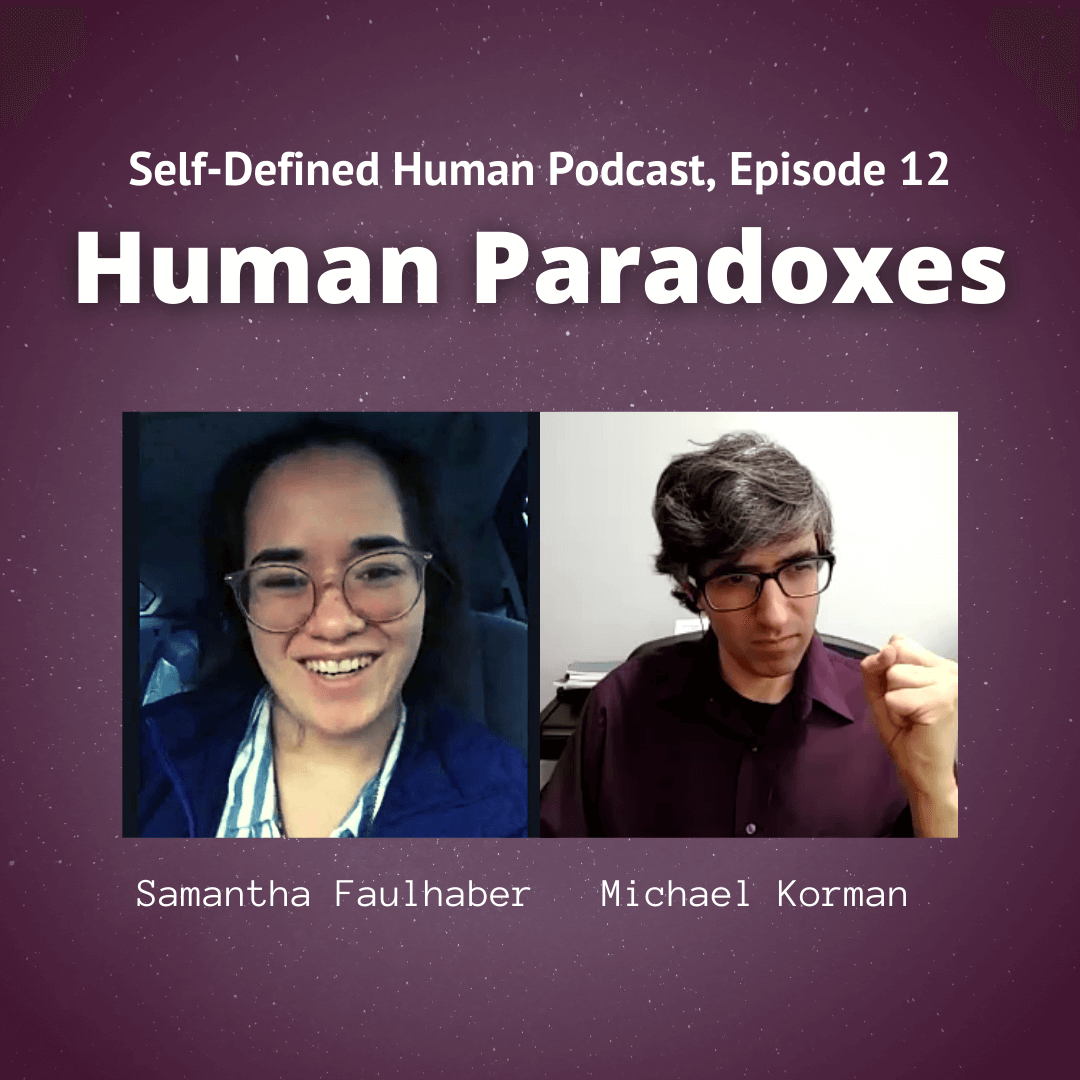
  • #12 – Human Paradoxes, with Samantha Faulhaber

    #12 – Human Paradoxes, with Samantha Faulhaber

    Self-Defined Human
    Self-Defined Human
    #12 – Human Paradoxes, with Samantha Faulhaber
    Loading
    /

    Today, I’m having another conversation with my friend Samantha Faulhaber.

    Sam teaches jiu-jitsu and communication, and she does coaching and all kinds of cool things.

    She was the guest in the last episode, and she requested we have another conversation, because there were some things she wanted to ask me. What could they be? Let’s find out.

    0:01:35 – Why Sam requested this talk.
    0:04:07 – Michael’s accomplishments for 2020, and how he’s changed.
    0:07:12 – Internal and external perspective shifts over the past few years.
    0:10:33 – Seeing oneself from a narrow internal lense vs. an external perspective.
    0:11:51 – Michael’s experience walking out of an opera because everyone hated him.
    0:14:20 – Having choices.
    0:20:20 – Having regrets about the past.
    0:24:07 – How to grow and improve, specifically. Mind-body connections.
    0:26:02 – There’s no such thing as “thinking.”
    0:30:12 – Anchoring everything into the body.
    0:34:50 – Sensation, emotion, thought
    0:38:38 – Holding yourself responsible for who you were in the past, running for political office.
    0:40:07 – Where’s the Michael Korman train going?
    0:41:18 – The power of symbolism.
    0:44:17 – How much should coaches focus on clients’ autonomy?
    0:50:08 – Should you answer the phone when it rings?
    0:53:00 – The grip of time.
    0:54:38 – How useful are scientific explanations?
    0:55:49 – I hope this is useful to somebody.
    1:01:51 – Do people need scientific proof that good things are good?
    1:05:06 – Human beings are paradoxes.
    1:06:28 – How people misunderstand the Four Noble Truths.
    1:08:10 – Where do thoughts come from?
    1:10:00 – Leaning in vs. resisting.
    1:13:16 – Michael’s goals for the podcast, the difficulties of publishing content online.

  • A simple trick to change how you approach drawing

    Here’s a technique you can try, which will help you practice drawing.

    I’m calling this technique Face Your Mistakes.

    Problem

    A big mistake is to try to block out mistakes.

    When you draw, the tendency is to try to make it look good. The problem with this is that it causes your brain to filter out mistakes.

    Then, when you’re done drawing, you take a step back and admire your work.

    The mistakes are still filtered out, so you don’t see them.

    Solution:

    Let yourself see the mistakes.

    You can do this by intentionally critiquing your work. Be like Simon Cowell. Tear it to pieces. Throw the harshest criticism you can possibly dream up at yourself.

    This will hurt.

    It will especially hurt when you can see a problem but you don’t know how to fix it.

    But, the idea here isn’t to fix problems. It’s to learn how to take off the rose-colored glasses that prevent you from seeing them in the first place.

    So, when you sit down to draw, you break it down into two steps:

    1. Draw (fully and completely, without a care in the world)

    2. Critique (fully and completely, without holding back)

    Keep these two steps separate from each other, and you’ll find that it will completely transform how you draw.

    —Michael

    P.S. If you want drawing to be fun, check out Just Draw It.

    P.P.S. I heard from my imaginary friend, Joe, to whom I showed this before sending it. Here’s how our conversation went:

    Joe: Michael, I read your Face Your Mistakes piece. I’m a little confused. How do I draw without critiquing myself?

    Michael: You don’t need to worry about that. You will critique yourself. What’s important is that you have the intention to draw without critiquing. If critiquing happens, let it happen.

    J: But, won’t the critiquing mess it up?

    M: Yes, but you don’t know how to let go of it yet. You need to practice letting go. The way to do that is to continually set an intention to let go, and see what happens. Over time, you’ll learn how to manage it.

    J: Aren’t I just reinforcing bad habits?

    M: Yes, but do you have any better ideas. You’re reinforcing good habits, too. Try this and see what happens. It requires practice, not analysis.

    J: But, I don’t want to practice something that will be the wrong thing to practice.

    M: Is this worse than what you’re doing now? Are you aware of what problem I’m trying to solve with this technique?

    J: I guess I am.

    M: What problem do you think I’m trying to solve?

    J: You’re trying to solve the problem of being too hard on yourself.

    M: No. I’m trying to solve the problem of wasting practice time because I’m filtering out useful information.

    J: OK. I’m not sure I fully get it. I mean, it sounds like it might be interesting.

    M: Try it. Let me know what happens.

    J: OK. I’m also concerned that if I critique myself too harshly, I will get discouraged and quit drawing.

    M: Yeah, that might happen. But that’s because you haven’t exposed yourself to enough self-criticism.

    J: I certainly feel like I have.

    M: What do you normally do when you criticize yourself?

    J: I look at my drawing, and say something negative about it, and get discouraged and stop drawing.

    M: Right, that’s what I mean by not exposing yourself. Exposing yourself would be looking at your drawing, saying something negative, and then keep drawing.

    J: But, I get discouraged. It’s hard to keep drawing.

    M: Yes, it is. You need to practice that. It’s a deliberate skill.

    J: But, this takes all the fun out of drawing.

    M: Have you tried it?

    J: I criticize myself all the time.

    M: No, I mean, have you tried criticizing yourself and then afterwards keep going?

    J: I just told you, it’s hard to keep going.

    M: It sounds to me like you’ve never intentionally tried doing this. It sounds like you criticize yourself and then get discouraged and quit, like you’re just going with the flow.

    J: I guess I don’t really get what you’re saying.

    M: I want you to try it, very deliberately. Draw something, then criticize your work, and then draw another picture immediately afterwards. Do this even if you feel discouraged. Draw 20 pictures this way. Use a checklist to ensure that you do all of them. Do them all in one sitting.

    J: That doesn’t sound like fun.

    M: Then, don’t do it.

    J: So, what should I do?

    M: I don’t know.

    J: That’s not very helpful.

    M: What would you like help with?

    J: I want to draw better.

    M: How can I help you with that?

    J: I’m not sure you can.

    M: Then, why did you comment on the piece I wrote?

    J: Because I thought it was interesting and I wanted to share my thoughts on it.

    M: Did you want a response from me?

    J: If you want to respond, sure.

    M: Were you expecting a response from me?

    J: I don’t know.

    M: Would you have been fine if I hadn’t replied at all?

    J: I guess that would have been kinda rude.

    M: So, are we cool, then?

    J: I guess…

    M: Don’t “I guess” me. Tell me what’s going on.

    J: You’re being mean.

    M: Did you want help with drawing?

    J: Not really.

    M: I’m only interested in helping you with drawing, nothing else. So, if you don’t want help with drawing, this conversation’s over.

    J: What’s wrong with you?

    M: Did you want help with drawing?

    J: No.

    M: OK, then.

    J: I don’t understand.

    M: My job is only to help you with drawing. Your job is everything else.

    J: But that seems rude.

    M: Maybe it is rude. But, I have my own life to live. I trust that you can take responsibility for your life, and let me do my things.

    J: I just don’t understand how we can construct a society when people are so rude to each other.

    M: I don’t know. I’m not a social scientist. Personally, I don’t understand how we can construct a society when I can’t put out helpful information about drawing without being called rude.

    J: Fine. We’ll just talk about drawing.

    M: OK, great. Is there anything I can help you with?

    J: I’m going to try what you suggested and let you know what happens.

    M: Excellent.
>