Maybe you feel like playing is too difficult. What your teacher is asking you to do just doesn’t make sense. You might say “this is too hard!” or “I can’t get it” or “I’m just bad at this”. You may get angry with your teacher, and wonder “why are you making me do this!?”.
You can say something.
You have the right to ask the teacher for an explanation of how working on this piece fits the goals that you have for yourself.
Does it seem like your teacher is forcing you to play a piece you don’t like? Don’t just tolerate it. You have the right to talk to your teacher about your own goals.
I am not saying that you should refuse to play what the teacher assigns. The teacher, as an expert, is supposed to give you assignments that are in your best interest. Maybe that means you won’t like some of those pieces, but the teacher should be able to explain why they are being assigned.
If the teacher asks you to do something too hard, you have the right to ask: “How?”
You don’t have to struggle by yourself. Your teacher should offer a solution to any problem you face. Sometimes that solution might be a way to eliminate the problem entirely, and sometimes it might be a way to help you accept that you can’t eliminate the problem. But, it is your teacher’s responsibility to ask you for things that are right for you. If it’s really too hard, this is not your problem.
If you can’t get it, you have a right to wonder why.
If you are trying really hard to master something, and it’s not working, there is a reason. It may be a simple reason, or it may be a complex reason, but there is a reason. Part of the excitement of music study comes from figuring out these reasons. So explore them!
You have the right to ask the teacher why you aren’t getting the results you are expecting.
You might be frustrated with your playing. You might be frustrated with your hands, which aren’t doing what you tell them to do. You might be frustrated with your brain, which can’t read notes fast enough. Or, you might be frustrated with the piano, which isn’t making the sound you want. You can complain about all of this.
If it seems like you are just bad at this, you have a right to be given a path to improvement.
And that path should not be just “practice harder.” Your teacher should be able to suggest concrete exercises which target the specific issues you have. The path may not be so obvious to you, and there’s no guarantee how long it will take to reach any specific point, but the teacher should be able to chart a course for you.
You have the right to tell the teacher that you don’t feel at ease with the way you are sitting.
Perhaps it hurts to sit at the piano. Maybe you are trying to sit up straight, but it’s just too tiring.
Sitting should be reasonably comfortable. If it isn’t, it might be possible to change the way you are sitting. Don’t assume that you need to just deal with it.
You have the right to let your mind wander to whatever you find most exciting in the moment.
Maybe you are bored. You try focusing on what you are playing, but it’s just not happening. You don’t need to fight this. It’s how your mind works.
If you aren’t practicing enough, but still want to improve, you have a right to be taken seriously.
I assume you know that you can’t expect miraculous results without consistent practice. However, you should still expect some results even with minimal practice. If you practice for 5 minutes, you should get 5 minutes worth of results, which is still more than nothing!
If you want to practice more, but can’t seem to motivate yourself to do so, your teacher should be able to help you to either find a way to incorporate more practice into your life, or help to accept whatever amount of practice you are doing.
If you don’t want to practice more, and your teacher wants you to, you have the right to talk to your teacher about this, or look for a teacher whose goals for you are more in line with your own.
You can challenge yourself, too
This isn’t just your teacher’s problem.
If things hurt, If they are no fun, If you don’t understand, If they aren’t working…
…don’t just deal with it!
You have more power than you realize to get what you want.
Wouldn’t it be great if you never had to worry about making mistakes while playing the piano? Memory slips, wrong notes, and many other hazards constantly plague pianists, but there are solutions to these problems if you are willing to adopt a flexible mindset.
In this article, I will list several reasons why you are having trouble playing the piano without mistakes, and what to do about them.
And, I will show you why sometimes the best thing to do is nothing at all.
Let me stop right here, and make something very clear:
I DON’T CARE ABOUT YOUR MISTAKES!
You are a human being, and human beings make mistakes. There is nothing wrong with that, and nothing that needs to be fixed. The only conversation I will entertain is how to fix mistakes because fixing mistakes is fun, and playing with mistakes is also fun. Got it?
If you disagree, try to remember what it was like being a kid, when mistakes were fun.
Before trying to fix mistakes
First, ask yourself: “am I sure that this is a mistake?”
Sometimes, we assume it’s wrong just because something feels off, or because someone told us it was wrong, or because we’re used to making the mistake in the past.
Second, ask yourself: “am I sure I can fix this?”
If you know exactly how to fix it, great. Just do it, and stop reading here. On the other hand, if you think you know how to fix it, but thefix doesn’t work, then…you don’t knowhow to fix it.
If you don’t know how to fix it, first try to understand why it’s happening.
OK, now let’s get to the list:
1. You don’t understand the music
If you don’t understand the music itself, you are likely to make mistakes while playing the piano. If I asked you to navigate from one end of a foreign city to the other, without a map, how successful would you be?
The Solution:
Make sure you understand the music. That is, analyze the score, and try to understand why it’s written the way it is.
Do you understand how the piece is put together? Could you talk me through it, like a tour guide?
How about the purpose of each note, each chord? Can you tell me where phrases begin and end? Are you following where all the melodies lead? Do you know where the beats are?
2. You don’t understand the movement
Do you know how to move your body the way the music requires?
If so, and it’s still not working, you need to look further into what exactly it is about the relationship between your body and the piano that you are not seeing.
Repeating the wrong thing over and over will not fix it. Only understanding will. (However, repetition is often necessary to let the mind calm down to the point where understanding can present itself.)
The Solution:
Pay attention to any physical problems in your playing. If there are any moments where things feel awkward, tight, tense, or painful, you will have a greater chance of making a mistake. Be ruthless about this.
3. You’re distracted
Human beings are not robots. The mere fact that we told ourselves to complete a task is no guarantee that we will be directed toward that task without interruption. Distractions can come from the external world, in the form of unfamiliar pianos, noise from the audience, movements that catch our eye, etc. And they can come from the internal world as well, in the form of thoughts about our performance, our self-concept, what we had for dinner last night, how much we like this piece, or how much we are worried about the passage coming up, etc.
The Solution:
You need to practice in a way that takes distractions into account. Practice when you are tired or stressed out. Seek out unfamiliar pianos in unfamiliar environments, and practice on them.
4. You don’t practice long-term
If I wished to learn Chinese within the next ten years, I would practice very differently than if I had an upcoming trip to China next week. In the former case, I would immerse myself in the language, listening to spoken dialogue and reading texts that I comprehended very little. Eventually, I would understand more, and within 10 years, given enough practice, I would be fluent in Chinese. In the latter case, however, I would not have time for this, and would instead probably concentrate on memorizing specific phrases that I anticipate needing for my trip.
In music, the same thing happens. Ideally, I want my practicing to be oriented long-term. I want to get things to the point where mistakes simply don’t happen while playing piano because the correct way is completely obvious. In long-term mode, I would not care about a specific performance or a specific mistake.
However, if I need to learn a piece by next week, my priorities would change. In short-term mode, I would be more interested in fixing specific mistakes, so that a given performance is successful.
These are two very different ways of practicing. One does not lead to the other. However, it may be worthwhile to develop strategies for each.
The Solution:
In terms of long-term practicing, the following will reduce mistakes over time:
Sight-reading a lot of music.
Listening to a lot of music.
Analyzing a lot of music.
Paying close attention to your performance habits and working on eliminating the harmful ones, and increasing the helpful ones.
Finding an approach to practicing that encourages you to face whatever you are consciously avoiding.
Changing your long-term practice strategies is the only way to figure out how to stop making mistakes on the piano.
5. You don’t practice short-term
When you have a performance coming up, the objective may not be only to “play well”, but also to “avoid playing badly”. This will require hunting down specific mistakes and taking steps to reduce the chances of their occurrence.
The Solution:
Let me stress that I don’t believe piano practice must include this mindset. If you are not performing, is it necessary to spend time fixing mistakes that are of little interest, when that time might be better spent on working through a new piece? I have never “corrected” many of the mistakes I made in pieces I played as a beginner, but I guarantee I would not make those same mistakes again.
That said, if you want to hunt down specific mistakes, try the following strategy:
Play through the piece. Do not stop when you make a mistake.
After you have played the piece, make note of one mistake.
Play again.
If the mistake is still present, great. What we want to do now is zoom in on it.We want to capture it so that we can study it more closely. We could:
Reduce the size of the section you are playing so that it includes just the mistake.
Slow down the tempo to a point where the mistake still occurs but you can understand it better.
The object here is not to eliminate the mistake. It is to find out what we need to do to make the mistake.
If the mistake disappears, try to bring it back. For example, you could:
Increase the tempo.
Expand the section you are playing.
Play for someone else, or record yourself.
If you aren’t sure if there was a mistake while playing the piano, assume there wasn’t. Always focus on that which you do see.
6. You think you fixed your mistake
The truth is, the mistake will never go away. Under the right conditions, it will come back. Your job is not to eliminate it, but rather to understand it so that you know exactly which conditions will cause it, and can adjust accordingly. Many pianists get frustrated when a mistake they had believed to have been eradicated suddenly reappears. If this happens, understand that it only means you don’t fully grasp the situation, not that you did anything “wrong”.
Then, when you play, adopt the attitude that mistakes are part of the experience of playing piano. They are not a sign of a problem. Do not stop.
When you work on fixing the mistake, do not be so eager to mark it as “done”. Understand that it is likely to return. Stress-test your fixes. If you can play correctly at a slow tempo, play faster. Try to prove to yourself that the mistake is still there, not that it’s gone.
7. You think you understand the mistake and don’t need to fix it
If you don’t understand the music itself, you are likely to make mistakes while playing the piano. If I asked you to navigate from one end of a foreign city to the other, without a map, how successful would you be?
The Solution:
You may think you understand the mistake and move on prematurely. You may recall your teacher saying “play that note with your 4th finger”, and assume that because you didn’t use your 4th finger, you “get” why the mistake happened. But, do you understand why you didn’t use the 4th finger? Is your teacher even right about this?
Stick around and watch the mistake until you see what’s going on. Only then will you have a chance at correcting it naturally. If you are relying on mental rules to tell you what to do, you don’t get it yet. It’s like reaching out for a glass of water. You don’t need to recall a teacher’s advice to know how far to reach. If it is not automatic, it’s not yet a part of you.
8. You’re spending too much time trying to fix the mistake
You may wonder: how will mistakes be corrected if I don’t correct them?
True, if you don’t take the time to identify each of your mistakes and understand its cause, it will never be corrected.
On the other hand, if you correct your mistakes, you will be constantly chasing yourself in circles, and never build a strong foundation upon which to base anything.
This is a paradox.
The way to resolve it is to commit to doing one thing at a time, observe the results dispassionately, and adjust your course as needed, based only on results, and not on your level of worry.
“To play a wrong note is insignificant; to play without passion is inexcusable.”
Ludwig van Beethoven
Ferdinand Ries, a student of Beethoven’s, tells a story about how the master prioritized mistakes:
“When I left out something in a passage, a note or a skip, which in many cases he wished to have specially emphasized, or struck a wrong key, he seldom said anything; yet when I was at fault with regard to the expression, the crescendi or matters of that kind, or in the character of the piece, he would grow angry. Mistakes of the other kind, he said, were due to chance; but these last resulted from want of knowledge, feeling, or attention. He himself often made mistakes of the first kind, even when playing in public.”
The Solution:
You may try to correct the mistake. Do not try to correct it. Simply observe it. Get to know it in its natural habitat. If it doesn’t disappear, you probably haven’t gotten to know it well enough!
“Are you saying I should just ignore my mistakes?”
No, I’m saying you should work on one thing at a time. By all means, notice them. Write them down. But when you practice, work on one thing at a time.
Some of those mistakes will be fixed simply by noticing them. Some, you will not know how to fix anytime soon.
“If I keep hitting wrong notes on the piano, won’t it become impossible to eliminate them?”
I will say a few things in response to this:
Do not worry about this problem. Worry only about understanding the mistake, not about eliminating it.
If you don’t know exactly how to fix the mistake, you are already repeating whatever behaviors led to the mistake in the first place. Those behaviors may even be present in everything you play, whether the notes are right or wrong.
Do you know why you are making the mistake? Do you know what reward you are getting from it? We don’t do things simply because we have repeated them, but rather because those things have been reinforced. Habits can be learned in a single repetition.
As I mentioned above, you will never eliminate it from your brain. Your only hope is to build something new.
This may be something you have done thousands of times in the past. A few more will not make a difference.
Do not worry about this problem. Worry only about understanding the mistake, not about eliminating it.
9. You don’t want to fix the mistake
You may not truly attempt to bring the mistake back. It is natural not to want mistakes to occur, and to try to prevent them. This may, however, get in your way. I’m serious when I say you should try to bring the mistakes back. When you increase the tempo, don’t do it by one click. Double the tempo. If you play from memory, don’t stop when you aren’t sure of the next note. Let your hands play and watch what they do.
The Solution:
Many pianists will tell me: “What you are saying is obvious. Of course, you shouldn’t fixate on mistakes, but merely take steps to correct them. Why make a big deal out of this?”
This may seem obvious, but watching the way most musicians practice, you would never know it. We obsess over our mistakes in many subtle ways, and we continue to repeat strategies that have no hope of working.
As a result, fixing mistakes is simply not fun, and musicians try to avoid noticing mistakes because they don’t want to have to get dragged into trying to fix them.
Everyone does this. This is why I place so much emphasis on learning how to let go of things. When we are free of these traps, we have much more energy and time left over to pursue what we are actually interested in doing.
When fixing mistakes is approached from a place of playful curiosity, we have a much better chance of being successful, and of enjoying the process.
10. Your expectations about mistakes at the piano are too high
The danger in practicing for short-term performance is that we often tend to fixate on mistakes that we cannot possibly fix within the given time-frame. Thus, it is thus crucial to set realistic expectations. If instead of correcting mistakes, we can often increase our chances of success in other ways.
These options are often available to you, and often they are not. For example, you may not have control over what piece you are permitted to play, or how well you sleep, or how much time you have to practice. Always, it is better to focus on what you have control over and accept what you don’t.
The Solution:
Instead of trying to fix your mistakes, try some of the following options:
Play a piece that is easy enough that you are likely to play without mistakes.
Simplify the piece to the point where it is easier to play correctly.
Learn how to make peace with any mistakes that you make during the performance, and the fact that you are a fallible human being.
Reduce factors that are likely to lead to mistakes (get a good night’s sleep, spend time on the piano you will be performing on).
Refuse to play altogether.
11. You’re trying to do something else entirely
Many pianists assume that if a mistake occurs, it must be “corrected” immediately. There are, however, dangers in “correcting mistakes”.
It’s hard to fix things when you aren’t OK with them first. Work on accepting mistakes. Make friends with them and see them for what they are. Then, when you get to know them, you can decide if you want to keep them around.
The Solution:
It is natural not to want mistakes to occur, and to try to prevent them. This may, however, get in your way. I’m serious when I say you should try to bring the mistakes back. For example, when you increase the tempo, don’t do it by one click. Double the tempo. Or, if you play from memory, don’t stop when you aren’t sure of the next note. Instead, let your hands play and watch what they do.
Don’t change course too quickly.
Is playing piano without mistakes even a worthwhile goal?
That’s for you to decide. Let me ask a few questions:
Why play the piano?
Why correct mistakes?
Why play well?
Why not play badly?
Can you enjoy playing the piano if you are making mistakes?
Ask yourself these questions and see what your mind tells you.
Many beginners wonder if professional pianists make mistakes. Of course, they do…all pianists make mistakes. That’s just part of being human. So, is the goal of completely eliminating mistakes even possible?
When you practice the piano, do you just sit down and play, hoping that you won’t make any mistakes? This is common but counterproductive.
I am quite familiar with the experience of being a student in a lesson and feeling like I have no clue how to fix everything, how to please the teacher, or what the heck I’m supposed to be doing right now. Teachers don’t help matters by encouraging the student to focus on whatever the teacher or student is most worried about. So, it is no wonder that students often don’t have a clear idea of what they are supposed to be focusing on while playing the piano, and seem to lack the ability to focus on anything.
In this article, I will explain why pianists generally don’t practice very well, and I will describe 4 specific things you can focus on while practicing piano.
Wrong ways to practice
There are two big mistakes pianists make all the time:
What NOT to do while practicing piano
Chase feelings
Chase mistakes
Chasing feelings
Sometimes, we try to reproduce a feeling we experienced in the past. For example, if I played well at home and felt confident and in control, I might try to achieve this same feeling in my lesson.
Chasing mistakes
When we are practicing, we might have an intention to work on one thing, and then change focus when we notice another mistake that begs for our attention.
This is also counterproductive.
Don’t focus on the thing you’re trying to fix
Surprisingly, it can be a mistake to focus on the thing you are trying to correct. For example:
To find a good fingering, don’t focus on the fingering while you play (try not to even write in fingerings).
To correct wrong notes, don’t focus on the notes while you play.
To avoid rushing, don’t write “don’t rush!” in the music and trying to heed this advice while you are playing.
It is only natural to want to try to fix our mistakes. However, it just makes it worse. Instead, focus on something simpler, with an eye toward trying to identify what is causing you to make the mistake, rather than trying to fix it. Trying to fix mistakes themselves often leads to frustration and a feeling of effort and is generally not the most efficient way of fixing problems.
When you practice the piano, pick one thing to fix your attention on for the duration of the session. This can help you understand better where you are avoiding putting your attention, and why.
What TO do while practicing piano
Focus your attention on one thing at a time
So, what should you focus your attention on?
Focus point #1: The metronome
Many pianists who are not used to the metronome find it stressful. The only way to deal with this is to get used to it.
Practice tips:
Listen to the clicking of the metronome, and listen to how your playing aligns with it. If you are not with the metronome, listen to that as well. There is no need to fix it. Check out my post on how to use a metronome.
Focus point #2: Your arms
It can be very useful to think of piano playing as being about dropping the arms onto the keyboard. Here, you can focus on the feeling of release in the arms with each beat. This makes thinking about technique much simpler than having to worry about the tiny movements of the fingers.
Practice tips:
As you play, focus on how your arms drop onto the keyboard with each beat. Even if you make mistakes, make sure that rhythm in your arms is not interrupted. Keep the attention on the dropping. Not on the lifting. Not on the notes.
Focus point #3: Your body
Piano playing is a whole-body activity. It’s not just about your arms. So, the more awareness you can gain of your full body, the more awareness you will have of your piano playing.
Practice tips:
The breath can be a remarkably reliable indicator of your physical state in general. When we feel anxiety, we tend to hold our breath, or otherwise interrupt it suddenly. If you keep your attention on the breath, it is amazing what you will become aware of.
Focus point #4: The sound
Normally, our brains interpret sound coming out of the piano as music. If the music sounds right, we get lost in it, much in the same way as we get lost in the imaginary world of a good novel or film. If the music sounds wrong, it can make us feel physically uncomfortable and anxious. It is good that we can experience both of these possibilities, but they also take our attention away from the task at hand.
Practice tips:
Try focusing on the sound, not on the music. If you play a wrong note, hear it without reacting to it, without trying to correct it. If a chord progression captures you and makes you feel excited, don’t react to it, but rather try to hear it as simply sound, with zero emotional content.
Creating a piano practice routine
In a given practice session, you might combine all 4 of these focus points, spending a certain amount of time on each.
Here is a sample piano practice routine (1 hour):
1
Choose a piece to work on for the entire practice session.
2
Play the technically difficult sections, focusing only on the rhythm in the arms (15 minutes).
3
Play the entire piece over and over, focusing on the breath and whatever other bodily sensations show up (15 minutes).
4
Spend the remaining time listening to the sound as you play, noticing whatever feelings it provokes in you (15 minutes).
You can also develop similar routines to help you practice scales or other technical exercises.
Feel free to mix things up as much as you are able to. Studies show that interleaved practice can be quite effective.
Your turn
The most important thing is that you have a clear sense of what you expect as you practice the piano. So, give it a try. Take a few suggestions from this article, build a practice routine for yourself, and let me know how it goes!
When you first start learning a musical instrument, you are full of excitement and optimism. Your life will be so wonderful when you can finally play, you just know it.
At some point, however, this optimism will disappear. I can guarantee it.
You will tell yourself “I know I should be practicing, but there are so many other things that need to get done.” You may feel guilty, and embarrassed to tell your teacher about this. Perhaps it reminds you of being in school and not being quite prepared enough for a test, or not spending enough time on your homework.
I have never had a student who didn’t reach this point, and I have been there myself many times. You should be expect it from the beginning. It is part of the learning process.
You might feel like taking a break. You will just wait until things calm down a bit and then get back into it, when you will really be able to give it your all.
This is a trap. Do not do this.
Instead, view this as an opportunity to try something new. You are discouraged and bored. Is it possible that the “old way” is what has gotten you there?
If practicing is not exciting, please consider the possibility that something in your practice routine could be adjusted. Maybe trying harder to do what you know you are “supposed” to be doing isn’t all that it’s cracked up to be. Could you maybe find a new way?
If I am your teacher, my job is to help you figure this out. Tell me that you are not excited about this, that you feel like you are in a rut.
When you start learning a skill like piano, it’s normal to wonder, “how long is this going to take me?” You’re impatient because it seems like it will take forever to learn piano. I want you to feel optimistic.
In this article, I am going to put forth a few ideas that will help you answer this question for yourself. So, here are 6 questions you should ask yourself when you’re wondering how long this will take:
Question 1:
What does progress mean to me?
How high are your standards for your piano playing?
Of course, the higher they are, the harder it’s going to be to reach them. So, ask yourself: why did I set them so high, anyway? Where did I learn to do that?
How high are your standards for yourself?
The more talented you are, the more you will realize how short you are falling of your standards, and the harder it’s going to be…
Why it’s important:
Only when you have a clear definition of “progress” will you be able to evaluate your progress realistically.
Question 2:
How much patience do I have?
I wish there were a quick way to get good at piano, but I haven’t found a shortcut. Instead, what I have found are:
Slow ways that work.
Ways that will waste your time and make you so frustrated you will eventually quit.
So, at best, it’s slow-going. This stuff is just really hard. Why do you think most people can’t do it? But you can do it, you know. It will just be slow. Like a lazy river.
Why it’s important:
Learning piano will take time. Learning to enjoy the slow pace will make things easier.
Question 3:
Do I feel guilty about wanting progress now?
A beginning adult student said to me:
“I think the biggest lesson for me is that this is going to take a long time. I like instant gratification, and the ego likes that too, right? But with continued effort, eventually, there will be music.”
Yes, it might take a long time to learn piano, a long time before you sound good, and a long time before you are happy with your playing.
Now, our culture teaches us that there’s something wrong with wanting instant gratification.
Is it possible there is one part of you who seeks instant gratification, and another who labels it as bad? Which part is the ego, and which part is the one who lives only in the moment, experiencing without evaluating?
Actually, I wonder if there is no gratification other than instant (it’s not like oatmeal). What is delayed gratification, apart from a story you are telling yourself about the future, about yourself and the meaning of your actions?
When you were a child, did you have any problems seeking instant gratification? When did you learn it was a problem? Who told you this? Do you believe it 100%, or is there any part of you to whom it’s news, who maybe even feels hurt by it?
If you’re not being gratified, why not? Really, pay attention to this. Is there anything there, in that space between when you try to play (and fail) and when you get frustrated with the whole thing? You’re allowed to be frustrated, you know. You’re allowed to want this to be fun.
Why it’s important:
Learning piano requires you to accept your feelings in the moment. Even if you’re feeling impatient.
Question 4:
Do I know how to make piano practice fun?
It may take a long time to learn to play the piano well. In the meantime, can you make it fun? For example, can you find some pleasure in the physical movement, regardless of the sound? Or, can you find any satisfaction even in the ugly sounds, knowing that they are the result of your body’s own freedom? Even if you don’t play a note, can you find something right there, in that place where you know that you have the power to move as you see fit, or not, depending on your whim?
If none of that works, can you just stand up and scream? Would that be fun?
What would it look like if you didn’t label it? If you played an exercise, messed it up, got frustrated, and just kept going? Is it even the playing that frustrates you? Maybe it’s just when you’re in the shower thinking about playing? It’s so easy to label the whole thing. But frustration happens at a specific moment in time. What is triggering it?
Can you just make it fun? Just take it. It’s yours, believe it or not.
Does your hand hurt? Then stop doing whatever you’re doing that makes it hurt.
There are two common objections I hear to this kind of thinking:
“But then I won’t play it right.”
Yeah, you won’t. But your hand won’t hurt anymore either. You decide.
“But if I don’t work hard and make sure it’s right, I’ll never get better.”
Why do you want to get better, anyway? You’ve already said you want instant gratification, and if working hard is preventing you from getting your gratification, how much do you really want to work hard and get it right, anyway? If you don’t really care about that, why are you telling yourself you do?
Why it’s important:
If you practicing is fun, you will want to practice. If it’s not, you won’t. So, you should focus on making practicing fun.
Question 5:
Am I practicing well?
Let’s suppose you are my piano student. If you ask me, “am I progressing fast enough?”, I would answer:
“I can assure you that you are progressing exactly as you should be given the amount of practice done between lessons, the level of willingness during lessons, and the degree to which practice reflects the exercises that are done during lessons.”
As a teacher, my responsibility is to my student. Unfortunately, this is difficult when money is involved, because I want paying clients. However, as much as I might wish I could, I cannot magically cause you anyone to improve at piano. I have no minimum expectations as far as “progress” goes. My job is to make the student aware of cause and effect, and I trust that they will make the best use of this awareness that they know how to.
If you are teaching yourself, the same holds true. That is, the rule of cause and effect still applies. Except now, you have to be your own teacher.
The amount of time is takes to get good at piano will be reduced if:
How you practice just as important as how much you practice (if not more important).
Question 6:
Am I appreciating the journey?
It takes a long time to learn a musical instrument such as piano, time which is measured in years, not weeks. So, if you judge the success of your practicing based only on the amount of progress you make, there will always be a feeling of failure.
The process of piano practice itself must be enjoyed and appreciated for what it is. Even with no visible progress in the way of piano playing (the worst-case scenario), studying the piano will still teach you:
Appreciation of music
How to handle distractions
How to express music using the skills you do have
How to stay out of your own way
How to understand why you practice or why don’t practice
What frustrates you about playing
What you enjoy about playing
What I have found personally is that sometimes these lessons need to be learned before noticeable “progress” occurs.
But, don’t discount them. These are valuable lessons! So, try to enjoy learning them.
Why it’s important:
Piano can teach you a lot. The more you pay attention to how many different things you are learning, the more progress you will feel you are making.
So, how long does it take to learn piano?
If you’re still asking this question, I can’t blame you, because I didn’t answer it.
The fact is, there’s no answer to the question of how long it will take to get good at piano. It’s entirely subjective, and every pianist comes from a different place. It’s a bit like asking “how long does it take to clean a house?” That would depend on how clean you want it, how much dirt there is, how fast you are at cleaning, what kind of cleaning supplies you have, etc.
Your turn
Spend some time with these questions. Choose one everyday, and ask it before you practice. As you are practicing, just notice what shows up.
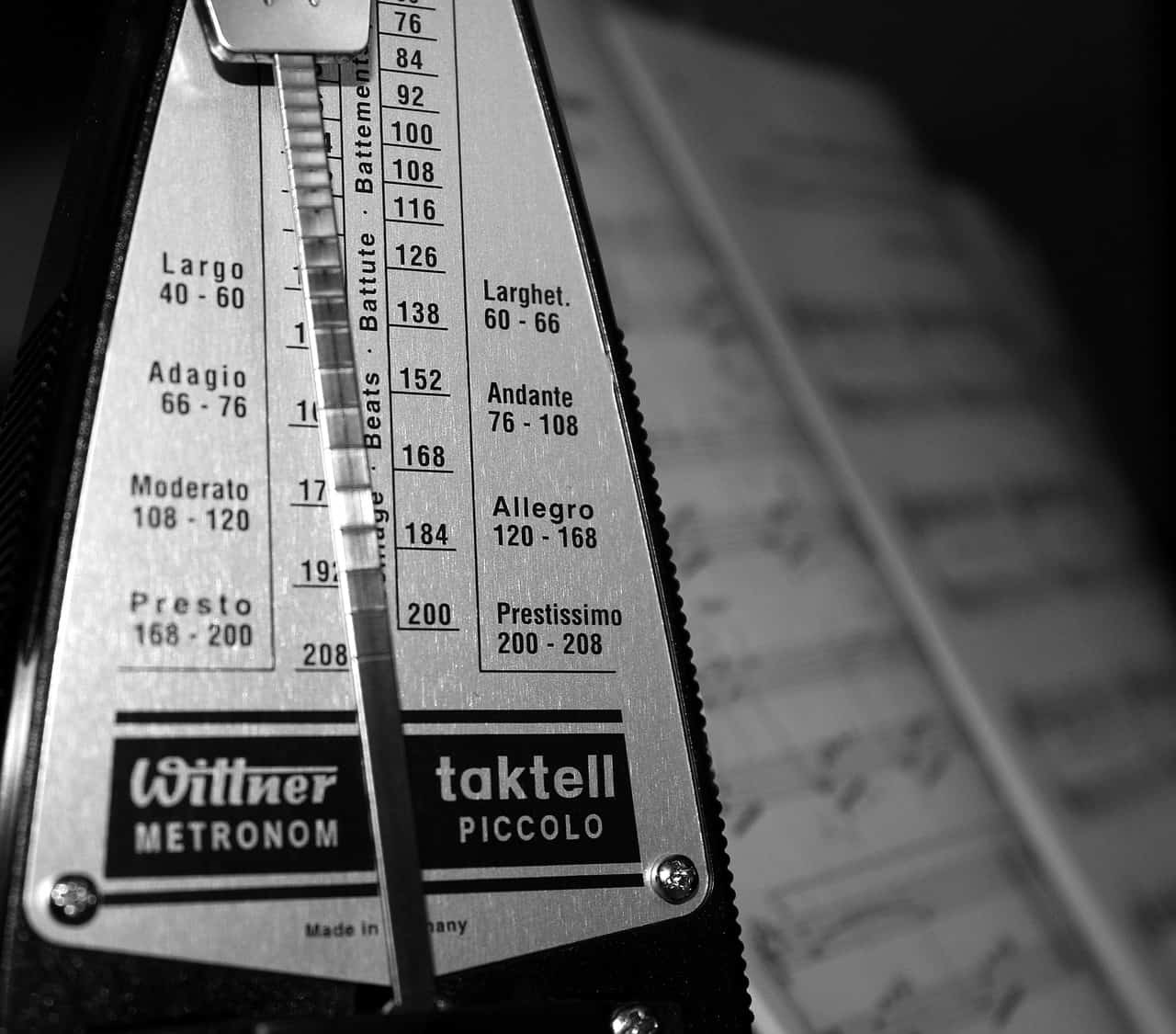
At first, most musicians despise the metronome. That’s normal because this mechanical device makes it impossible to ignore flaws in your playing. At the same time, this is precisely why you should learn how to use a metronome.
In this article, I will address a few common arguments against practicing with the metronome. Also, I’ll give some practice tips which will help you learn to see how the metronome makes practicing easier and more relaxing, once you get over the initial hurdles. Finally, I will give some advice on how to find the best metronome for piano practice.
Argument 1: The metronome only has one purpose.
The metronome has many purposes. It can help you solve a variety of problems, and is useful in a variety of circumstances.
Thus, I am tempted to say that if you don’t use a metronome regularly in your practicing You’re Doing it Wrong, but I’m sure that would be unfair. The purpose of a metronome is to help you keep one foot in the “real world.” So, don’t ignore how much benefit you can get from it!
Practice tips:
If you aren’t accustomed to practicing with a metronome, or if you only pull it out once in a while, try practicing with it more frequently. Have it running the whole time, while you practice for 20 minutes (set a timer). Notice what it does for you. What does it make easier? What does it make harder?
Argument 2: The metronome is only for beginners who can’t keep time.
No one has a problem “keeping time.”
The same beginners who struggle mightily to count to the number 4 in a piano lesson have no problems performing complex dance moves with their friends or singing along to their favorite songs on the radio. Additionally, they have no problems walking, talking, playing video games, or any of the other thousands of tasks that call for highly trained and coordinated senses of rhythm and timing.
The reason they seem to lose all of this in a piano lesson is only that they are distracted. That is, they are trying to do many things at once (play the right notes, read the symbols on the page, please the teacher, prevent themselves from screaming in frustration) and they are caring very much whether they are doing them well. Yes, that messes up your sense of time. So, the purpose of the metronome is to bring you back into the present.
Finally, it is not only beginners who get distracted. However, maybe you’ve learned to hide it. That is, you’ve learned to play reasonably in tempo, despite your distractions, your anxieties, your fears, and your insecurities. However, are you paying any price for that?
Practice tips:
If you find that you have a problem keeping time, experiment with letting go of this. Instead of trying harder to play in tempo, rely on the metronome guide you. Trust it to keep the tempo, and focus your energy on playing comfortably. Let it be your teacher.
Argument 3: The metronome is too stressful.
If you think the metronome is stressful, you are probably taking it way too seriously. In reality, the metronome can be a calming, soothing force.
Practice tips:
Don’t try to follow the metronome. That is where the stress comes from. Instead, let it click in the background. Sometimes you’re with it, sometimes you’re not. Does it matter? Is it going to yell at you if you deviate from its tempo?
If you feel rushed by the metronome, can you let it go?
Argument 4: The metronome leads to mechanical playing.
On the contrary, I believe that it can be an incredibly useful tool for developing musicality. That’s because the purpose of the metronome is not to learn musicality per se, but rather to learn control and poise. Once you have control, you can express the music however you see fit.
It is musicians who cannot play with a metronome, and instead base all of their movements on escaping their internal anxieties, who end up playing inflexibly and mechanically.
Practice tips:
Use the metronome to help you get to a point where you can play mechanically. Once you are at this point, notice what freedom this gives you in being able to play expressively.
Don’t rely only on your feelings while practicing to tell you whether this is working. Instead, record yourself. Does your “expressive” playing sound expressive? Does your “mechanical” playing sound mechanical? Use your ears to guide you, not just your thoughts about how you “should” be practicing.
Argument 5: I don’t have a metronome.
If you don’t have a metronome, you should get one. Luckily, this isn’t a hard problem to solve. There are many types, at all different price points, including free apps for your phone.
You don’t need anything fancy, but here are some factors you should consider when shopping around:
Price
Volume level: Make sure it gets loud enough!
Ease of use: It should be easy to change the tempo quickly. I prefer the kind with dials as opposed to up/down arrows. I don’t like digital displays, because it just takes too long to read them.
Portability: If you travel with it, it should be something that you can easily throw into a bag (both in terms of size and durability).
I have been using Simple Metronome on my Android phone for a few years. Many mobile metronome apps are cumbersome to use or have too many ads. I find that Simple Metronome lives up to its name. I still prefer the real thing with a dial, but this is the second best.
Now that you’ve read these tips, take out your metronome and practice. Don’t be satisfied doing things the same way you’ve always done them. Try a new way of using the metronome!
And, leave a comment below and let me know how it goes for you. I’d love to hear how this article is helping you with your practicing.